The Church of the Assumption in Turk — church, warehouse, gymnasium, temple
 The beauty and charm of Turka will not be overshadowed by the glittering, coffee and mystery-scented Lvov, nor the main balneological treatment center of Ukraine — Truskavets, nor cave temples, nor Old Slavic fortresses, nor mountain ranges and wayward Carpathian rivers. The town of Turka has the unofficial title of «the capital of Boikivshchyna». It has changed three coats of arms, each of which could decorate any European capital. By the way, the first and the last city coat of arms depicts a turk, an extinct ancestor of the domestic bull. Only Turka and Italian Turin can boast such a cool-horned decoration. So there you go, se-la-vie.
The city has a grandiose history — then it was conquered by Lev Galitsky, then it was given to a Wallachian knight-crusader, then it was bought back by a Polish nobleman. Naturally, such a round dance of rulers had to leave behind a worthy cultural heritage. Like the ancient Romans did. Conquering another settlement, they promptly built a sewerage system, a water supply system, a road, an amphitheater and a Triumphal Arch.
Unfortunately, the first two rulers and their heirs, except for beautiful legends and the theme for the coat of arms, left nothing significant and material after themselves, but the last one, the Polish nobleman Antoni Kalinovsky, did everything to make Turka shine like a drop of dew on a leaf in the rays of the sun rising over the Carpathians.
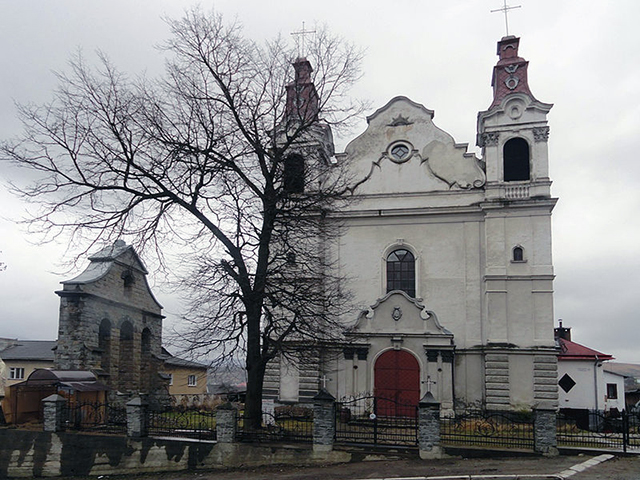
One of the objects of material heritage left by Mr. Kalinowski was the Church of the Assumption. Sometimes it is called the Church of the Assumption of the Blessed Virgin Mary. It was built in 1730, after Kalinowski invited the Jesuit Fathers to the town. The fact is that the town had just received the Magdeburg Law, and the Jesuit mission would have put the last point in the ennobling of Turki and turning it into a European town. The first church was wooden, in the Gothic style. The material and robotics were entirely paid for by Antonius Kalinowski.
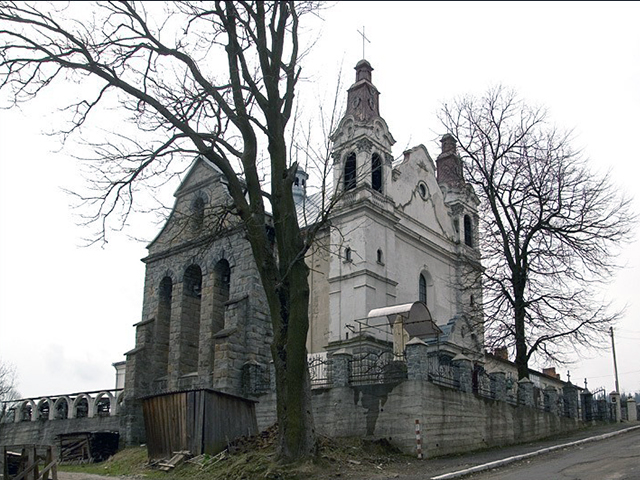 The church became the heart of the small Roman Catholic parish of Turki. But in 1777, the wooden structure began to crumble. Therefore, in 1778 the local community began to build a new brick church in the already molten place, on the site of the old religious building. In 1779 the construction of the Church of the Assumption was completed, but there were as many as 5 (!) altars in it. Two — the altar of Our Lady and St. Ignatius of Loyola, were moved from the old wooden church. Three altars — St. Tekla, Crucifixion and Jan Nepomucký, in honor of the Czech vicar tortured to death by the Old Town Court of Prague, were planned during the construction. And in 1828, the Catholic community commissioned a new, sixth altar in honor of St. Anthony, an Egyptian anachoret, hermit and founder of the Fayum monastery.
At the beginning of the XX century, the Church of the Assumption underwent a global reconstruction, which was led by Stanislav Maersky. The result was a building that combined Gothic, Baroque and Neo-Gothic features. However, it was damaged during the First World War. Before the Second World War, the Parafians managed to repair the church, repainted the walls and erected a bell tower, but the new war and the arrival of Soviet power crippled the church again. In addition, its functioning as a religious object was forbidden. Back in 1990, the church was a vegetable storehouse, then a gymnasium and a carpenter’s workshop.
It was only in 1992 that this landmark of Turki was returned to the faithful. The Catholic community of the city is completing its restoration. Staying on vacation in Turka, you will immediately see this monumental white and gray structure under a metal roof. The temple is located at a walking distance from the administrative center of the city, at 35 Stusa Street.
When you come to Turku, you can make sure that holiday in the Carpathians can be not only «green», therapeutic or snow-entertaining. The sacred values here are fully in line with cultural European standards. In addition, they are undergoing the procedure of taking them under UNESCO protection.