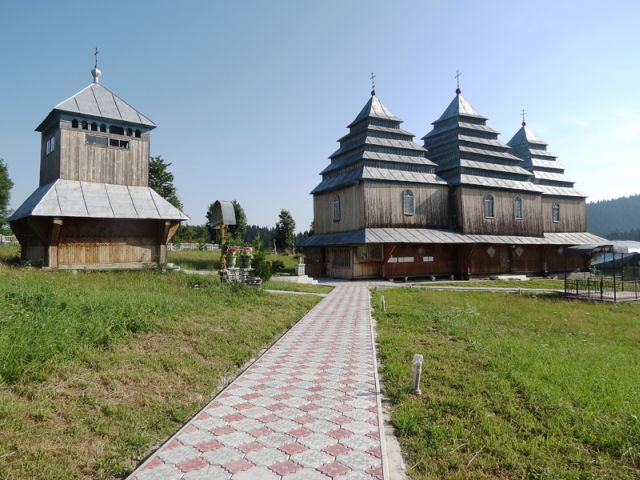
 The first rural Church of the Nativity of the Virgin Mary is mentioned in sources from 1534. In this year, on October 22, the Sambora headman Stanislav Odrovonzh sold a field of soil for the church in Borisova Wola (old name Rozlucha). The parish received the privilege in 1666. In 1733 on the place of the old one a three-brick three-story wooden church of the Bojkov type was built. The church, built in 1783 on this site, burned down in 1875. Instead of it, in 1876 a new church was built by the master Gavriil Roman from the village of Bagnovatoe (the carved inscription on the beam of the nave informs about this event). The construction was helped by Joseph Hammer, director of the industrial company in Vienna and owner of forests in the vicinity of Rozlucz, who donated the building material. The church was rebuilt in 1923. The church is in the use of the UAOC congregation.
It is located on a hill in the western part of the village, near the center of the village. It was planted with old linden trees. The wooden three log building consists of three square volumes, located on the axis northeast-southwest. The main logs are crowned by pyramidal tent tops with five ledges over the nave and four over the altar and narthex. 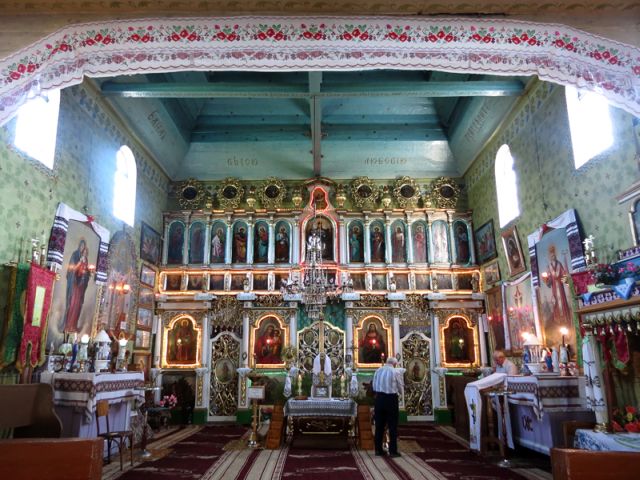 The church is girdled by a wide curtain resting on the ledges of the log cabin crowns, under which a small sacristy is hidden, adjoining the altar from the north. A glazed porch is attached to the babinets that overhangs the entrance under the canopy from the west. The walls under the canopy of the church are upholstered with wooden planking, above the canopy and backstops — with boards. The four-tiered carved and gilded iconostasis is modern in the church. To the west of the church there is a wooden, two-tiered, square in plan bell tower covered with a tent pyramidal roof. It was erected at the same time with the church. The entrance to the church territory is organized in the form of a cross in plan, completed with three pyramidal tops of the superstructure over the gate.
The Rozlutskaya church is an example of a typical wooden shrine of the Boykovsky type.