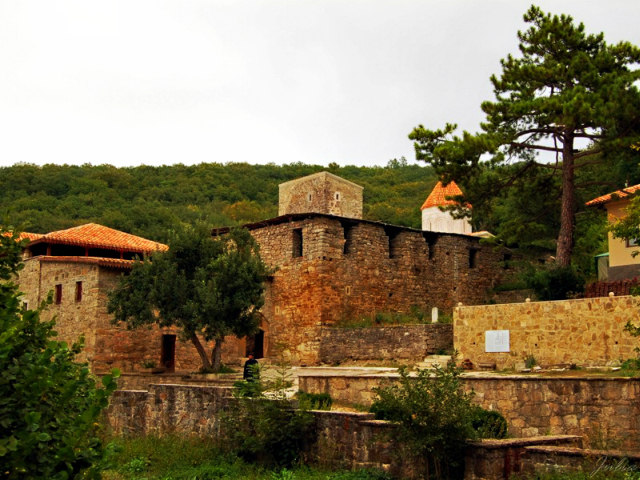
The medieval Armenian Surb Khach Monastery, celebrated its 650th anniversary on July 29, 2008.
Surb Khach means «Holy Cross» in Armenian. The monastery was founded in 1358 by the spiritual leader of Crimean Armenians Hovhannes Sebastatsi, who saw a huge fiery cross on this place. He took this vision as a sign from above and founded a temple here, which was called Surb Nshan — Holy Sign. It took 20 years for its construction. Gradually around it began to form and build a male monastery. For many centuries in this monastery was kept a stone cross, created in the VI century A.D. — a sacred relic called Pyrgchakar (translated as «salvation stone»), according to legend, consecrated by the apostle Tadei and brought to Tavrika by the first settlers from the ancient Armenian capital Ani in the XIII century.
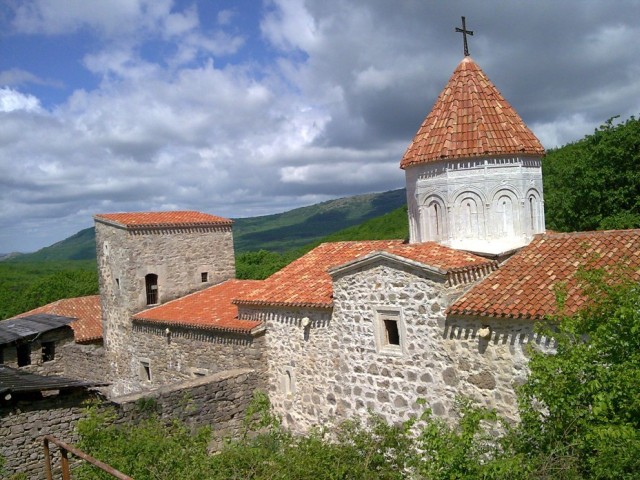
In medieval times, Surb Khach Monastery was the largest Armenian religious center, spreading its influence from Crimea to vast territories as far as Romania, Moldavia, influencing politics in Armenia. In the XVII century, 30 monks lived here. And in 1924, as people say, the communists killed the last monk on the road near the monastery. On this place grows a tree, which our contemporaries decorate with colored ribbons in memory of that tragic event. Since then the monastery has been destroyed. Yet it is the best preserved of all the buildings of the Middle Ages. In 1993-1997 it was partially restored.
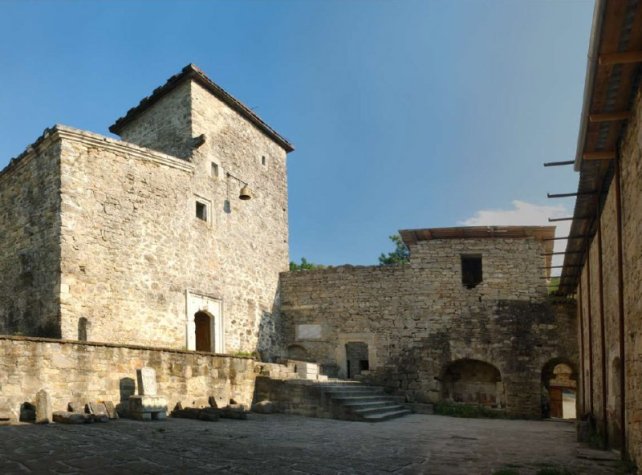
The church of Surb Nshan (St. Sign) is the central building of the monastery, located in its eastern part and stands outside the monastery fence. The construction of the church is dated 1358 according to a poetic inscription on the upper part of the drum of the church dome.
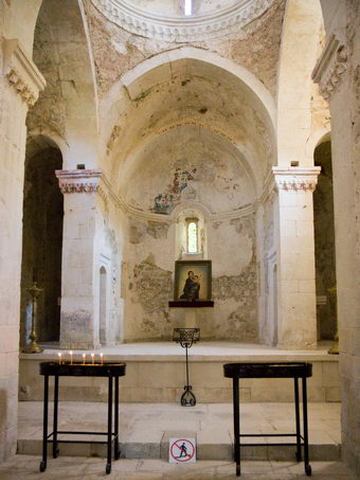
The inscription reads, «This divine temple of glory, on earth is the paradise of the tree of life: it is like the mountain sky, the dwelling place of the Trinity. From the birth in the flesh of Christ in 1358, having begun, erected in the name of St. Sign by the diligence of his servant Hovhannes monk and his brothers and sons in spirit…». Remains of medieval paintings have been preserved in the temple.
From the side of the main facade a rectangular in plan gavit (narthex) adjoins the temple building. Two entrances in the south and west walls led to the gavit. Above the south-west corner of the gavit a bell tower was erected, a stone staircase leads to it from the gavit. The interior of the gavit is decorated with carved crosses. Probably, the havit was added to the temple not later than the end of the XIV century, the earliest surviving inscription in the havit is dated 1401.
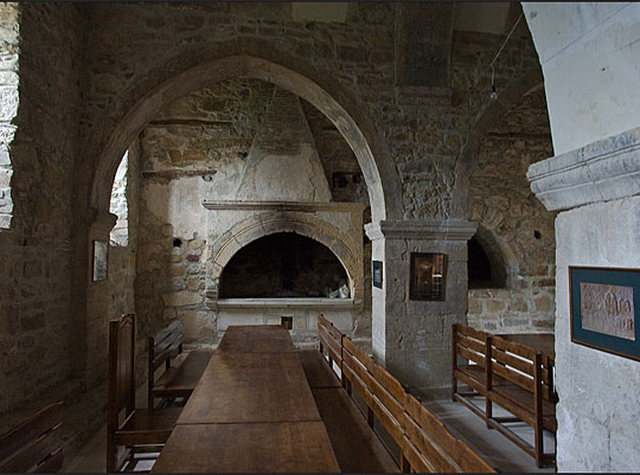
The refectory of the monastery is located to the west of the temple, they are separated by the inner monastery courtyard. Under the building of the refectory were arranged basement rooms. The refectory itself consisted of two halls of rectangular shape. In the northern hall there was a fireplace with an arched lintel and a stove. From the southern hall to the basement led a two-marched staircase in the northwest corner. The second floor above the refectory was intended for hotel rooms and was added at the end of the 19th century.
In the northern hall of the refectory there is a slab with the inscription: «I, Sarkis the cook, nephew of Vardapet Kirakos, served the holy cross for four years for the salvation of my soul, year 1211 (1762)». The north side of the building is externally reinforced by strong buttresses. The gatehouse adjoins the southern wall, between it and the cells is the entrance to the monastery with two doorways.
 .
.
Above one of the openings was an inscription dating this part of the monastery to 1684. From the north, the inner courtyard between the refectory and the church is enclosed by a wall. In it, to the right of the entrance to the cell courtyard, under the staircase leading to the second floor of the refectory, there is a fountain.
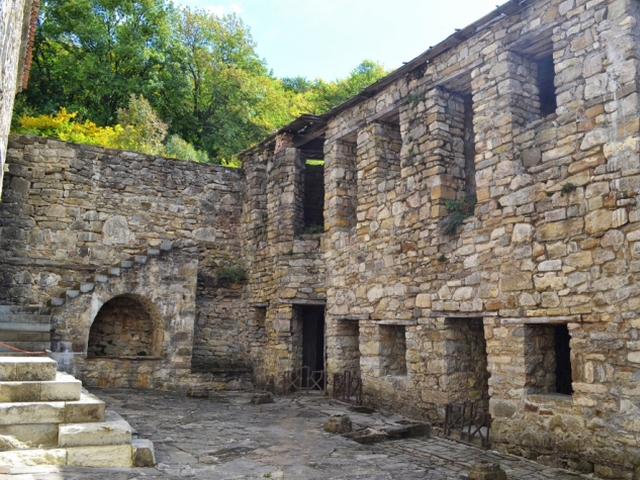
The cells (fraternal building) and the courtyard adjoin the southern facade of the church and the gavit. The cellular courtyard can be accessed from the inner monastery courtyard and from the gavit. The building of the brotherhood building is g-shaped in plan, two-storied. On the first floor there were eight rooms covered with semi-circular vaults. The cells of the second floor had an exit to the open balcony-gallery at the level of the interfloor ceiling, which rested on wooden columns, from them in the paving of the courtyard preserved stone bases. The entrance to the balcony-gallery was first accessed by a staircase from the eastern edge of the courtyard, and later an entrance was also built from the landing of the staircase leading to the inn above the refectory.
 .
.
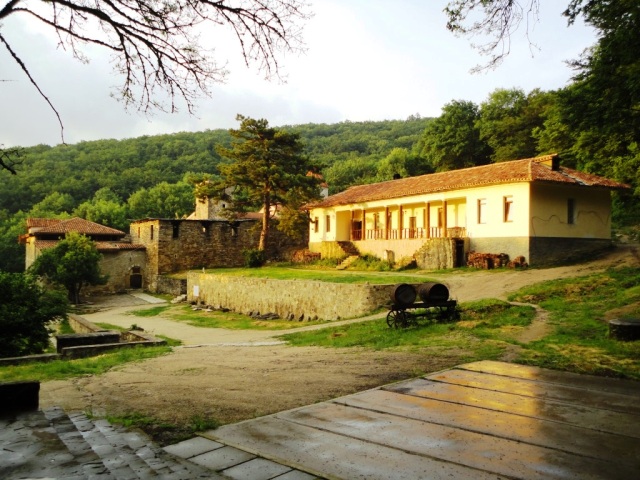
Separate to the south of the brotherhood building is a one-story stone building of the monastery hotel. It was built in the second half of the XIX century, when, due to the revitalization of the spiritual-educational activities of the monastery, the number of visitors increased.
A retaining wall was built to the west of the hotel, under which there was a spacious area for carriage transportation. The hotel building was destroyed in the 40s of the XX century and reconstructed on the surviving foundations in the 80s of the XX century.
Two fountains and the stairs leading to them are located in the garden southwest of the monastery complex.
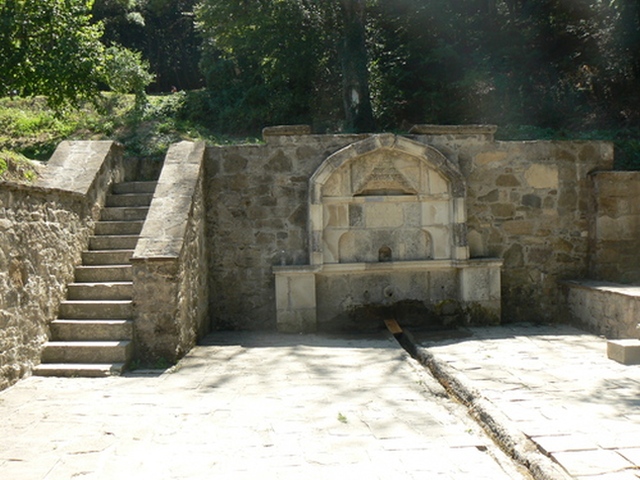
All the fountains were built according to the same principle — a rectangular structure with a decorated facade and blank walls, with a cistern well adjoining it from the rear. Water was supplied to the fountains through water pipes made of ceramic pipes from water sources located up the slope.
The garden of the monastery was laid out in several terraces on a gentle mountain slope. From the refectory, from the level of the outer open courtyard of the monastery, a five-march staircase led to the lower fountain in the garden. Four terraces with retaining walls of rubble stone have been preserved in this part of the manor. The road bed near the monastery and the open courtyard of the complex were paved with rubble stone.
 .
.
Nowadays the monastery is used for weddings, baptism of children, festive liturgies, and public festivities during major religious holidays. Recently, Armenians from all over Ukraine came here for Vardavar, the Feast of the Transfiguration of the Lord.
Those who are already familiar with this place, which looks like a magical fairy tale, are envious of newcomers for a reason. First impressions are exciting and enchanting. Dense green forest envelopes the majestic in its simplicity and power stone buildings of the monastery complex. Nearby murmur two springs — fountains, beautifully framed with carved stones. Their water flows through ceramic pipes laid in the XIV century. One fountain is called the source of youth. When people come here, they drink from it and wash their faces. They say that this water preserves health, beauty and prolongs life.
 .
.
This molten place constantly attracts enthusiasts who selflessly fight for the restoration of the monastery, keep its spirit alive and work hard.
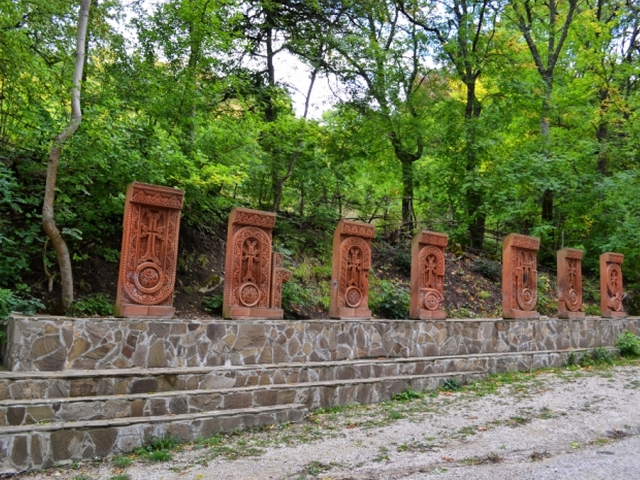
Now the monk Akop lives in the monastery. He beautifies springs in the forest surroundings and creates marvelous cross stones (stone crosses), which are not inferior to the ancient ones with their unique ornate patterns and ornaments. More than 70 stone crosses can be seen on the columns of Surb Nshan temple. Everything here seems miraculous. And the most important miracle is happening before our eyes — the monastery is being reborn!