I’m dead now. I’ve become the lines of a book
In your hands
And your love’s burdens are off your shoulders,
But my ashes are stinging
I am now a book to be thumbed through
I can be thumbed through
But thou wilt always keep my seal
My seal.
I have buried myself in the tombs
Of my poems,
But listen, do you hear the bird singing?
It’s alive, my verse!
Don’t go away embarrassed Magdalene.
My coffin is not empty
Touch once for a single moment.
Touch my lips.
M.A. Voloshin
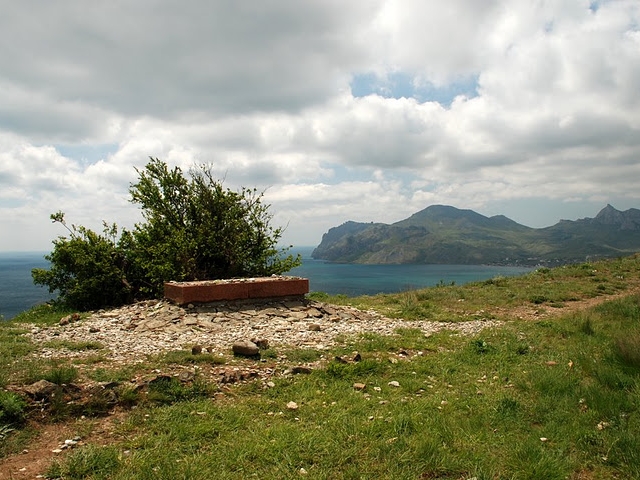 The memory of the life and work of the outstanding poet, philosopher and artist Maximilian Alexandrovich Voloshin is kept not only in his poems and paintings. This memory can be felt in many corners of Koktebel — the town, which was deeply loved by this man, in which he lived until the end of his days. And one of the brightest places is certainly the last shelter of M.A. Voloshin — his grave.
Being a man of broad thought, M.A. Voloshin (1877-1932) never concentrated in his creative activity on one thing. As a result, he left a great trace not only in literature, but also in the fine arts. It is thanks to Voloshin that Koktebel became the town it is to this day — a muse for creative people, writers, poets, artists (the writer’s house was visited by such prominent people as poets and writers M. Gorky, M. Tsvetaeva, O. Mandelstam, A. Tolstoy, A. Grin, M. Bulgakov, etc., artists K. Petrov-Vodkin, P. Konchalovsky, K. Bonevsky, etc.). Having moved to Koktebel at the beginning of the last century, he began not only to paint picturesque corners of his favorite place, but also to write poems about it:
«…So all my soul in your bays,
Oh, Cimmeria dark country,
Imprisoned and transformed…»
These lines became the poet’s testament. Voloshin chose the place that would become his last refuge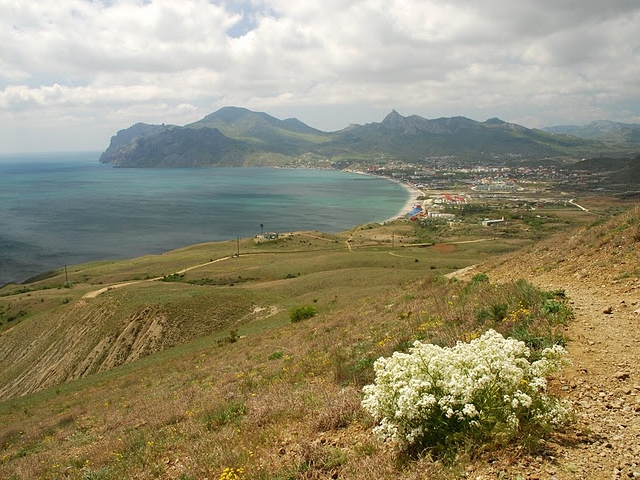 himself: on the top of the mountain to the east of Koktebel called Kuchuk-Yenishar, from which opens a breathtaking panorama of Koktebel valley and bay, all the natural beauty that the artist loved so much. And now this place and the whole mountain, which is often called Voloshin Mountain, have become one of the most famous sights of the city.
The way to Voloshin’s grave — to the very top of the steep mountain — is not easy. But, despite this, it is overcome by many guests of the city. And the efforts of visitors of the last shelter of the artist are rewarded in full — magnificent views of hills and mountains, boundless valleys and expanses, seemingly boundless sea. Only after visiting this place, one can understand why this outstanding, bright and interesting person chose it. The poet bequeathed that no trees should be planted near his grave — probably because the picturesque panoramas of his favorite city, the place to which he gave all his love and soul, would be open before him forever.
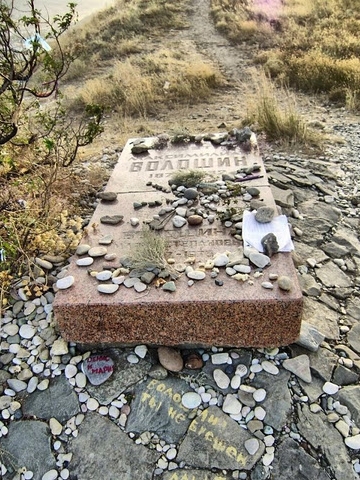 Buried here in August 1932, Voloshin asked to bring to his grave only different stones, pebbles, semi-precious stones, which he loved to collect during his lifetime. This wish led to the fact that now near the tombstone everywhere you can see a variety of stones. It is also interesting that visitors to Voloshin’s grave do not just bring stones, but scratch on them their deepest desires, peculiar prayers addressed to the man with whom the soul of the city is forever connected. This attraction of Koktebel is talked about as a very interesting, cult place.
Visiting the tomb of Maximilian Voloshin — an outstanding thinker, artist and poet, will be interesting not only for fans of his work. Having made an ascent to this attraction of Crimea, all guests of Koktebel get bright, unforgettable impressions, pleasant memories, which are preserved for a lifetime.