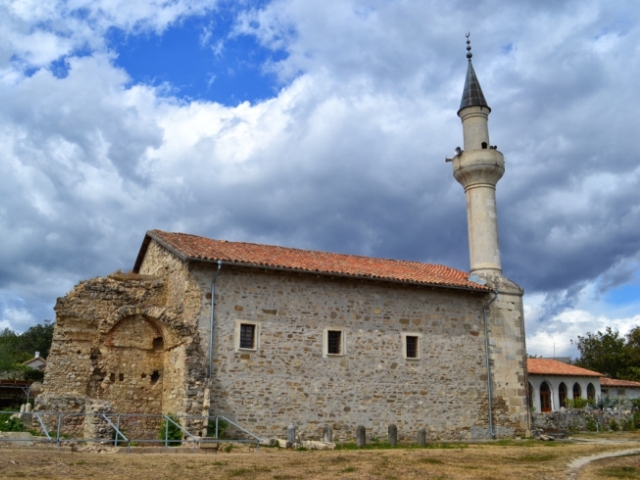
 In the central part of the city, on Khalturin Street, stands an ancient building — the so-called Uzbek Mosque and the ruins of the adjoining building of the madrasah (religious school). This extremely interesting in its architectural merits historical monument is one of the main attractions of the city, a shrine for all Crimean Tatars. The complex of the mosque and madrasah still attracts the attention of historians and numerous ordinary lovers of antiquity.
During the reign of the Golden Horde Khan Uzbek (1312-1342 years) Solkhat, as well as the entire Tatar state, reaches the highest prosperity. Under Uzbek, Islam spread widely among the Tatars, and he ordered to build a mosque in Solkhat. To strengthen the new religion, the khan even resorted to very drastic measures: by his order, shamans, who had previously played a significant role in the life of the Golden Horde, were killed. The Uzbek mosque became the main Muslim temple of medieval Solkhat, it was a cathedral in 1512-1513 under Mengli-Girey I, as reported by Evliya Celebi.
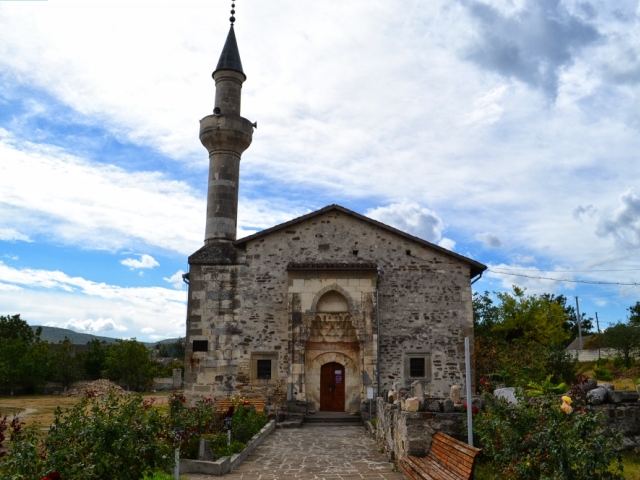 The mosque is very simple in its forms — it is a six-pillar rectangular basilica covered with a double-pitched roof. A tall minaret is built into the southeast corner of the mosque, the entrance to which leads from the mosque itself up a spiral staircase. The minaret and the staircase have only recently been restored. The main entrance in the northern side is framed by a high carved portal, on which an Arabic inscription has been preserved, informing that the temple was built in 1314 during the reign of Uzbek Khan. This mention of the khan’s name was the reason why the building was named the Uzbek Mosque.
Above the entrance to the mosque is a wide pediment covered with multicolored glaze with fanciful arabesques. The building was crowned with a light blue dome with precious stones. The portal is decorated with epigraphic ornamentation, i.e. carved inscriptions; it is combined with rich floral ornamentation, evidence of the high, virtuoso art of stone-carvers. The portal has remained unchanged since the 14th century. Above the portal is a large arch made of brick, the arched stone is held in place without mortar. This element is not authentic and is the result of later rebuilding of the mosque.
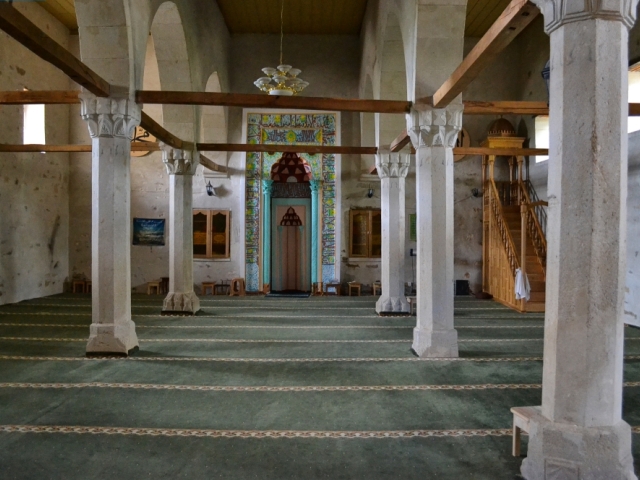 Left of the portal is the minaret. Since the minaret is built directly into the building. This feature in the architecture of the mosque speaks about the early construction of the building. Later minarets were built next to mosques. There could be several of them. The inner space of the mosque, like the Byzantine basilica, is divided into three naves by two parallel rows of thin faceted columns with oblong stalactite capitals. Stalactite — is a relief pattern, named so for its resemblance to natural scale formations in karst caves. Nave — an architectural detail, an elongated room bounded on one or both sides by rows of columns or pillars. The columns inside the mosque are made of limestone stone. «Stalactites» are varied in pattern, gathered in a graceful, expanding to the top of the bundle-colors. The symmetry does not dry them out in any way. They «live» gathered in bouquets.
Each of the elements of the capitals (the upper parts of the columns), seemingly identical, repetitive, conceals a small violation of the geometric stereotype. The trunks of the slender columns are simple. 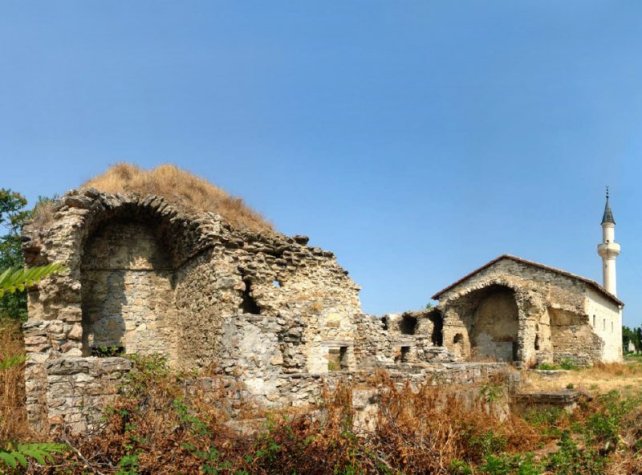 They are organically fused with the capitals, exactly taut strings «in the abode of Allah». The sunbeam penetrating through the upper side windows played on the columns, reflecting differently from the stone faces. The windows are placed high up so that the rays of the sun and the «gaze of Allah» could penetrate into the mosque. One can easily imagine how the sunlight from the upper windows flowed down the faces of the columns, made the colored carpets on the floor flash and faded in the depth of the temple at the shaded southern wall with its deep, dusky mihrab (a kind of altar niche).
The mihrab faces toward Mecca. It is framed with magnificent handmade ornamentation. The konkha, the spherical perektiriye of the mihrab niche, is also trimmed with «stalactites», all shining with multicolored colors. The true polychromy (multicolor painting) of the mihrab has not been preserved. Restorers have yet to discover the real content of the artistic painting of this monument.
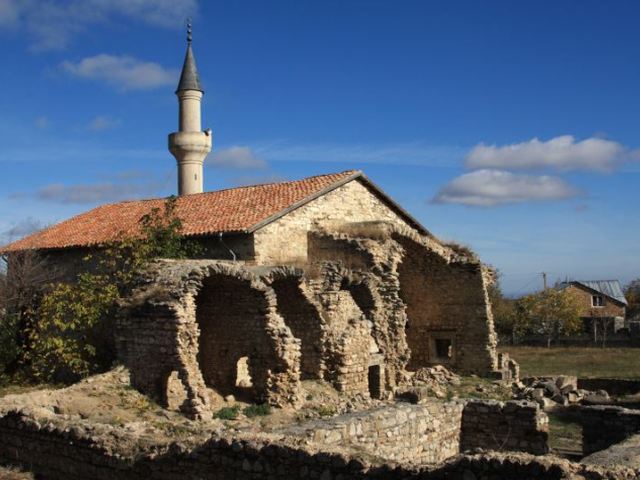 Remains of a large complex of vaulted rooms adjoin the southern end of the mosque of Khan Uzbek. The majority of researchers of this construction defined it as a madrasah — a Muslim high school. Some scientists consider the annex of tekiye — a monastery. Madrasah — a square in plan buildings with an inner open courtyard paved with stone slabs Along the inner walls of the courtyard were placed 24 cells with domes. Remains of a marble portal attract attention. Fragments of a pylon with architectural details give an idea of the spectacular entrance to the opulent building of the Solkhat Higher Spiritual School. The madrasah had a large courtyard in the center of which there was a fountain covered with evergreen plants. Loggias or edicules, niches inside the building, faced the courtyard. In such a school various knowledge in astronomy, medicine, geography, history was acquired, and educated people, respected by ordinary citizens, came from here.
Evliya Chelebi reported that there was a construction inscription on the madrasah, informing that the madrasah was established by Injibek-khatun in 1332-1333.
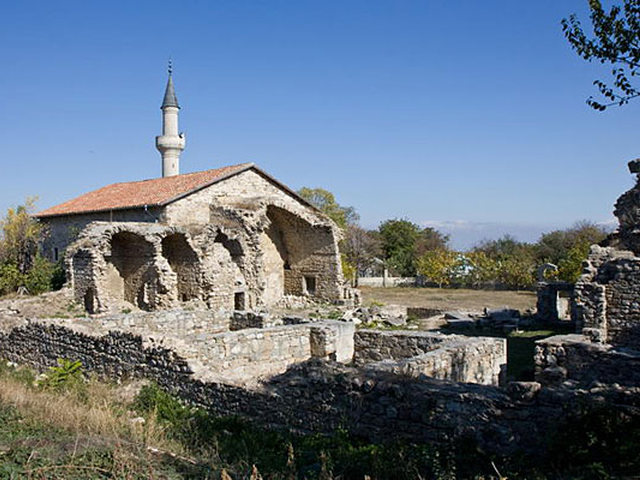 The Uzbek Mosque and madrasah were investigated in 1925-1926 by an archaeological expedition led by Professor I.N. Borozdin, which registered about 800 items of all kinds of finds and fragments. This expedition revealed in the monuments of Solkhat the presence of many features of Asia Minor art of Seljuk Turkey.
In 1978-1981 the most scientifically and artistically interesting Muslim tombstones were sent to Leningrad by the expedition of the State Hermitage. Excavations established that in front of the madrasah there was originally a pre-portal square paved with large stone slabs. At the level of this square along the eastern wall of the mosque, a necropolis later appeared. Archaeologists found a total of 90 burials with Arabic and Turkic inscriptions, and a water pipe was found.
Available materials of the study of the Uzbek mosque and madrasah allow to refer these buildings to the number of outstanding creations of medieval architecture. 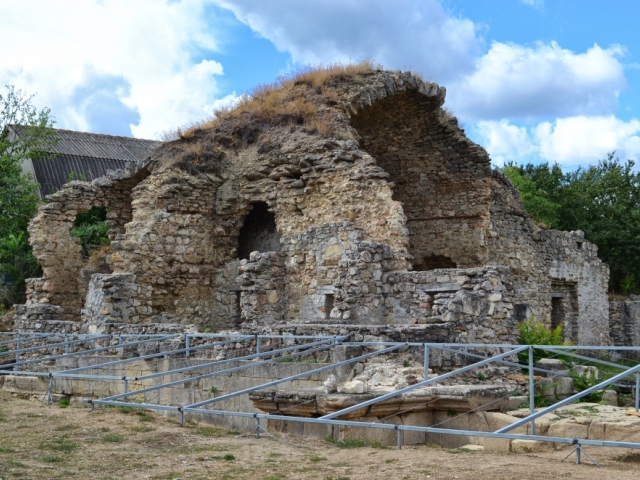 One feature of these monuments especially attracts attention: the style and ornamentation of the buildings have much in common with those buildings left by Genoese, Armenians, Crimean Greeks and other peoples. Obviously, the local architecture, which absorbed late antique, Eastern Byzantine, Western European and other elements, manifested itself here. Not so long ago the Uzbek Mosque was restored and again fulfills its direct purpose, being a functioning Muslim temple — one of the most revered in the Crimea.