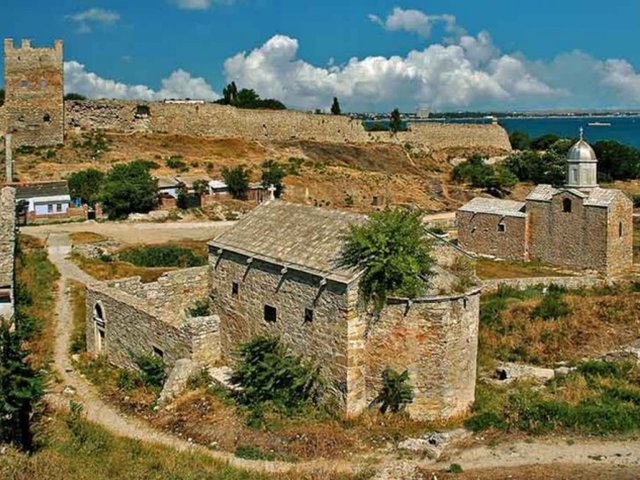
Today Feodosia is a popular among tourists resort city of Crimea, attracting not only developed infrastructure of rest, beautiful beaches, a variety of opportunities for recreation, but also unique sights, including medieval ones. The most outstanding of the latter is Cafa Fortress — the main ancient architectural treasure of the city.
The history of Feodosia goes back to the distant past, this city belongs to several eras, and owned it at different times several peoples. So, in XIII-XVveky masters of the city were Genoese, who turned Theodosia into a prosperous port city of Caffa, which by the middle of the XV century surpassed the size of Constantinople. Evidence of this period and is the fortress Kaffa, the ruins of which can be seen today in different parts of the city. Somewhere the remains of the fortress are preserved very well, and somewhere they are almost invisible, but many corners of Feodosia are actually closely related to the medieval fortification — when in the XIX-XX centuries the fortress was subjected to a thorough destruction, the stone — marble-like limestone, from which it was built, became the basis for many local buildings — private houses, fences, etc. But first things first.
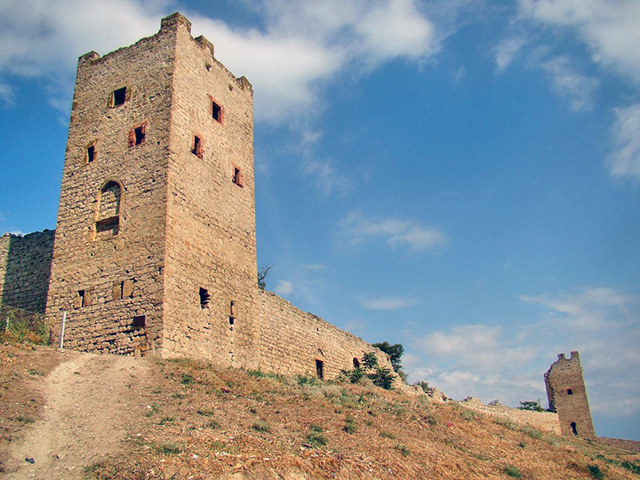
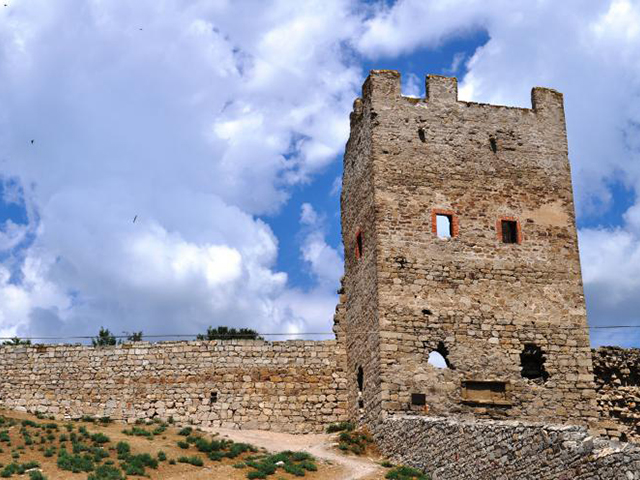
The construction of Kafa Fortress began in the XIII century, when the Genoese bought from the Tatar Khan Oran-Timur the ruins of the ancient city of Hellenes, which was destroyed in the IV century AD during the invasion of the Huns. Over the course of a century here built defensive structures of the Italian type, and Theodosia, then called Kaffa, acquired one of the most powerful fortresses in Europe, the second largest after the Greek fortress Solonik. In plan it resembled an amphitheater, in relation to which the stage was Theodosia Bay. The outer fortifications with two rows of walls and more than 30 towers covered the territory of almost 70 hectares, and their perimeter was almost 5.5 km. Each tower had its own name — either in honor of one of the Roman popes or in honor of the consul under whom it was built. A deep moat was dug around the outer fortifications, which had not only a protective but also a drainage function — storm water drained into it and was diverted to the sea. The outer line of fortifications protected the citadel located inside, which was built in 1340-1343 on the Quarantine Hill on the steep sea slope. The walls of the citadel stretched for 718m, reaching 2m in thickness and 11m in height, and inside it were located the main city buildings: the bishop’s residence, the treasury, the consular palace, the courthouse, stores and warehouses of especially valuable goods.
Eastern spices, gold, precious stones were exported to Europe through Cafa — it was the largest transit center of international trade, and life in the city was corresponding. In the novel «By the Russian Sea» by the famous Russian writer A.S. Krupnyakov Caffa was described as follows:
«All night until the dawn did not close the gates of Kaffa. Passed through them mossy horses with harbors loaded with grapes and fruits, with carts full of cucumbers, melons, watermelons …. Caravans of camels from distant lands were passing by, unhurriedly … Wagons carrying salt, fish, caviar, grain to the fair … Cafa, insatiable Cafa».
Trade within the walls of the fortress Kafa was conducted not only in goods, but also in people — it was under the Genoese here began to work slave market, which later became the largest in the Black Sea under the Ottomans. This was the life of the medieval city of Caffa — in the walls of its citadel, including tragic events took place.
 .
.
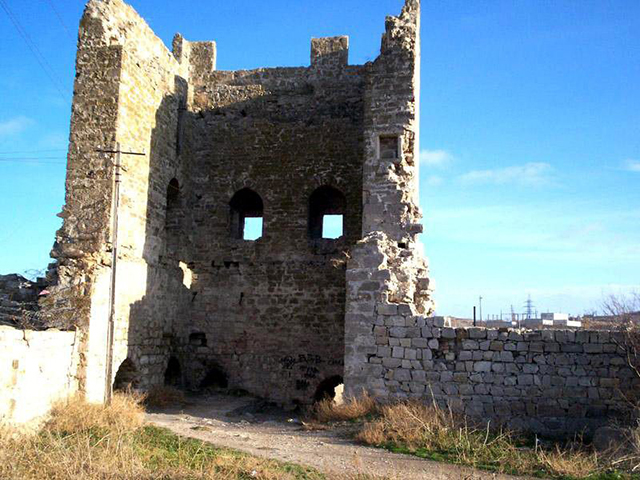
One of the worst among them was the plague epidemic that occurred in 1347 because the Golden Horde troops besieging the city decided to throw the corpses of their dead from the «black death» into the city, unable to take the city by storm. Then the Genoese were forced, fleeing from disease, to leave the city, which came under Turkish rule. Under the Ottomans, Caffa was gradually depopulated, although it remained fortified, and in the XIX century, when it came under Russian rule, Empress Catherine II found the once majestic fortress in ruins.
Today, the remains of the fortress Kafa are considered a historical and cultural reserve, although in practice it does not look like it — every year a little that remains of it, is getting closer to disappearing altogether. Restoration works, as in Sudak, are not carried out here, and the condition of the most important attraction of Feodosia is getting worse. Now, fortunately, you can still see the walls and towers, which attracts all the guests of the city, but we can only hope that their protection will improve in the coming years, and the main evidence of the most important period in the history of these amazing places will not fade into oblivion.