Incredible, but it is a true historical fact — in the Middle Ages, the small Ukrainian city of Theodosia was bigger, cooler and more luxurious than the then Constantinople, the capital of the reigning Ottoman Empire. Such successes Feodosia achieved due to its favorable geographical location and the constant interest to this settlement of all conquerors who fished in the territory of the Crimea and the Black Sea.
This city on the shore of a convenient bay in the southeastern part of the Crimean Peninsula was founded by the Hellenes of Miletus. The Bosporan Kingdom, Huns and Alans, who successively conquered Theodosia, were replaced by the Byzantine Empire and Khazar Khaganate. In the XIII century on the shores of Theodosia Bay ruled the Golden Horde. Genoese merchants bought the city from them. They changed the Tatar name Kafa to the melodious Italian Kaf-fa, and then made the city the capital of all their Crimean colonies.
The envoys from the Genoese Republic needed to back up the status and wealth of the parent city with force. Under them in the city was built Genoese fortress. Its «sisters» now decorate the shores of Balaklava and Sudak. Feodosia «Genoese fortress» consisted of 2 structural parts. One — the citadel, girdling the Quarantine Hill, the other — a five-kilometer chain of fortifications, consisting of 30 towers. Many of them received their own names and became objects of urban legends — the tower of Dokovaya and St. Clement, Crisco and St. Thomas, the name of Consul Giovanni di Scaffa and St. Constantine.
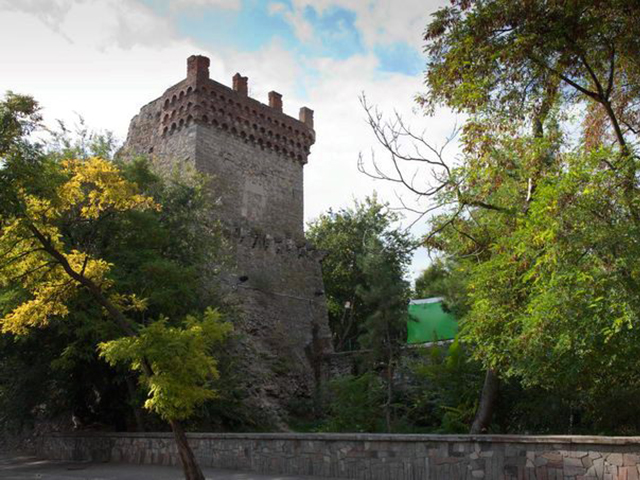
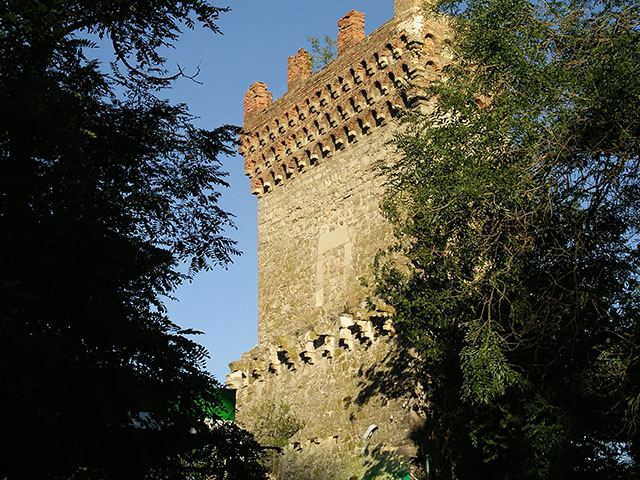
The latter tower has long been depicted on the city’s coat of arms as a symbol of the wealth, power and extensive history of the polis. The Tower of St. Constantine first appeared on the coat of arms of Theodosia County in 1844 on the background of the silver bow of the Genoese ship. Then it «appeared» as the basis of the whole composition, on the coat of arms of the city in the versions of 1967 and 2005. Today the tower is neighboring with the sea, anchor and vine.
 .
.
The Tower of St. Constantine is a single tetrahedral structure based on a square. The height of the building was 20 meters when built. Moorish-style entrance gates let warriors into its gut, protected by walls two meters thick. Unusually round loopholes and battlements surrounding the upper platform gave this structure a resemblance to a chess tourney.
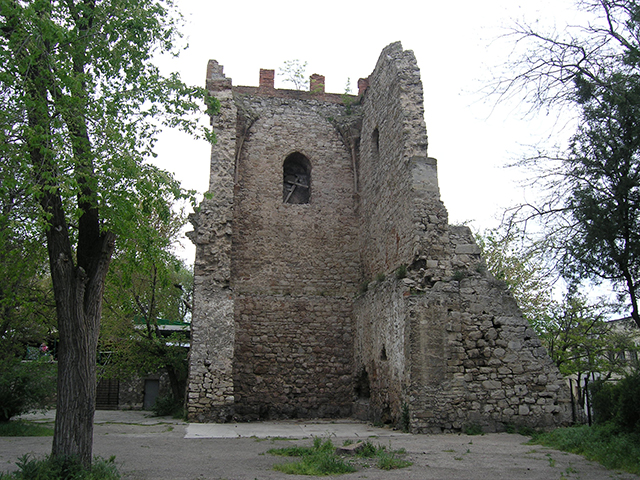
Due to the fact that the construction of Feodosia Genoese fortress was carried out from not very hard marble-like limestone, all its elements easily succumbed to anthropogenic destructions — artillery raids, military actions directly on the territory of the city and attacks of barbarians, which were enough under any authorities. The Tower of St. Constantine was no exception. It suffered considerably during the last World War. On its body were left multiple wounds — traces of German and Soviet shells. Therefore, its current state is characterized by the archaeological term «ruins».
As many attractions of Feodosia, the remains of the tower of St. Constantine are located in the historical center of the city on the territory of Jubilee Park. In its neighborhood there is an Ottoman barbican and fountain «To the Good Genius». Not far from it begins the territory of the Embankment and the railway station. All Feodosia sights of Ukraine, despite their current state, can strike the imagination of any traveler. After all, from them for a mile «smells» history, wars, the smell of gunpowder, gold and victories.