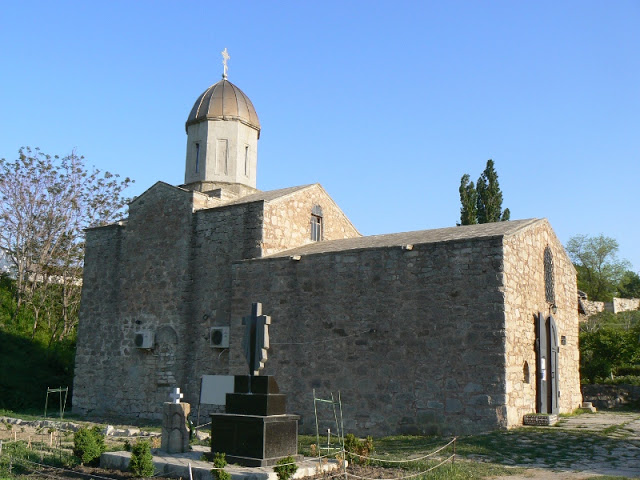
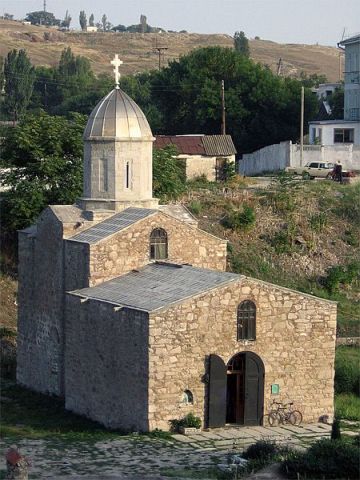
The medieval Temple of the Iveron Icon of the Mother of God resembles Armenian churches of the XIII-XIV centuries with its architecture: a square building crowned with a dome on an octagonal drum with narrow windows. The exact time of its construction is not known, it is believed that it was built in the XIV century, but most likely — much earlier. Initially the church was consecrated in honor of John the Baptist. Later the church was rebuilt: a rather spacious room was added on the side of the main entrance — thanks to this the church could receive a larger number of parishioners.
The temple was painted with amazingly beautiful frescoes, fragments of which have survived to this day. In 1927, the medieval temples were inspected by a restoration commission, which included Russian artist and art historian I.E. Grabar.
He suggested that some of the frescoes of the church belonged to the famous Byzantine painter Theophanes the Greek (1340-1405), an outstanding master of frescoes, iconography and miniature painting. In the 70s of the XIV century he worked in Russia. His icons in the Annunciation Cathedral in Moscow and frescoes of the Church of the Savior on the Ilyin in Novgorod have survived.
In 1475 the Turks seized the Crimea. Theodosia renamed in Kef becomes a religious center of representatives of different confessions. But obviously with the passage of time the church of St. John the Baptist came into disrepair, changed and its name, now it became quarantine. In 1887, Bishop of Tauris and Simferopol Hermogenes wrote: «Quarantine Church, of wild stone, in honor of the icon of the Iveron Mother of God — in the southeastern part of Theodosia, in the Quarantine Slobodka, inhabited mostly by retired lower military ranks and workers. The time of construction of the church is not known, but undoubtedly it has existed since the Genoese rule in Theodosia.
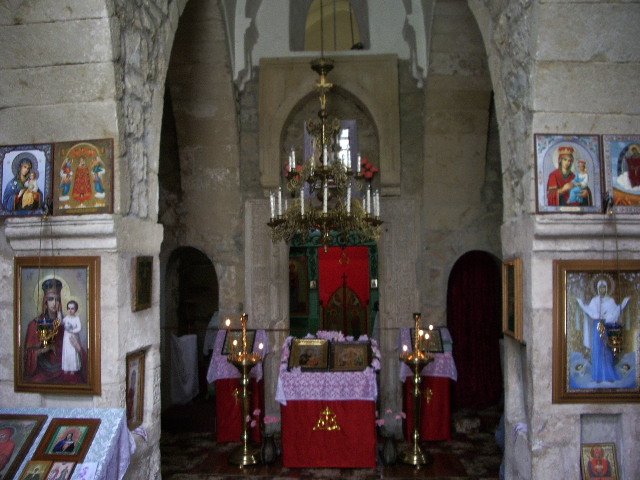
Nikolai Tregubov, a priest of the Carantine Guard, with the help of benefactors, renewed it in 1858 and consecrated it on August 31. In 1875 Rukavishnikov painted it and donated three icons in ciotes behind glass». The temple was consecrated in memory of the Iveron icon of the Mother of God.
In this temple in 1906 married Konstantin Fedorovich Bogayevsky and Josephine Durante. K.F. Bogaevsky (1872-1943), a famous Russian artist-«Kimmerian», was born in Feodosia and lived in Karantina, here was also his studio. The temple of the icon of the Iverskaya Mother of God was his favorite.
In the formidable revolutionary years near the temple were shot about 7000 white soldiers and officers.
 .
.
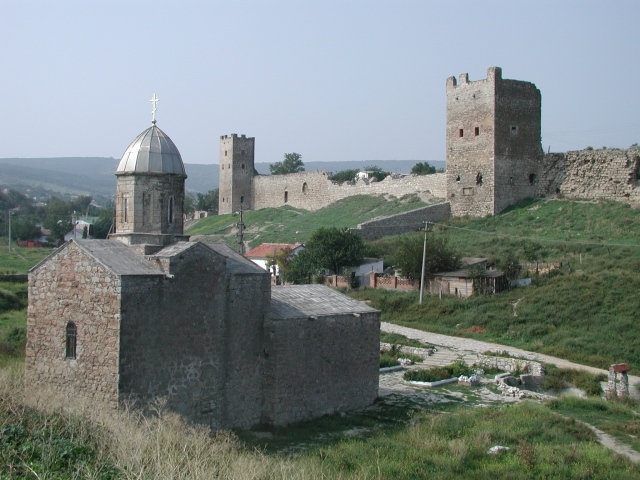
In the 30s of the XX century the church was closed and actually abandoned. Despite the fact that in Soviet times on the Karantina created historical and architectural reserve, which was protected by law, the temple began to deteriorate and almost died. Due to disputes between the design institute and the architecture authorities, restoration work was not carried out for seven years. In the meantime, water through holes in the leaky roof flooded the walls and damaged the ancient frescoes, the floor was covered with piles of garbage and wet soil. Thank God that there were not indifferent people — architects, art historians, museum workers, who were able to convince the authorities of the need to urgently save the temple. Architect and sculptor Valery Zamekhovsky consulted on the restoration work. Drainage works were carried out, the ground level was lowered by 60-70 centimeters, the churchyard was paved with stone. Future parishioners of the temple also helped, they took out the garbage from the temple, decorated the yard with flower beds. The restoration of the church was completed in 1996, and it was returned to the faithful.