The beautiful Theodosia, whose name translates from Greek as «Goddess», amazes its guests with a multitude of monuments of different historical epochs. A separate place in this list is occupied by a group of Armenian temples. They were built in their time by the richest Feodosia Armenian Diaspora in Crimea.
This ancient people appeared on the peninsula in the XIV century, attracted by the opportunity to participate in trade operations conducted by merchants from Russia and Crimean steppe with the peoples of the Mediterranean. Mediation always brings the biggest profit, so Armenian temples in Feodosia in the Middle Ages had no equal. One of the most famous sacral buildings of this period is Surb Sarkis Church. Translated into Russian, the name of the temple looks like Church of St. Sergius.
The church of Sourabh Sarkis was built in 1330. The money was raised by the Armenian community of Theodosia. Just as the Armenian Apostolic Church is one of the oldest Christian institutions, so this temple was the very first, and accordingly the oldest, construction of this series on the territory of «Bogodannaya».
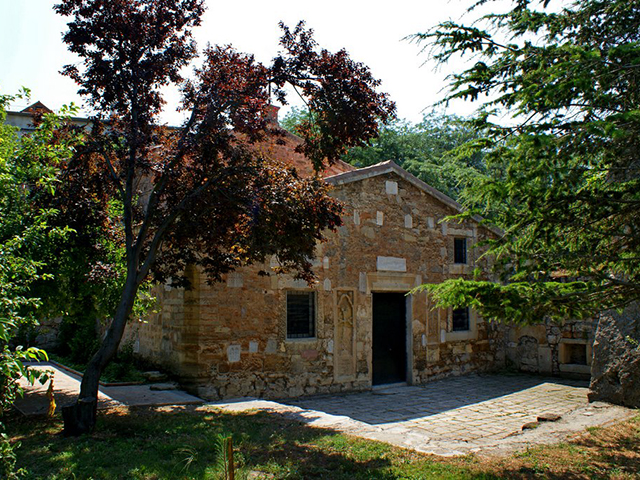
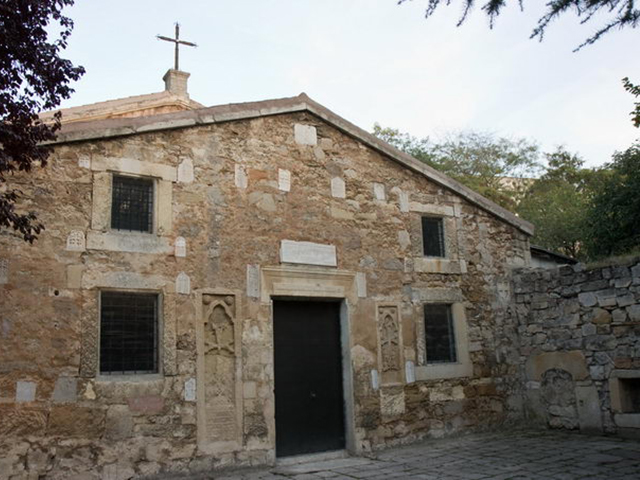
It is an unusually low rectangular structure oriented to the east. The interior of the church is divided into sectors by three arches. In the western part there is a deliberately wide arch opening the entrance to the narthex. A two-room «annex» adjoins the temple from the north. The building itself is covered with an unpretentious, unpretentious two-pitched roof, on which the original tiles have been preserved. Externally, the church of Surb Sarkis categorically does not look like the temple that people expect to see — a dozen domes, plenty of gold, stained glass windows, chimeras and apostles on the pediments.
The temple of Surb Sarkiz was built of limestone blocks. Today they are destroyed in many places, overgrown with moss and lichens, so the appearance of the building is very romantic. All that is missing are ivy branches and a singing minstrel. A distinctive feature of this church is a lot of khachkars. These are peculiar Armenian stones-crosses. On a piece of rock a cross, a biblical plot or symbolism of a family is carved. After that khachkar is inserted into the body of a church, monastery or set along the road. The whole facade of Feodosia temple, like medals, is covered with khachkars. People who understand art can look at them for hours.
In the Middle Ages it was Surb Sarkis that was the epicenter of Armenian culture in Crimea. The annex housed a scriptorium — a workshop for the production of handwritten books. In the neighboring room they made engravings and painted miniatures. Many of them were honored to have in their collections the National Library of Paris and the Matendaran Institute in Vienna.
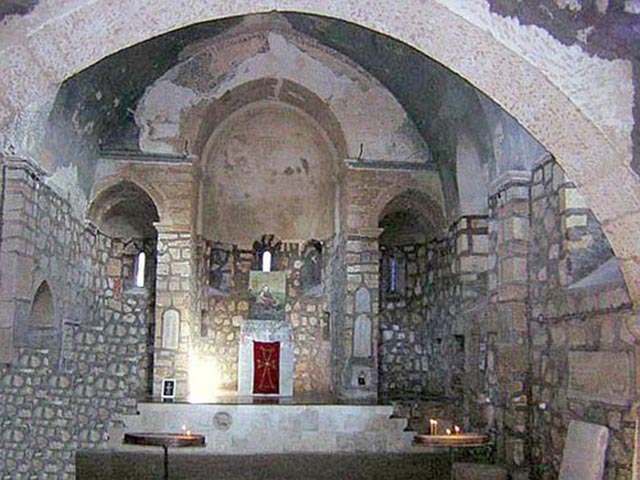
In 1888 Surb Sarkis was restored. The money was allocated by the painter I. K. Ayvazovsky, who was known in his hometown as Hovhannes Ayvazyan. He was baptized in this church — there is still a carved stone font in the altar. He was married there with his first wife Julia Grevs. Here he was buried. On its territory buried the famous marinist and his second wife Anna Sarkisova. By the way, according to Aivazovsky’s will, the temple received 50 thousand gold rubles.
The most difficult and little honored existence of this temple fell on the period of the Soviet Union. Sub Sarkis was declared an architectural monument, but during the construction of residential buildings in the neighborhood, the ancient drainage system was damaged, so it began to be flooded by groundwater. This ruined the remains of the medieval frescoes. The unique carved walnut entrance doors were removed and divided into 2 parts. One is in the Hermitage, the other is in the local museum of local lore, and the entrance to the church today is blocked by peeling plywood doors. In 1980 the restoration of St. Sergius Church began, which has not been completed to this day.
Despite this attitude towards St. Sargis Church, it is still holding on. Those who come on holiday in Feodosia will be charmed by the medieval atmosphere that emanates from the structure itself, the two hundred year old bell tower and the charming view of the Armenian Street, fragmented with stone slabs. Coming on holiday in Crimea you can endlessly enjoy contemplation and immersion in the mysteries of one of the most original temples of Feodosia.