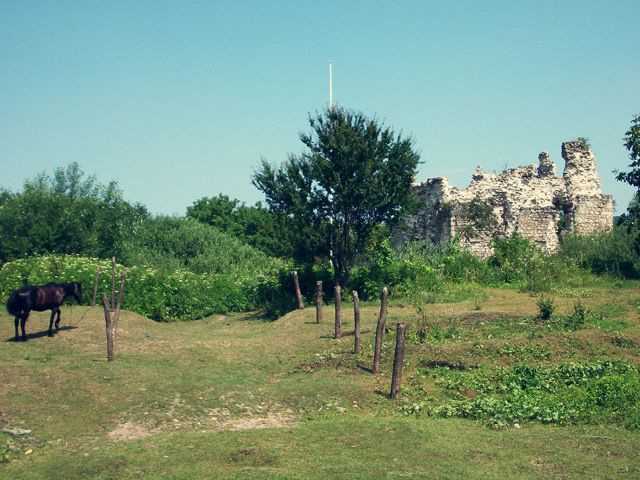
Seredniansky Castle — built in the XIII century by the Knights Templar Order. In 1312 the Order of Templars because of its wealth became a victim of greed of Western European kings, its members were accused of links with «unclean power», arrested, the property was plundered, and the Order itself was liquidated.
The castle of Serednany Castle was taken over by the monks of the Order of St. Paul. During this period there is a struggle for the royal throne in Hungary, as a result of which the feudal front suffers defeats and loses all its possessions. The new king of Hungary, Charles Robert, gave these estates to his associates — representatives of the new magnate families, including the Drugetts, Doges, and Debreceni, who came from France and Italy.
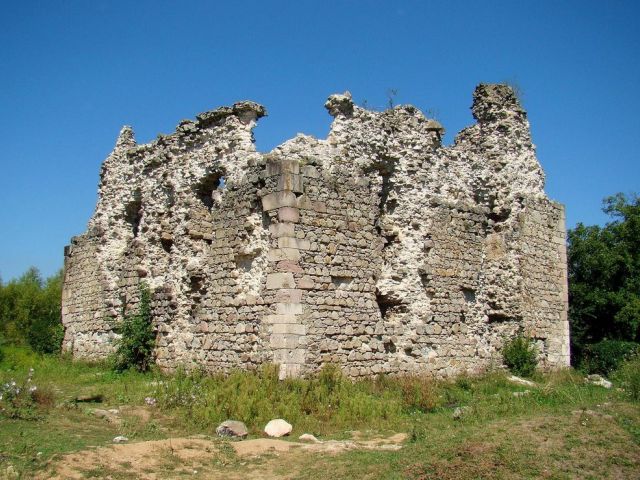
Serednyansky Castle was looked after by the Drugetas, but at the same time it began to be encroached upon by the feudal lord Palochi. The struggle between the two clans lasted for a century and ended in favor of Palochi. But the Palochi feudal lords did not have to hold the castle for long. In 1526, the last male member of the Palocci family died in the battle of Mogaci.
After that the castle passed into the possession of the noble family Dobo. His son restored and strengthened the castle with the help of captured Turks and expanded the cellars.
During the XVIII-XVIII centuries, the Serednianska Castle repeatedly changed its owners in the whirlwind of endless Austro-Turkish and Austro-Hungarian wars. During these wars, the castle gradually fell into disrepair, and no one carried out any repair works, as the archaic stone block no longer met the lifestyle of the nobility of the XVIII century.
The castle suffered a significant blow during the anti-Habsburg movement of the Hungarian nobility led by Ferenc II Rakoczy in 1703-1711, after which it was never restored again.
 .
.
The Serednianska Castle consists of only one quadrangular mighty stone tower — the donjon (18.6×16.5m) — the main and most characteristic part of the Romanesque medieval fortress, the prototype of which was the ancient Roman border watchtowers on the Rhine and Danube. At first, the donjon of the Serednian castle was three-tiered with a girder floor between floors.
The height of the tower reached 20 m and the walls were 2.6 m thick. The entrance to the tower-donjon was placed at the level of the second tier in the center of the eastern wall for security purposes. Wooden steps led to it from the street, which could be easily removed or burned in case of danger.
The second tier was created by three rooms. One of these rooms had steps that led to the third tier. The first tier consisted of two rooms — «east» and «west», the dimensions of which were 11.2×6 meters. In the middle of the dividing wall, which is 1.3 m thick, there is a door slot 80 cm wide. Not far from the door, a hole (filled with stones) can be seen in the floor of the «eastern» room. It was probably a well. Opposite the pit, a square-shaped foundation has been preserved, which is adjacent to the eastern wall of the tower. The first floor of the Romanesque tower was poorly lit, so it was used for barns, an arsenal of weapons and a prison.
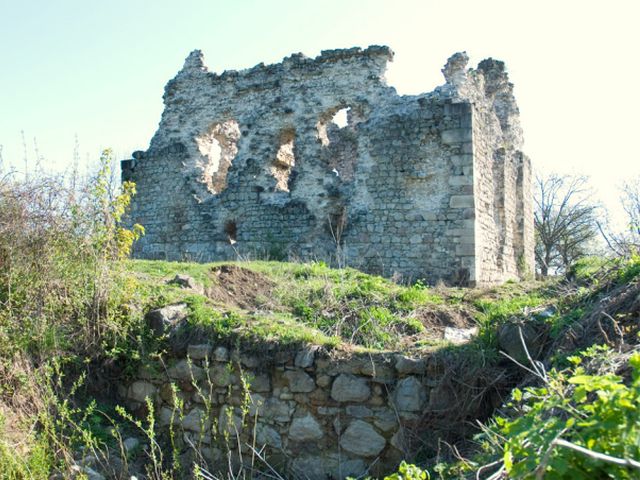
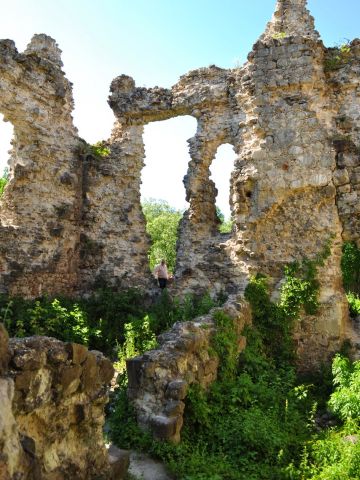
The castle was defended by two defensive lines. The first defense line was wooden, the so-called «palanok». The main role in the defense system of the castle was assigned to the western and southern walls, from which the entrance to the castle courtyard was controlled. These walls had the most windows. There are five such windows in the western wall, which are placed in two horizontal rows. In the southern wall there are four windows — loopholes with arched end. In the double wall there are three windows of the same completion. On the inner side of the walls between the windows there was a planking that allowed the castle defenders to move from one loophole window to another without going down to the floor.