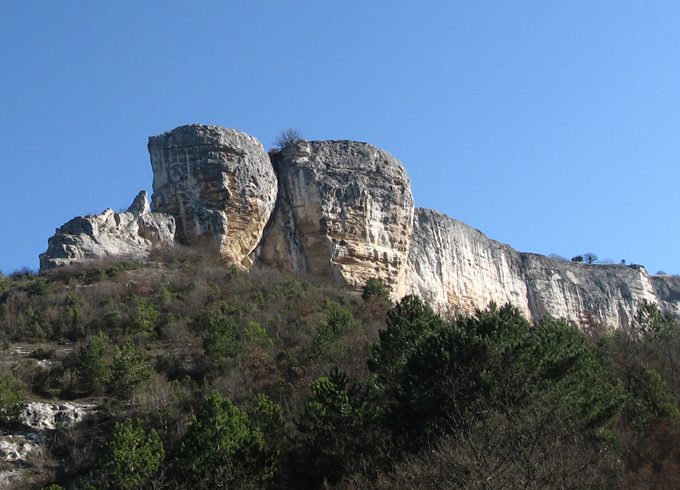
Suiren. This beautiful sounding word translated from Crimean Tatar means «sharp peak». Just such a «sharp peak» falls into the Belbek valley cape Kule-Burun (Tower Cape).
In the turbulent era of the Middle Ages, the tip of this cape was turned into a fortification. According to researchers, it was the residence of a local feudal lord.
Thick stone walls stretched from the eastern to the western cliff, closing at an obtuse angle. Crossing the cape across, the walls separated a 1.7 hectare area. From the other sides, it was reliably protected by multi-meter steep cliffs.
It is not easy to answer the question of when the fortress was built. There are practically no written sources shedding light on the history of medieval Crimea, except for a few scanty documents.
All that scientists have is archaeological data. It is therefore impossible to give a definite answer. Researchers disagree about the matting (V-XII cc).
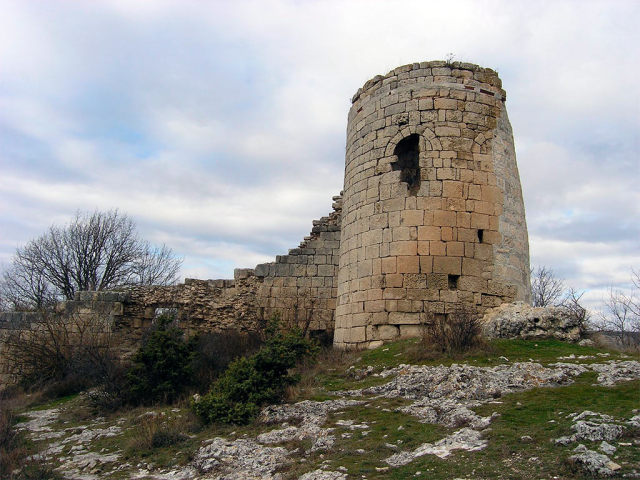
Walls Suyurenenskaya fortress thick — 2.5 meters. They are composed of two shells of smooth limestone quadrangles with rubble between them. The total length of the walls is from 92 to 110 meters (according to different sources), height — 4.8 meters.
At the intersection of the walls there is a round 2-storey tower 10 m high and 8 m in diameter. It is also made of limestone quadro blocks. Inside, there was a wooden ceiling dividing the building into two floors. It has not been preserved and its existence is evidenced only by the grooves for the beams. The second floor of the tower probably housed a chapel.
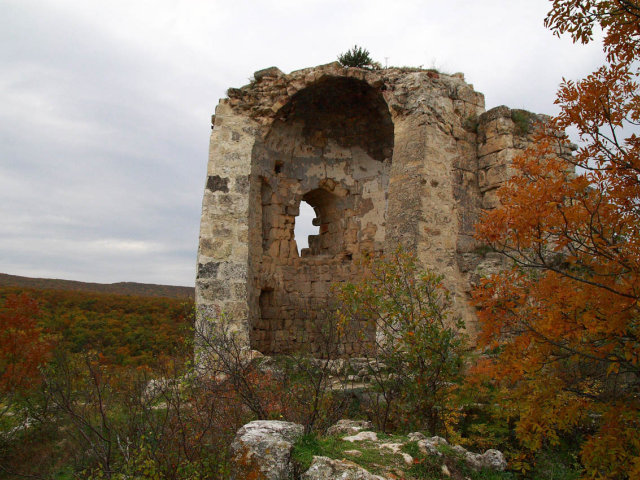
Back in the first half of the XIX century, the scientist Köppen I.P. saw on the vault the well-preserved remains of paintings of the XIII-XIV centuries. According to these remnants it was possible to reconstruct in general terms the subject of the fresco: either «The Assumption of the Virgin Mary» or «The Position of the Savior in the Tomb» — as Köppen suggested.
Inside the fortress to walls adjoined stone outbuildings. Most likely stone houses existed and on the internal territory of fortification. Excavations have not been carried out there yet. There are several grave cuts in the rocky ground near the tower. Under the northeastern slope of the cape there are 5 grape-growing houses — tarapans, which are indispensable attributes of any medieval Crimean settlement.
 .
.
In 300 m from the main wall there was another — less large-scale defensive line — an advanced wall 155 m long and about 2. 5 m wide. 5m, which also crossed the cape from edge to edge.
Judging by the collected archaeological material, the most intense life in the fortress took place in XII-XV centuries, until the infamous 1475, when the Turkish conquerors merciless avalanche swept across the mountainous Taurica. It is not excluded that in the following years there were still some manifestations of life in the destroyed fortification, but soon it was finally abandoned. The northeastern part of the tower collapsed in the late Middle Ages. It has never been rebuilt since.
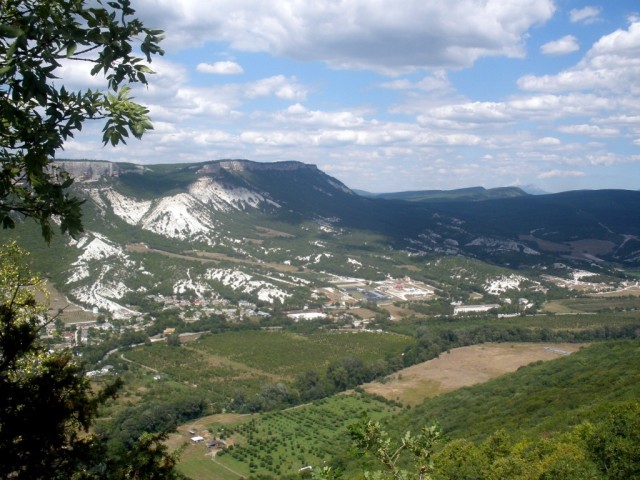
Several medieval settlements have been excavated in the vicinity of the fortress. One was located right at the foot of the Kule-Burun cape, and several others were located between the cape and the present-day village of Kuibyshevo.