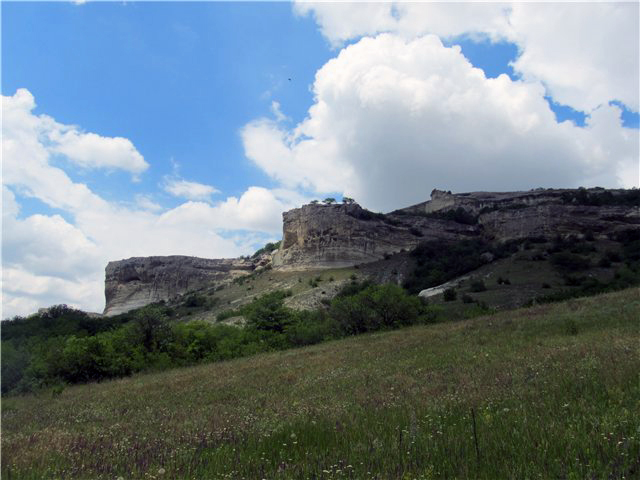
 Bakla is well known in three worlds, in three different dimensions. Firstly, luminaries of geological science and students of relevant universities willingly come to this tract for field practice. Secondly, Bakla mound is an inexhaustible source of information about our ancestors of different levels of development, which is used by many domestic historians and archaeologists. And thirdly, the cave town of Bakla has become one of the objects that form the tourist «face» of Crimea. Just as the visiting card of Sardinia are a hundred towers-nuraghi, and Italian Alberobello is easily recognizable in any picture, thanks to the characteristic roofs of houses-trullo.
But the settlement of Bakly would never have existed, if on one of the southern slopes of the Inner Ridge of the Inner Cuesta of the Crimean Mountains, not far from the village of Skalisty, at one time would not have formed a secluded, hidden from envious eyes, tract. Its walls were formed by nummulite and bryozoan limestones, in which everyone can find a souvenir — a fossilized shell, a fossilized sea urchin or a print of flora of the Mesozoic era.
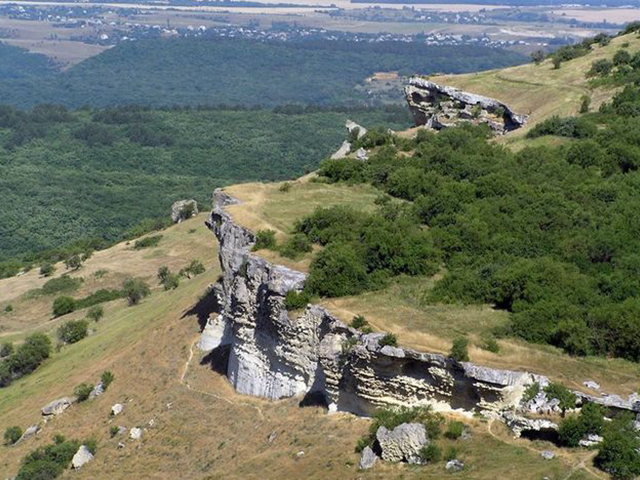 An additional decoration of the Bakla geological site are weathering traces, which gave the outer surface of the Inner Ridge the appearance of giant bee honeycombs. Special attention deserves the so-called «Crimean Sphinx» — the result of natural denudation of rocks, surprisingly similar to man-made Egyptian monsters. Because of the numerous limestone outcrops, the possibility to easily find any fossil organism, as well as to study the results of exogenous processes on site, geochronology enthusiasts constantly come to the Baklu tract, and in 1984 Skalistoe hosted the participants of the International Geological Congress.
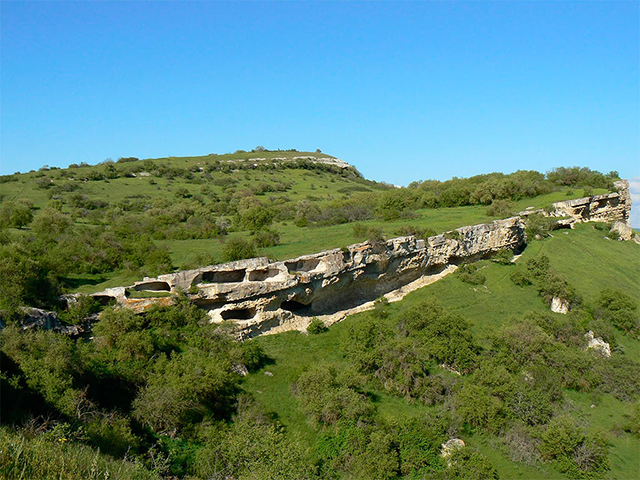 The historical Bakla is no less interesting for research. The first people here appeared in the Lower Paleolithic. They belonged to the Moustier culture, the level of development equal to Neanderthals and made primitive tools from flint and animal bones. In the Shaitan-Koba grotto, located in a protected tract of land, Soviet archaeologists opened the cultural layer of the ancestors of Homo Sapiens and extracted the remains of humans and mammoths, bison, saigas and wild asses killed by them.
In the III century, a fortified settlement of Alans appeared on the top of Mount Bakla. In the IV century rare visitors could see a small settlement, fenced by a solid line of defense, half of which was occupied by a winery complex. Special hatches were cut out in the rock for sentries looking out for the enemy. For the «artillery», represented by archers and slingers, special hollows in limestone were created or natural ones created by weathering were used. In the VI century Vinnitsa was rebuilt into a fortress with fighting caves-dots, with ladders carved in the rock and household rooms suitable for storing a huge amount of grain. By the way, by the number of grain pits Bakla is a record-breaker among all the cave towns of the Crimean Peninsula.
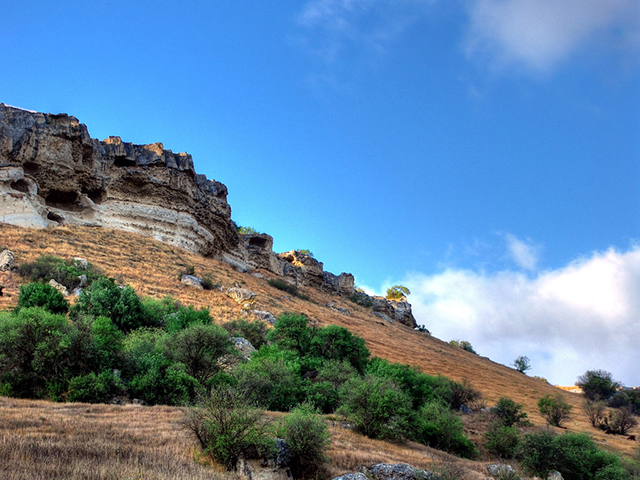 In the IX century Alans were replaced by Karaites. The new masters improved the defensive system, created tanks for collecting and storing water, cut down the cave temple and about a hundred individual caves, like apartments in a communal house. In the 11th century, a Christian church appeared on the territory of Bakla. It is a grotto, on the walls of which you can still see drawn figures of martyrs, ships and fish, one of the first Christian symbols. Scientists who worked on the territory of the settlement «dug up» many artifacts — dishes, ancient Roman and Byzantine jewelry, crosses and weapons. The settlement existed until 1299, when the Golden Horde beklyarbek Nogai took it by storm and destroyed or sold all its inhabitants into slavery.
Bakla historical and geological are among the most interesting attractions of Crimea. Its only problem is that tourists are more willing to go on excursions to the South Coast, rather than to remote villages of the Bakhchisaray district. In addition, «black archaeologists» have tread the path here, digging artifacts at such a pace that no state scientific institution can keep up with them.