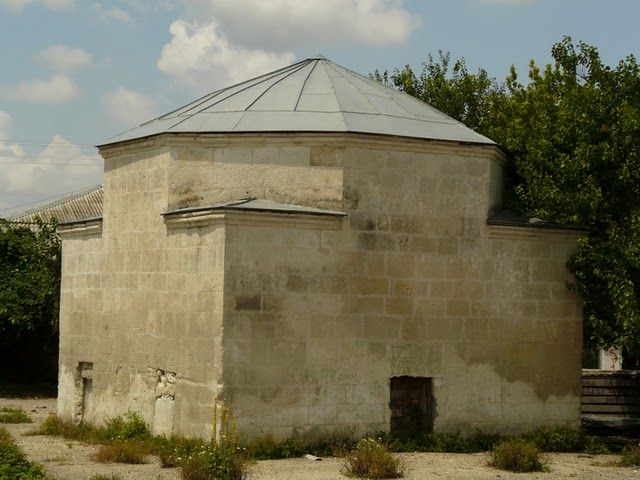
These days, Bakhchisaray is a bizarre mix of ancient and modern architecture. Thus, in the neighborhood of ordinary nine-story houses one can see ancient mausoleums, reminding that in the past this city was the backbone and heart of the khan’s power.
Azis — so today is called the oldest part of the city, where the burial vaults of representatives of the Khan dynasty, the oldest of which was built at the end of the XIV century. This place is sacred to the Tatars, they called it «Kyrk-Azizler» — forty saints.
The predecessor of Bakhchisarai was a large village Eski-Yurt, which appeared on the left bank of the Churuksu River in the XIII century. Eski-Yurt developed, grew and expanded on a hill near the road and a cemetery where righteous Muslims, sages and nobles were buried. The cemetery as a whole has not survived until our time, and only a few «dyurbe» — mausoleums of rulers have survived. Together these tombs are called Mausoleums of Azis.
The oldest surviving mausoleum was built at the end of the XIV century: in it Mohammed-Shah-Bey buried his mother Bey-Yude-Sultan. The Bey-Yude-Sultan mausoleum is located at the beginning of Frunze Street. This is how unexpectedly intertwined names from completely different and distant from each other eras. The mausoleum is also called «Eski-dyurbe», which means «old mausoleum», it has the shape of a cube with a spherical dome, an open courtyard adjoins it from the south. This was once the place where her descendants mentally communicated with the deceased. This construction inspired the builders of mausoleums in the following years. The development of this small form of medieval architecture of Crimea became the mausoleums of Akhmed-Bey, Muhammed-Bey and Muhammed-Girey, built in the XVI-XVII centuries.
These mausoleums are located across the road from Eski-Dyurbe, and the pulpit of the mosque of wandering Muslim monks — dervishes, which is a small octagonal tower, is also preserved here.
The mausoleum of Akhmed-Bey has survived since 1577, it is a cube-shaped structure, in the upper part of which passes into the
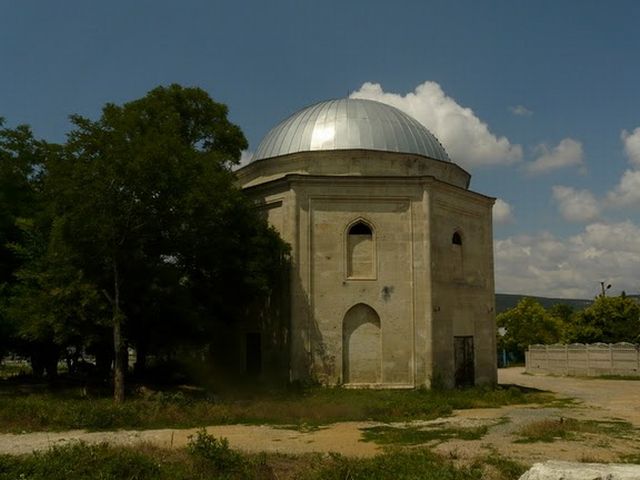
octagonal and crowned with a dome. The most beautiful of the complex of mausoleums of Azis is considered to be the durbe of Muhammed-Girey II, the most solemn and magnificent in the whole Crimea. It was erected in the late XVI — early XVII centuries and represents the embodiment of the best traditions of Ottoman architecture, which came from Istanbul to the Crimea.
The mausoleum has the shape of an octahedron, its entrance is located in the northeastern side, it has two tiers of windows and is crowned with a hemispherical dome lying on a hemispherical sixteen-sided drum. The interior of this mausoleum traditionally has a memorial room at the top and a crypt at the bottom. The remains of khans were buried in wooden coffins in the crypts.
Azis mausoleums in Bakhchisaray clearly illustrate the development of architectural traditions of this type of buildings. These ancient attractions of Crimea allow you to present a picture of medieval Bakhchisarai, clarifying and complementing the appearance of this city as it was in the XV-XVII centuries.
For all those who are interested in the history of the city and want to see the most ancient sights of Bakhchisarai, the Mausoleums of Azis are an invaluable gift of time, thanks to which you can look deep into the centuries and feel the atmosphere of this ancient city.