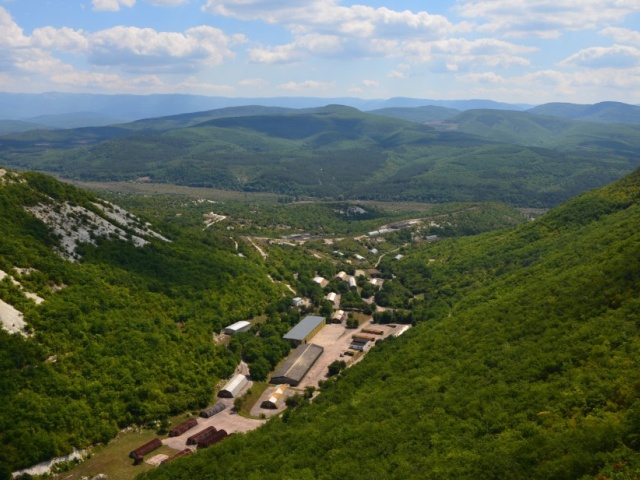
 Kachin Valley is a fertile place in the heart of the Crimean foothills. Populated by man since time immemorial, it is rich in historical monuments. These are the sites of ancient people, and mysterious petroglyphs, and Taurian stone boxes. But the most vivid trace was left here by the Middle Ages.
Along the right side of the valley stretches a number of mountains-islands with flat, stoliform tops and precipitous slopes. In the Middle Ages, these bastions, created by nature itself, turned into centers of cultural development, known today as cave towns.
Kyz-Kermen plateau looks like a long tongue with a sharp tip, extended towards the Kachin valley. Its steep cliffs, composed of mossy limestone, reach a height of 40 meters. Below them, gentle marl slopes diverge in a wide cone.
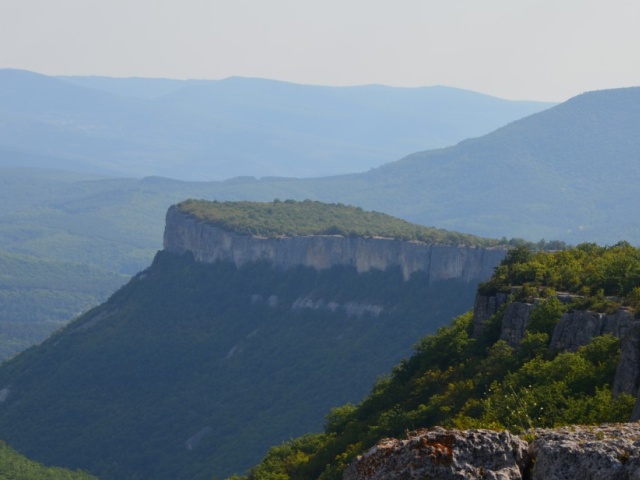 Of all cave towns Kyz-Kermen is less often visited by tourists. There are not as many historical monuments here as at Eski Kermen or Chufut-Kale. The number of artificial caves on Kyz-Kermen is calculated by a ridiculous figure — 3 pieces. However, this is just the case when the main thing is not quantity, but quality. A visit to one of these caves can bring a gamut of emotions much more than a whole day of climbing Eski or Tepe.
But about it later. First of all, it would be worthwhile to find out what historical science can tell us about the settlement.
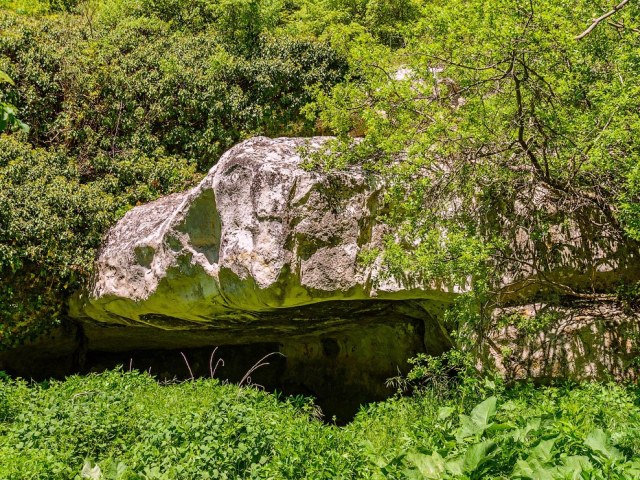
So, Kyz-Kermen is a place inhabited since ancient times. At the turn of the old and new eras in the northern part of the plateau was a settlement. Its population, most likely, was Scythian. Below the settlement, near the grotto, which received a funny name Turtle from modern tourists, there is a complex of tarapans (grapevines) of that era.
 To have a reliable shelter in case of enemy attack, the inhabitants of early Kyz-Kermen blocked the plateau across with a stone wall. Archaeologists excavated an ancient section of the wall. The masonry made of regular limestone blocks-quadrons very much resembles the Chersonese, and, perhaps, was erected not without the help of specialists from there.
Another settlement, of later time, was located to the south, within the area enclosed by the defense wall. It appeared in 70-80 years of the VIII century and existed until the end of the IX century. The number of inhabitants of medieval Kyz-Kermen was insignificant. According to the estimates of some experts only about a hundred people, according to others — even less — 60-70 people.
Archaeologists excavated 7 manor complexes. One of them, the largest, probably belonged to a local magnate.
 Like in other medieval Crimean towns, wine-making was intensively developed in Kyz-Kermen. The complex of 4 wineries-tarapans was found in the eastern part of the plateau. Since the tarapans were located away from residential buildings, archaeologists assumed that it was a public winery. Individual tarapans were also present. At least on the territory of one of the farmsteads such a private tarapan was found.
The locals didn’t make a big deal of the fortress wall. They left it in the same place. They only reinforced the wall with new masonry, erected two semicircular towers, and poured a rampart of earth and stones on the inner side. The total thickness of the resulting construction reached 6-8 meters.
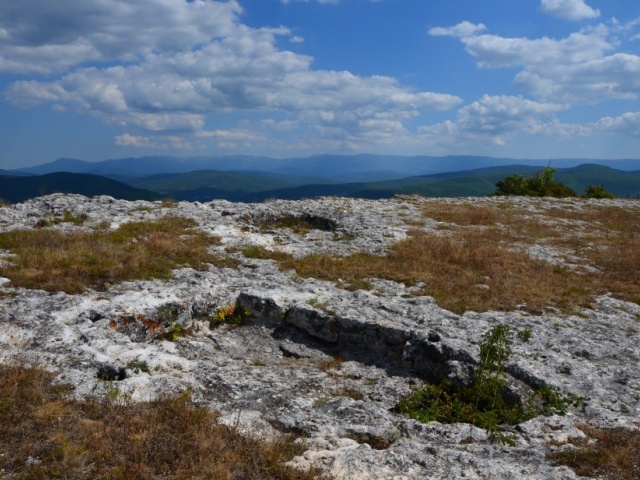 During the excavations archeologists found in the masonry wall the burial of a child with a pot for the accompanying food. Probably, during the repair of the section of the wall destroyed by the earthquake, a human sacrifice was performed here. The belief that the souls of people entombed in fortress walls become guardians of the surrounding areas was widespread in the Middle Ages in both Eastern and European countries.
Regarding the ethnicity of the inhabitants of the late Kyz-Kermen, there is no consensus among scientists. The famous researcher of cave cities Y. M. Mogarichev believes that they were the Khazars who arrived in the VIII century in Crimea, other researchers attribute the inhabitants of the city to a mixed Crimean ethnos — descendants of Scythians, Sarmatians, Alans.
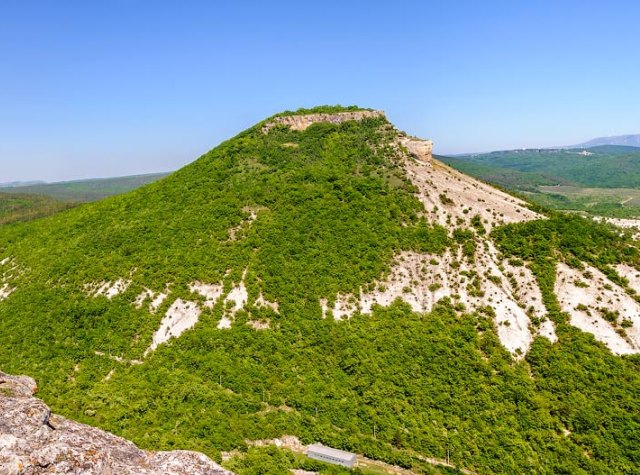
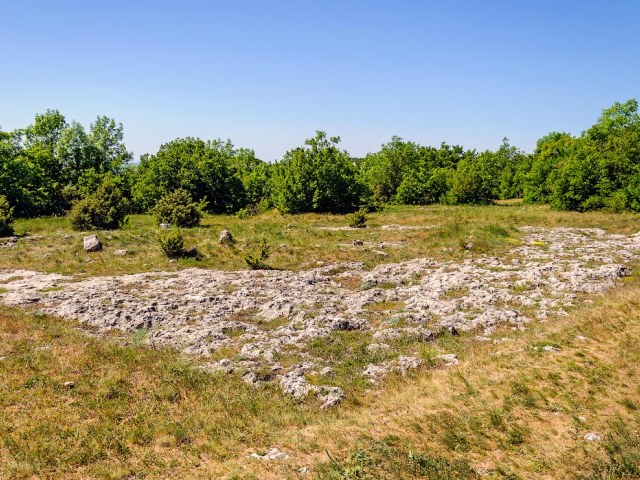 The inhabitants of Kyz-Kermen, unlike their neighbors in other cave towns, for some reason were not inclined to chisel rocks. Here, as already mentioned, only three artificial caves were found. One of them probably served as a cistern on the territory of one of the estates, another, in the southern part of the settlement, had a watch function. The third cave is probably the most interesting attraction of Kyz-Kermen. Its purpose is mysterious. It is carved on the eastern cliff, right in front of the majestic cone of Tepe-Kermen. It is simply impossible to find the cave from the surface of the plateau without knowing about its existence: the entrance is not visible, the steps have been erased so much that they resemble natural rock ledges. You can stand right above the cave, staring at the mighty Tepe in silent delight, and not suspect what is under your feet. The cave is well camouflaged. It can be compared to an eagle’s nest, nestled at a great height at the top of a steep cliff. Three meters below the edge of the cliff there is a tiny balcony, no wider than in «Khrushchev» apartments. The same narrow rocky staircase descends to it. In its upper part there are several steps. Closer to the balcony, they are replaced by a cutout, just enough to put one foot there. The whole thing is unobstructed: no rocks, bushes or the like. Going down these stairs, to the right is bare rock, to the left-. air. Below the stairs and the balcony there is an absolutely steep 40-meter cliff (a rope will not be superfluous here). The entrance to the cave you find only when you go down to the balcony.
  The cave itself is a tiny room. In the southern and western walls of the cave there are laying beds, in the northern wall there are two niches for icons and a lamp stand. In the floor, near the eastern wall, there is a hollow for a hearth. Above it is a chimney hole. In general, a small, but quite cozy and quite habitable room. But who and when settled in such exotic apartments on the edge of a steep cliff?
The most probable assumption is that some hermit monk lived here, hiding from the mundane world on the edge of the cliff in a cool cell with a view of Tepe-Kermen.
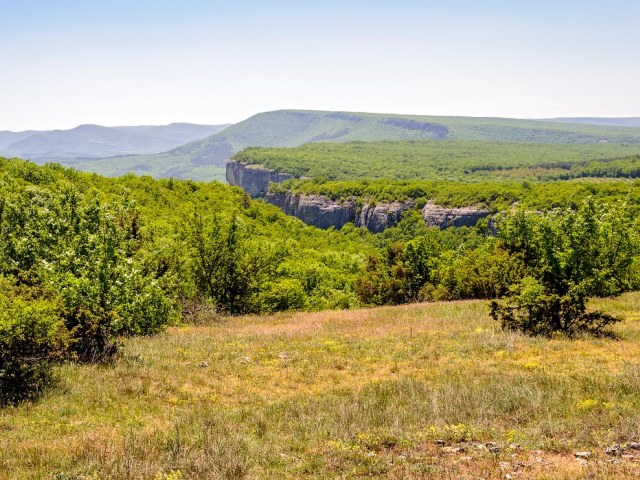
You will not meet more cave constructions on the plateau. However, their absence is more than compensated by the beauty of landscapes. After visiting Kyz-Kermen, it makes sense just to wander around the plateau, because it is small — from the fortress wall to the tip of the cape is not more than 1 km. The width is even less. In the area of the wall it is 130 meters. This is the narrowest part. The maximum width is 250 meters.
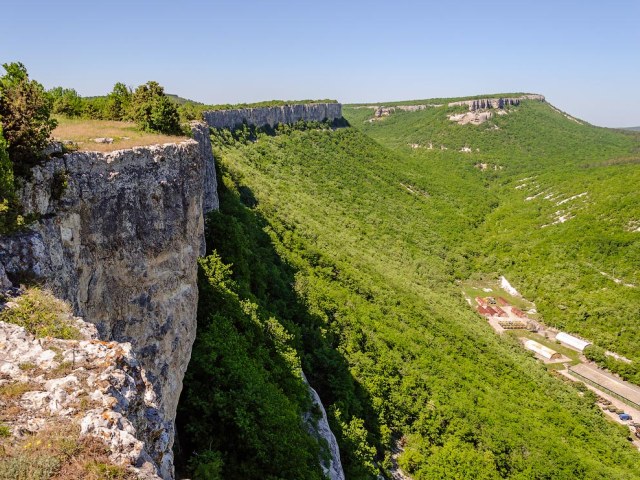 On the eastern side of the plateau plunges down an absolutely sheer wall, on the western side there is a place where the height of the cliff is greatly reduced. There were arranged the main gate of the city. A staircase carved in the rock, by which the ancient inhabitants climbed up to the plateau, has survived to our days. A little below it is the so-called Great Grotto with three artificial water reservoirs. One of them collects clear and cold spring water from a crack in the limestone.
Below the grotto is a smooth, without sharp changes in height, the road descending into the valley of Kaya-Arasa, separating Kyz-Kermen from the neighboring Kachi-Kalon. Today tourists walk along it. Many centuries ago, donkeys laden with loads, traders with their goods, peasants returning from vineyards traveled this way to the gates of the city. Once there was life here, the town on the rocky promontory rang with the clamor of the people. Today, only the forest rustles its leaves in the wind. Nothing on earth is eternal.