 Vilino is a large village in the southwest of the Crimean peninsula. It is located in the valley of the river Alma and is distant from the sea distance of 4 km. Almost the whole village is located along the right bank of the river, which is a classic steppe. The left bank is the beginning of the Outer Ridge of the Crimean Mountains. Now it is picturesquely covered with vine plantations. During the Soviet Union Vilino was called the collective farm named after them. XXII Congress. Here was the base of the Institute of grapes and wines «Magarach», specializing in the production of muscats, port and madera, so the collective farm was rich and was considered a resort, despite some remoteness from the sea.
The pre-Soviet history of Vilino deserves a separate proposal. The village was founded by Tatars and named Burlyuk. It consistently belonged to the Crimean Khanate and the Russian Empire. And it was here in 1854 that one of the key battles of the Crimean War, the Battle of Alma, took place.
 In the course of the Crimean War, Russian troops clashed with British, French and Turkish soldiers. The task of Alexander the Second’s soldiers was to keep the Allied forces from advancing to Sevastopol, completely unprepared for defense at the time of the war. French soldiers under Marshal St. Arnaud and British soldiers, led by Lord Raglan, had to capture Sevastopol as quickly as possible, as the main base of the Black Sea Fleet of the Russian Empire.
35 thousand Russian soldiers, led by Prince Alexander Menshikov, occupied the left bank of the Alma. On the right bank 2 redoubts were urgently built. 3 rifle battalions were also deployed here. The prince was so confident in a positive outcome of the battle for Russia that he invited all Sevastopol residents to the spectacle of the battle. Only that he did not sell tickets for this show.
Allies were more: the British — 26 thousand, 14 thousand French and 7 thousand Turkish-subordinate. The Russians were attacked from the front by the troops of Marshal St. Arnaud, and Lord Raglan and General Bosquet bypassed Menshikov from the flanks. The latter’s army was composed of Zouaves — African legionnaires, accustomed to fighting in the gorges of the Atlas. It is believed that half of the success of the Battle of Alma allies owe the military art of soldiers of General Bosquet. Suffering losses, the Russians retreated. After the battle it turned out that Alexander the Second had lost 5,745 soldiers and officers, the Allies counted 648 killed.
 After the Battle of Alma, the Anglo-French-Turkish military conglomerate cautiously and carefully headed towards Sevastopol. Foreign conquerors were preparing for a long siege of the main naval base of the Russian Empire.
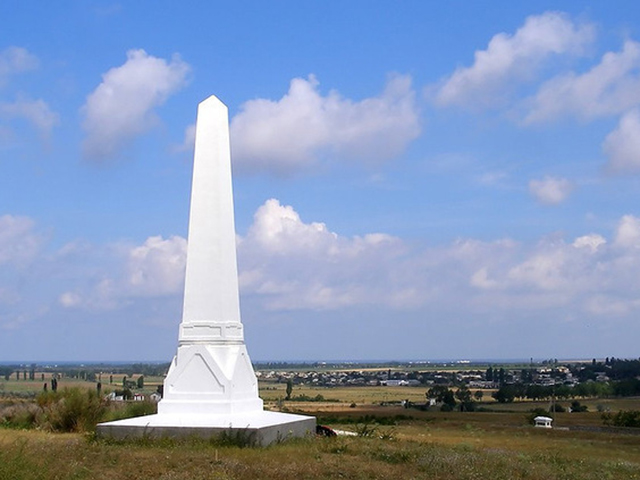
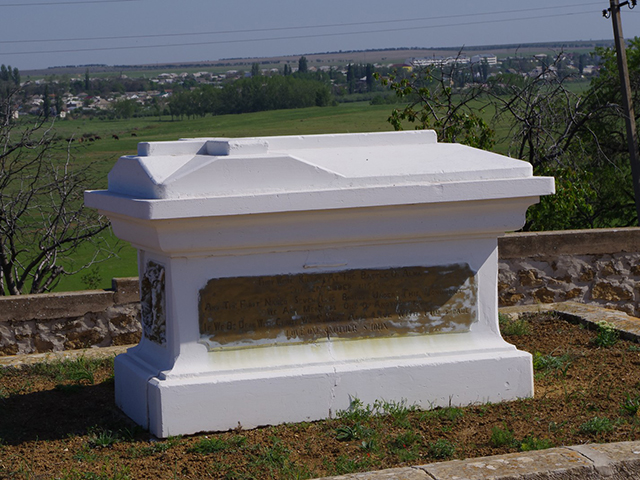
In memory of these unjustifiably bloody events, a whole memorial complex appeared on the field of the Battle of Alma. Its construction began with the designation of mass graves, both Russian and their opponents. Over the English grave was installed, and now reconstructed, a marble sarcophagus with a commemorative inscription. Over the Russian graves, which were very numerous, were placed simple wooden crosses. They quickly deteriorated or were barbarously destroyed, so many burial sites are now lost. The dominant monument on the field is a snow-white tetrahedral obelisk. Its height is equal to 10 meters. It is dedicated to all soldiers «fallen in the Battle of Alma». The design of the monument belongs to Colonel Gemmelman, a military engineer.
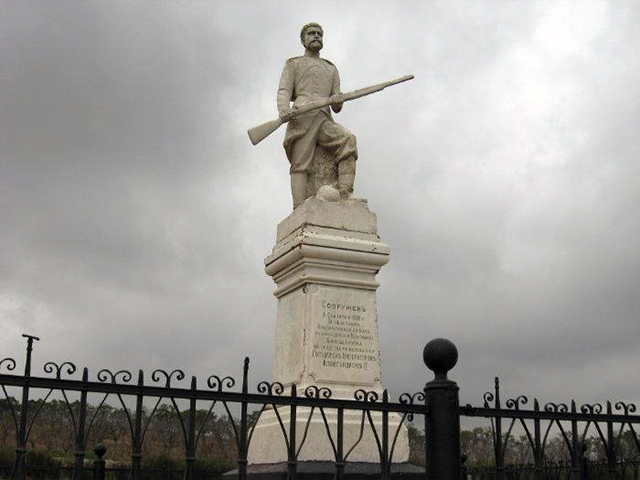
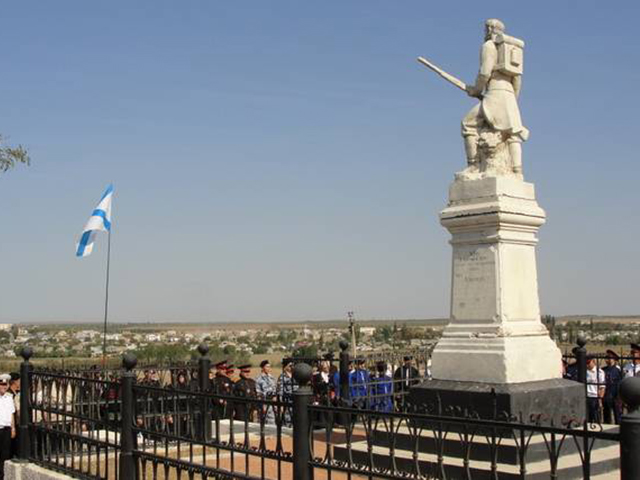 Another monument rising above the field is dedicated to the soldiers of the Vladimir Regiment. It is considered to be the first monument in the world, which is dedicated neither to generals nor admirals, but to ordinary soldiers. The monument depicts a seated Russian soldier holding a contraption in his hands. The sculpture was made by the Italian Baskritse. The monument survived the revolution and World War II. During the years of occupation it was visited by General Erich von Manstein, one of the most brilliant and respected commanders of the Wehrmacht.
Guests of Bakhchisarai and nearby Sevastopol willingly come to the village of Vilino. Once on the field of the Battle of Alma in September, they have a high chance to witness a reconstruction of the battle, a very popular way of immersing in history in Krym.