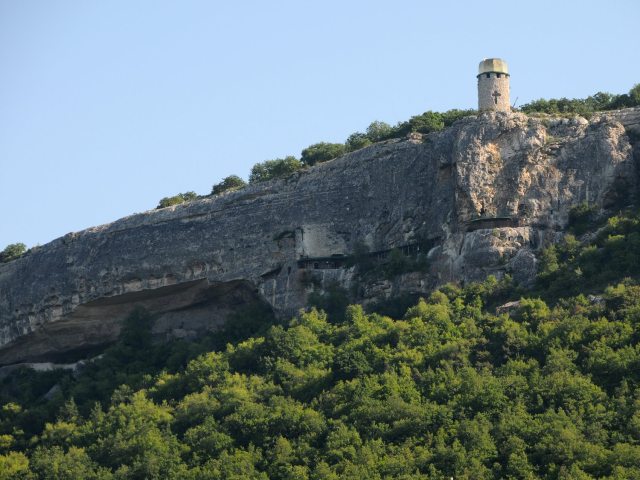
 This beautiful, mysterious-sounding name has an equally sonorous translation — «giving echoes».
Shuldan Cave Monastery can be recognized from afar. At the very edge of the rocky cliff rises a small tower, clearly visible from the highway, reminiscent of the donjon of an ancient fortress, or the dome of an observatory. Below it, in the rock monolith, there are several artificially created caves, once part of one of the numerous Orthodox cult complexes of medieval Taurica.
Compared to its neighbors, Shuldan is tiny. Unlike Mangup and Eski-kermen, it was never a town or a fortress. From the very moment of its foundation, it was exclusively a hermitage, where the monks who had left the world spent their days in prayer. There are only about 20 rooms, arranged in two tiers — several cells, refectory, household rooms and two temples.
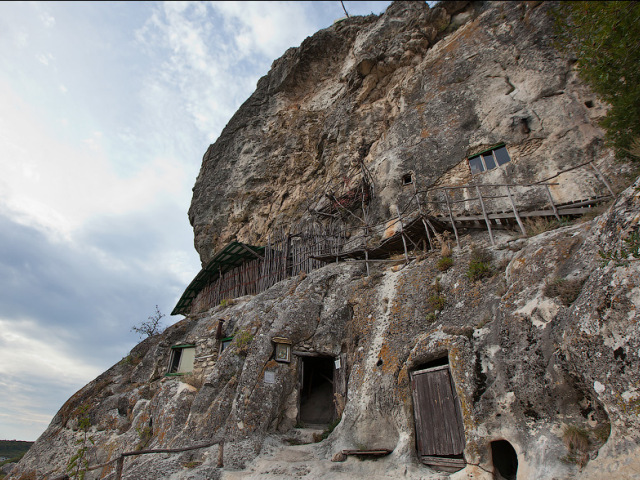 The first temple — the largest, was located in a huge natural grotto, covered by a vast rock canopy. Today’s visitors, who got under the vaults of this spacious cavity, can hardly see any evidence of the existence of the ancient temple. Boulders falling from the ceiling, garbage left by modern savages, obscure the already not too clear picture. Only looking more closely at the walls of the grotto, you notice the artificial recesses made many centuries ago. Archaeologists who studied the cult complex concluded that here, in the grotto, were quite a spacious temple, chapel and baptistery. In the XIII-XIV centuries, when the monastery just began its existence, the main temple was much smaller, but in the XV century it was expanded, increasing the area. A more spacious baptistery was built and the old one was turned into a tomb. Perhaps there was once a spring in the grotto. It has long since dried up, there is only a hole hollowed out in the rock by water. Back in the 30s of XX century on the hay of the grotto could be seen the remains of fresco paintings. A little earlier, the image of the Mother of God was clearly visible.
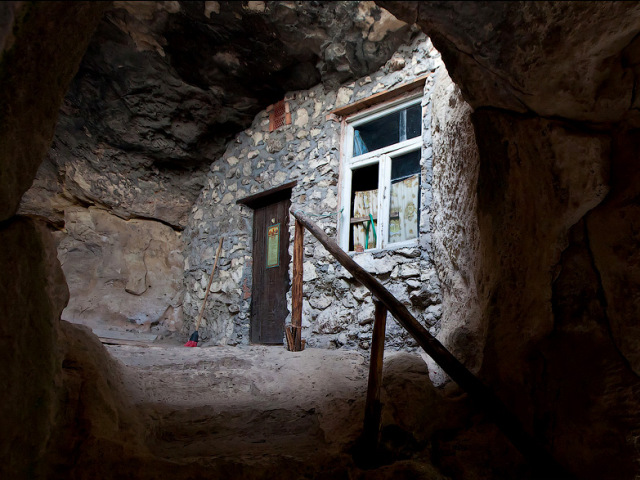 A narrow path, lost in the thickets of shibliak, stretches along the whole cliff and leads to the inhabited part of the monastery. After a couple of dozen meters it leads to a doorway cut out in the stone monolith. At the entrance there is a sign: «Church of the Pokorov of the Blessed Virgin Mary». To the right of the door is a small artificial cave, wittily turned into a …dog box.
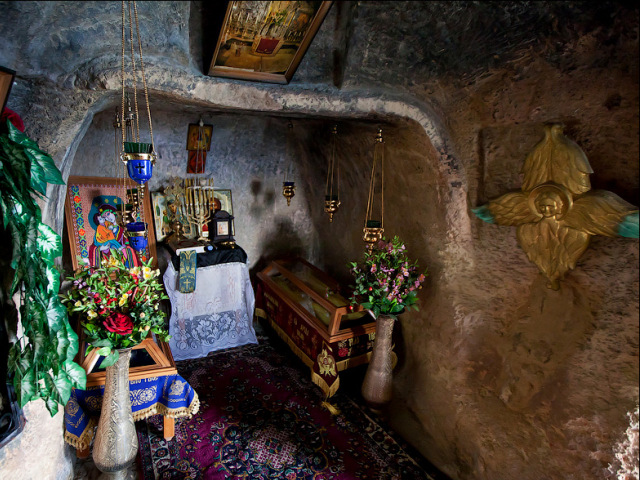
Those who enter inside immediately get into a whole labyrinth of rooms. Just outside the door is a loud, semi-dark artificial cave with a low vault. A staircase on the right leads upstairs, where modern monks have their living quarters. At the opposite end of the cave, there is an exit to a long rock ledge shaped like a balcony or terrace. Along the cliff there is a wooden fence and a canopy, near the wall there are neatly laid out beds with flowers made of wild stone. Everything is well-groomed, carefully put in order. Modern doors and windows are inserted into the stone openings, behind which one can see no less modern curtains and drapes. A wooden gazebo with benches overhangs the cliff. A little further on, just above the railing are several small bells. Opposite is the entrance to the church. Its decoration is exactly the same as that of ordinary land churches.
 After visiting the cave church, you can go further along the same path, attached to the foot of the rock. Here there will be a few more rock niches where construction has begun and two springs. One barely trickles in the summertime and turns into a stagnant puddle. The other, farther away, is a bit more powerful. Here, even in summer, you can get good fresh water.
That is, in fact, all the sights of Shuldan. There is very little data about its history. In the literature devoted to Crimean cave towns, its description is 1-2 pages. As mentioned above, it was founded, presumably in XIII-XIV centuries. (Although there are other dating. Some researchers attribute its emergence to the VIII century). It reached its greatest prosperity in the XV century, at the same time with the principality of Theodoro, located on the neighboring Mangup, and apparently had a direct relation to the monastery.
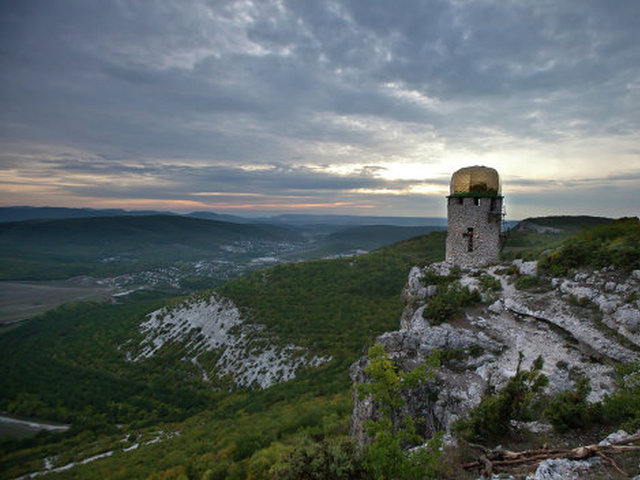 The small number of cells and outbuildings testifies to the same small number of inhabitants of the monastery. At the same time, the presence of two temples may indicate that the monastery was a popular place of worship. The population of the surrounding villages flocked here on the days of religious festivals. Some researchers are inclined to place here the residence of the Gothic metropolitan.
At the end of the XV century, after the Turkish invasion, the monastery fell into disrepair and was never restored. In its crumbling premises the Tatars kept cattle. In this abandoned state this building stood until the end of the 20th century, when, by God’s will, a few hermits who wished to leave the world to serve the Lord settled here.