Mariupol is a city of metallurgists, as harsh as Chelyabinsk. Therefore, the bulk of local memorials are dedicated to warriors and steelworkers. For example, the monument to Makar Mazai, sailors, paratroopers or workers of Azovstal who died during the war. The number of local monuments erected in honor of people of the «cultural front» is much smaller, but their quality causes a slight envious wave among residents of other settlements of Donetsk region.
For example, this city can boast a monument to its fellow countryman Arkhip Kuindzhi, Vladimir Vysotsky and Alexander Pushkin, who passed through Mariupol in 1820. The author of «Eugene Onegin» and «The Stories of Belkin» was traveling to the Caucasus, at the disposal of General Paskevich. The Russian Empire at that time was at war with Turkey.
And although this «metal heart» of the Azov region was not included in the list of so-called «Pushkin places», like the Lyceum, the Moika Embankment or the estate in Boldino, but the mere fact that the great Russian poet traveled through their city inspired Mariupol residents. Celebrating the centenary of the poet’s birth, the intelligentsia began to raise funds for a monument to Pushkin. In 1901, the public collected the funds and erected the first monument to their favorite song-singer.
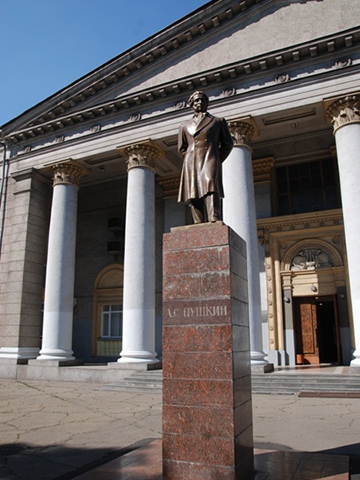
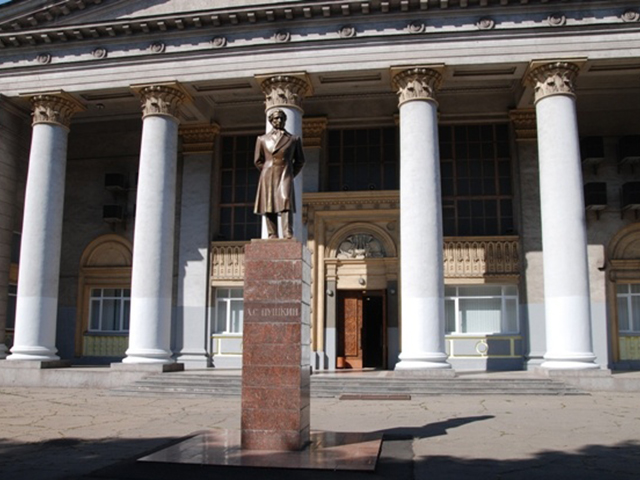
Unfortunately, this monument «did not survive» two serious wars and the October coup, so after World War II Mariupol residents installed a new Monument to A.S. Pushkin. Just like the old — pre-revolutionary version of the monument to the favorite writer, the new one was installed at the intersection of Torgovaya and Lenin. In the 80s of the past century, the bust was dismantled because of its unsightly appearance. And only in June 2000 a new monument to the great writer was placed on the Alley of Enlighteners, in front of the Regional Academic Russian Drama Theater. The author is sculptor Skorykh.
The monument to Pushkin in Mariupol is a two-meter high, metal sculpture of the poet in the period between two matchmaking — unsuccessful and successful, to Natalia Goncharova. It was during this period that the best lyrical works and the strongest prose came out from under his pen. Mariupol Pushkin is a Russian troubadour at the top of his creative career. The grandson of the «arap of Peter the Great» is depicted in full height. The right leg is frozen in forward motion. Hands are placed behind his back. In the eyes — a dream and Natalia Goncharova. The monument is set on a pedestal faced with red granite and a laconic signature — «A.S. Pushkin».
Even small as Pushkin himself, his monument has taken a worthy place in the list of Mariupol’s sights. It turns out that cultural objects look good against the background of metallurgical plants and do not get lost against the background of «Azovmash» or Trade Port. If you decide to visit the Azov region, you will be able to appreciate for yourself the industrial and cultural harmony that Mariupol residents have created in their city.