 .
.
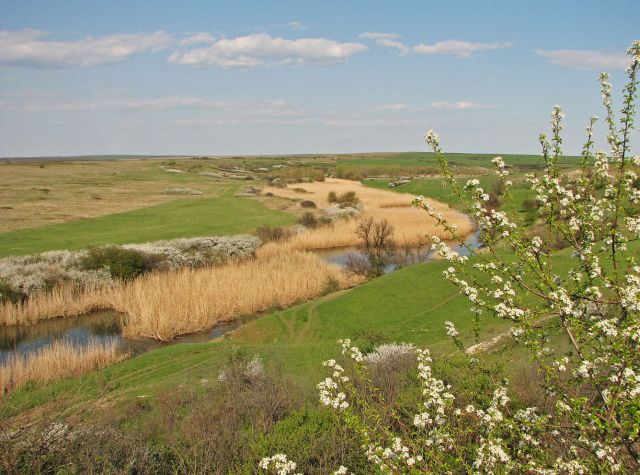
«Khomutovskaya steppe» is a botanical reserve with an area of 1028 hectares. The status of the reserve the steppe first received in the distant 1926, when Mariupol district executive committee adopted a resolution «On the organization of the local reserve «Khomutovskaya steppe». Then it was transferred to the Mariupol Museum of Local Lore, and in 1936 the Khomutovskaya Steppe became a reserve of regional significance, in 1947 it received the status of a state reserve of republican significance. The reserve is included in a special register of the United Nations, as well as included in the UNESCO list of natural monuments.
The Khomutovskaya Steppe is located in the Novoazovsk district of Donetsk region on the left bank of the Gruzskaya Elanchik River near the border with the Russian Federation. The village of Khomutovo is located near the reserve, but the central entrance to the reserve is in the village of Samsonovo.
And through Khomutovo you can get to the «black» passage.
The Khomutovska Steppe is part of the Ukrainian Steppe Nature Reserve, which consists of five departments (Khomutovska Steppe, Stone Graves, Chalk Flora and Kalmiuske in the Donetsk region, Mikhailovska Tselina in the Sumy region). The reserve has a museum, and on its territory there are 3 man-made Scythian burial mounds. Guests of the Khomutovskaya Steppe can visit the museum, where qualified staff will tell and show a lot of interesting information. The scientific staff of the reserve pays great attention to the issues of nature protection propaganda.
This is the first reserve organized in Donbass and the most significant in terms of area. It is an inimitable monument of pristine nature, reserved steppes of ancient Scythians.
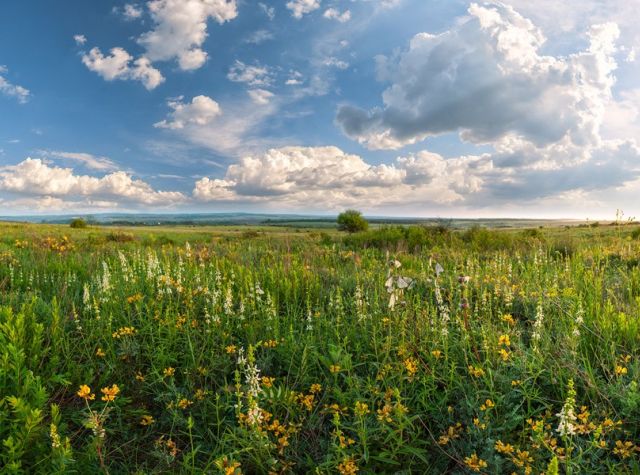
The Khomutovskaya steppe is one of the last patchwork of territories where wild steppe still remains.
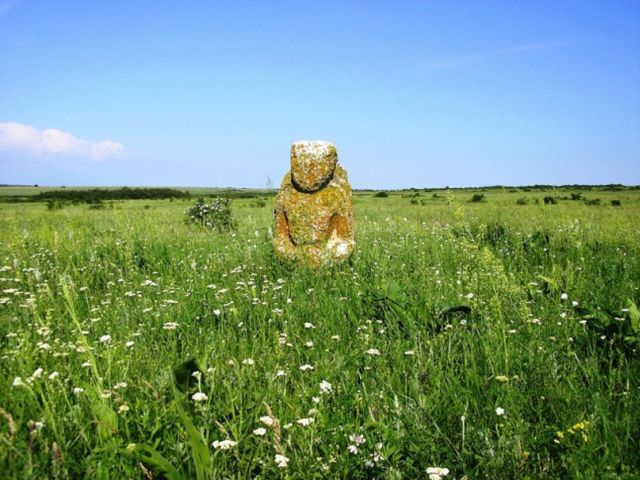
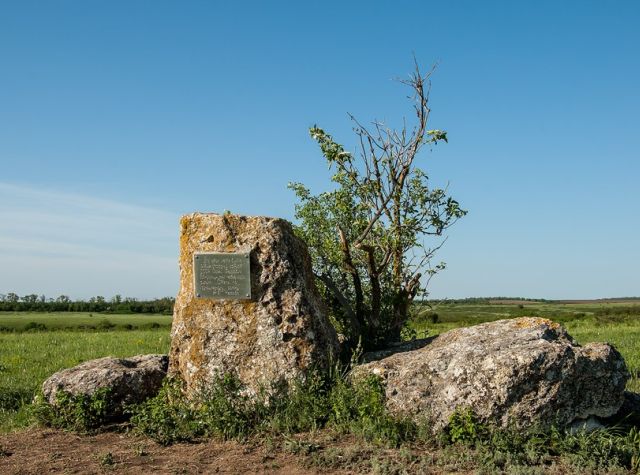
To hear the skylark singing, to see how the crow blossoms and the wattle shimmers with moon silver in the wind, to breathe the blooming steppe grasses, to drink fresh spring water — is it not the greatest gift that native nature gives us! Khomutovskaya steppe serves as a natural standard for studying soils, flora and fauna. Only here you have an opportunity to see the rarest plants, different species of animals. The steppe expanse is made unusual by stone sheep. There are more than 20 of these ancient sculptures on the territory of the reserve.
Khomutovskaya steppe is all that is left of the once vast Wild Field, which occupied the southern part of Ukraine. On its expanses appeared, developed and disappeared various peoples — 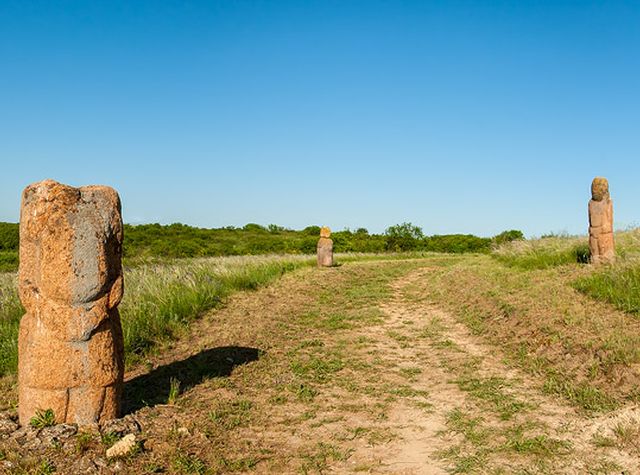 Scythians, Pechenegs, Polovtsians, Sarmatians and many others, who rolled in waves across the boundless steppe, leaving on the mounds sentinels of time — stone maidens. But these idols of the past could not protect the fertile steppe from the man who plowed the land. Today the area of the reserve is 1030.4 hectares, and 90 of them are absolutely reserved area, which has never been plowed and on which for 70 years no cattle grazing and mowing has been carried out. The territory of the reserve is a section of undulating Priazov plain, which gradually descends to the valley of the Gruzsky Elanchik River. The area is cut by the branching Brandtova, Klimushevskaya and Krasnaya beams.
The Khomutovskaya steppe serves as a natural standard for studying soils, flora and fauna. There are 560 plant species here, of which 50 are rare and endemic, 15 of them are included in the Red Book.
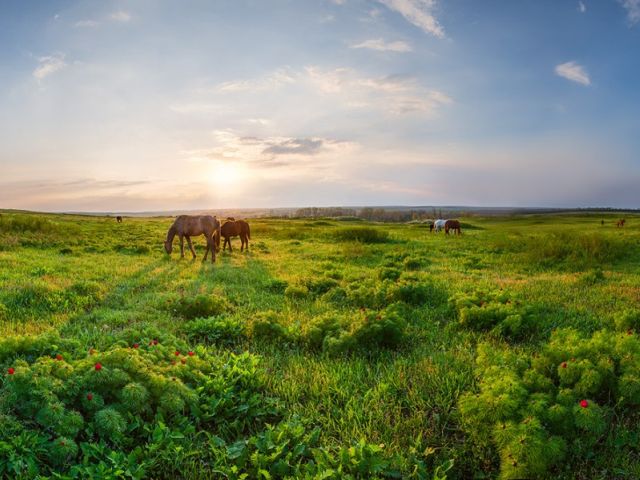
The most typical representatives of the flora are: katran, tulip, violets, almonds, kermek, waddles, wheatgrass, koster, yarsa, forget-me-nots, kashka, goryflower, drosera, caragana, cornflowers, bluegrass, sage and hundreds of other plants. At the beginning of May comes the blooming period of wild peonies («piwnia», as locals say). The whole steppe is covered with bright red spots of flowers and becomes like a rippling red sea.
The fauna of the reserve is also diverse: wolf, fox, raccoon dog, hare, vole, honey badger, urchin, steppe viper, mice, ferret, weasel, lizard, hamster, baybuck, gopher, stripe, toads, etc. The feathered world of the steppe is represented by more than 80 species of birds: partridge, quail, pheasant, ducks, bustard, skylarks, starlings, joulan magpie, barn owls, tits, harriers, steppe eagle, oriole, pipit, kestrel, sedge and others.
 .
.
At present in the Khomutovskaya steppe, as part of a scientific experiment, work has begun on breeding horses and their grazing. This is connected with the problem of accumulation, especially in areas with absolutely protected regime, of litter from a thick layer of dead plants.
In the Khomutovskaya steppe, Sergei Bondarchuk filmed the adaptation of A.P. Chekhov’s «Steppe».
Every year numerous excursion groups of teachers, schoolchildren, students, foreign scientists and tourists visit the Khomutovskaya steppe. This reserve is a must-see!