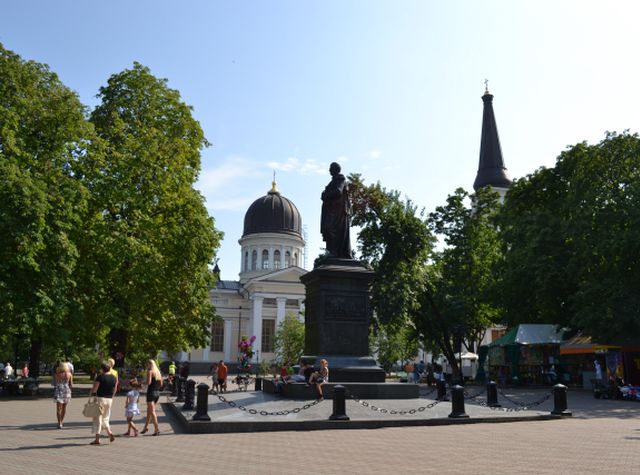
What can grateful descendants do for those to whom they owe much and owe much: Often only remember the names of their benefactors, thus paying tribute to their deeds. So it happened and with the monument to the Governor-General of Novorossiysk region and Bessarabian region, Field Marshal General of the Lightest Prince Mikhail Semyonovich Vorontsov.
The idea to erect the monument belongs to Count Tolstoy, who proposed to create a monument to His Serene Highness immediately after his death at the meeting of the Imperial Society of Agriculture of Southern Russia as its vice-president. The first who made a contribution to the fund for the construction of a monument to the Prince was Emperor Alexander II, who not only immediately approved the Count’s proposal, but also contributed serious money at that time — 3 thousand rubles. And then the money poured in from different corners of the Russian Empire. The sums were very different, and they continued to come to the fund even after the construction of the monument was completed.
 .
.
By the way, to this day in the Odessa State M. Gorky Scientific Library one can familiarize himself with the published «Report on the income and expenditure of funds for the construction of the Monument to His Serene Highness Prince Mikhail Semyonovich Vorontsov«.
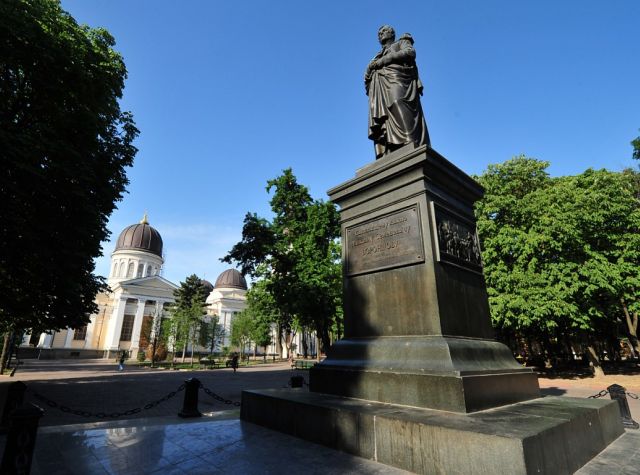
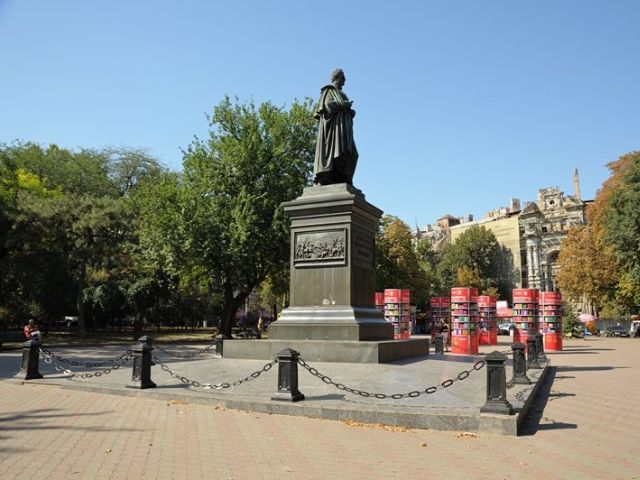
Then began the discussion of the project of the monument. According to the proposal of the members of the Society of Agriculture, it was to consist of a pedestal, a bronze statue and three bas-reliefs depicting the battle of Kraon, the capture of Varna, and the third — agriculture and commerce, which received rapid development under the patronage of Prince Vorontsov. The inscription on the monument was to read: «To His Serene Highness Prince Mikhail Semyonovich Vorontsov, grateful compatriots of 1863».
Soon the project was approved. The project of the monument was ordered to the Munich sculptor Friedrich Brugger, whose work is known to art historians and ordinary Europeans to this day.
In particular, he created the sculpture «Young Theseus, overjoyed by the discovery of his father’s sword» and the bas-relief «Odysseus at Calypso», as well as the statue «Bavaria in a horse-drawn chariot» on the Triumphal Gate in Munich and the tomb monument to the historian Johann von Miller in Kassel. The name played an important role in the choice of the master and the expensive order was given to Brugger, which, in fact, is another evidence of great respect and sincere love of Odessa citizens for the deceased governor-general. The master took part in the works on the installation of the monument to Vorontsov on Sobornaya Square and, of course, was present at its opening.
All bronze parts were ordered in Germany, where the work was carried out under the supervision of the Russian envoy in Munich, Privy Counselor Severin. Brugger executed the statue based on the famous portrait of Vorontsov by the Prussian artist Franz Kruger, who painted a portrait of Vorontsov in 1853. This is the latest depiction of the prince and contemporaries noted the striking resemblance that the sculptor achieved.
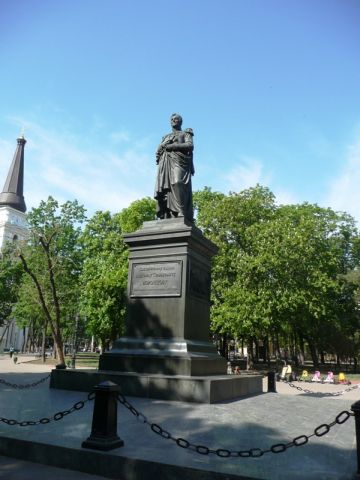
«You will recognize … familiar to you the face of the Prince, always calm, kind and affectionate, but at the same time a face that was constantly illuminated by a bright thought, the thought of doing something for the benefit of your neighbor», was written by one of them.
November 9, 1863 with a large crowd of people the monument to Mikhail Vorontsov was opened. A prayer service was held. Speeches were made. A salute rattled. The monument immediately «took root», quickly became a landmark of Odessa, which remembered the deeds of Vorontsov.
However, seventy years later came terrible times for Odessa. Spaso-Preobrazhensky Cathedral, in which the Prince and his wife Elisaveta Xaverevna found their last shelter, was sentenced to destruction. Red Army soldiers smashed the marble slab, broke the lid of the coffin, which contained Vorontsov’s ashes. The same fate befell the tomb of Elizaveta Xaverievna.
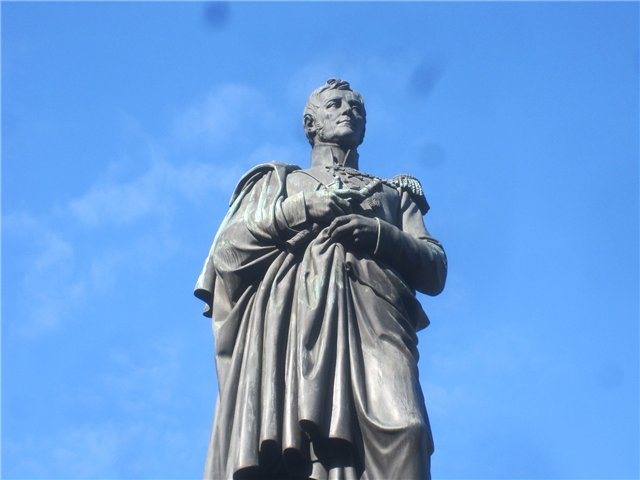
The monument, as well as the monument to Catherine, decided to demolish, but the chain around the monument and attached to a powerful tractor simply broke. So the Soviet authorities did not manage to tear down the monument. It stood…
Only in the late eighties of the twentieth century Vorontsov began to «return» as he really was: a major historical figure, whose contribution to the development of the state as a whole and Odessa, in particular, is inestimable. The first books about him appeared.
Cathedral Square has changed its appearance. The Spaso-Preobrazhensky Cathedral, whose parishioner were Mikhail Vorontsov and his pious wife, was reborn. The ashes of the Serene Prince and Elizabeth Xaverevna returned under the vaults of the temple, and modern Odessa thus paid tribute to the one to whom it owed so much, and the figure of Mikhail Vorontsov rises above the square, preserving the city in which he and his wife invested so much effort and labor.