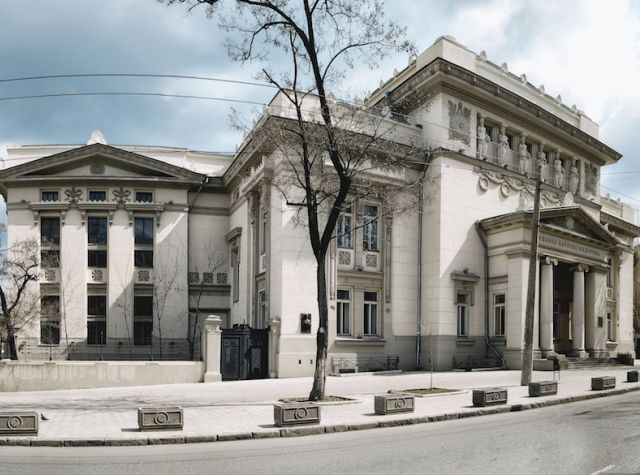
 . Gorky» />
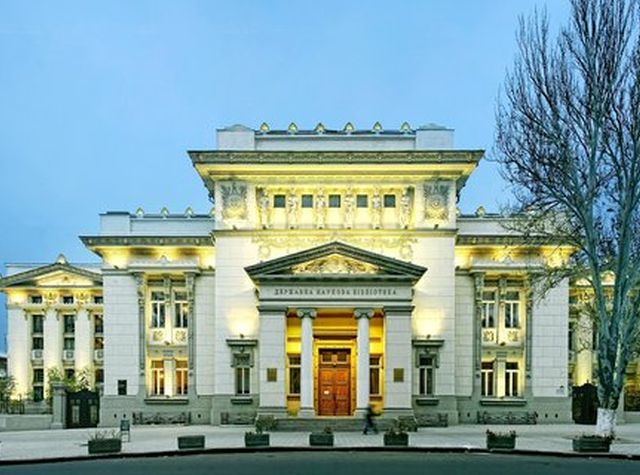
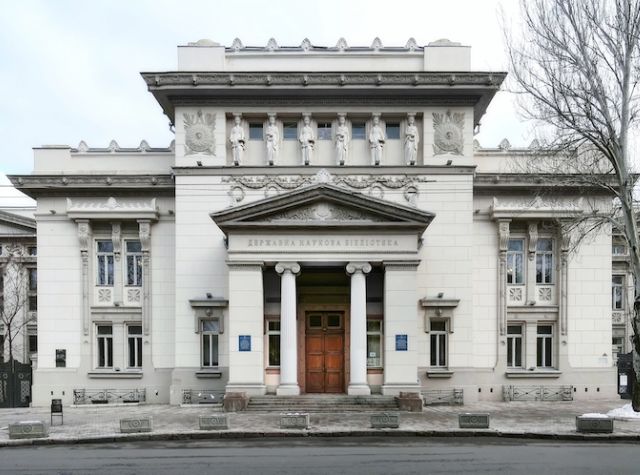
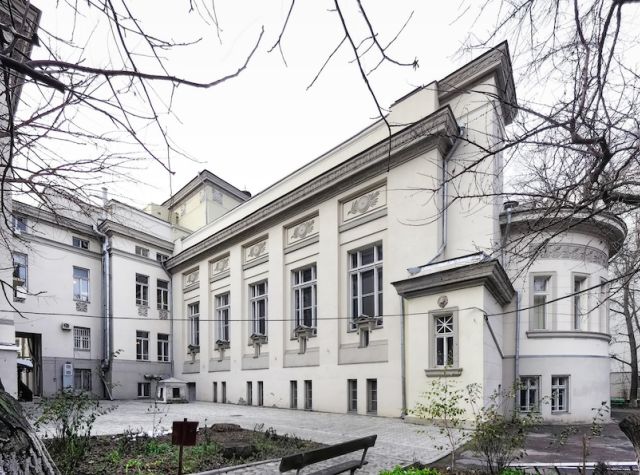
The City Public Library was built in 1904-1906 according to the project of architect F.P. Nesturkh. In front of the facade of the building of the original drawing fence with gates, and behind them a small palisade.
The very history of the library is remarkable. It was founded back in 1829.
From the first years of its existence the library was considered as the central one in Novorossiysk region. At first it was housed in the town house on Primorsky Boulevard (right semi-circular building, if you look from the monument to Richelieu).
The library was created at the suggestion of Count Vorontsov. Emperor Nicholas I issued an order that allowed to open the City Public Library in Odessa. It was the second public library in the Russian Empire (after the Imperial Library in St. Petersburg).
 .
.
M.S. Vorontsov made a great contribution to the library. He gave the library 600 volumes of French classics in a luxurious edition by Firmin Dido. The governor’s example was followed by rich citizens of Odessa, and the number of books in the library began to grow rapidly.
In 1831, all Odessa printers and lithographers were ordered to provide the library with two copies of all printed editions.
The collections of Count M.M. Tolstoy (more than 40000 editions), G.G. Marazli (10 000 volumes), the collections of Professor V.I. Timonov (1085 books and brochures), A.A. Borzenko (851 items), the library of archeologist P.A. Burachkov (3176 volumes) and others were of special value.
Foreigners also donated, including the libraries of Paris, the library of the British Museum, the library of the U.S. Congress and others.
As the funds of the library grew rapidly, in 1883 the library moved to the newly built on the funds of G.G. Marazli building of the Society of History and Antiquities on Langeronovskaya Street (now the building of the Archaeological Museum).
In February 1907, after the consecration of the newly built building, the library moved into its own building.
The building was constructed according to the latest library technology.
Here is how G. Moskvich describes the library in his Guide to Odessa for 1909. «In 1907, the city was enriched with a new grandiose building of the city public library… built in a strictly maintained New Greek style, interpreted in modern taste.
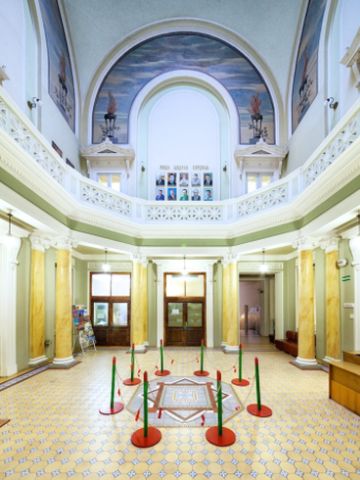
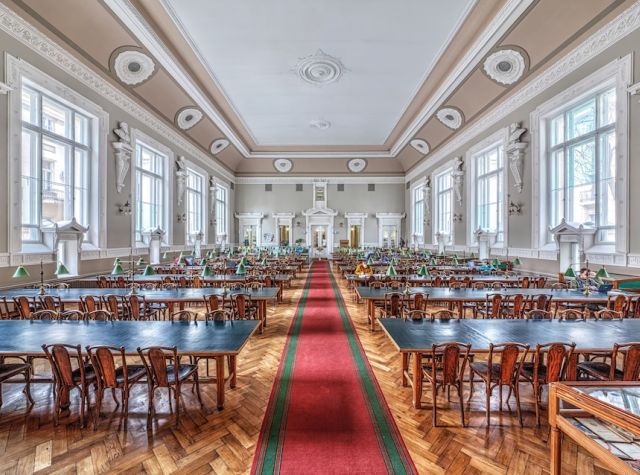
From the outside, the huge building with a small projection in the middle part and a small colonnade, decorated with relief figures, altars and other attributes of the style, loses a little from the fact that it is placed not on the square. Inside, however, it is magnificent. The front entrance, with a small vestibule, leads to a rather large vestibule for undressing. From the vestibule there is an entrance to a magnificent domed anteroom, illuminated from above. This is a large square hall, decorated with a group of massive columns, giving it an octagonal shape; the columns support beautiful choirs forming a circle; above the choirs is a glazed dome with a sky-painted ceiling, with altars and other details of style. At the entrance to the anteroom, — on the left is a large room — a niche with special devices for catalogs, on the right — in the same niche — chairs, where books are issued. From here is the entrance to the main reading room, striking for its size, abundance of light, softness of style and modest, without figures, decorations. The 10 huge windows on both sides of the hall flood the room with light at a great height;
 . Gorky Scientific Library» />
At the bottom of the windows, at the level of the reading desks, are cut through more small, beautifully framed windows throwing light directly onto the reading desks. On the walls, on 8 elegant brackets are busts of great Russian writers by the young talented sculptor Grinshpun. The hall ends with a vast semicircular niche, separated by a beautiful colonnade and flooded with light; this is the ladies’ room.
The hall has a capacity for 350 visitors, which gives a total of more than 2000 persons during the day. The hall has 19 special systems of graceful tables, presenting every comfort for study. Among the attractions of this hall are the portrait of the Emperor Nicholas I, under whom the library was founded, and the portrait of the Emperor Nicholas II, which is a copy of the portrait of the famous painter Repin, reproduced in his workshop, with his participation. Another attraction is a mathematically correct astronomical electric clock, the only one in Odessa, arranged by the university mechanic I.V. Timchenko.
Of particular interest in technical and constructional terms is the book department, which is the latest in library technology; it consists of 7 vast tiers, of exactly the same equipment and completely isolated in fire terms from the other sections of the building. There are no bookcases, and the books and folios are placed on special, very cleverly designed, metal racks across the entire height of the building and installed with mathematical precision, as the racks have holes in which shelves of different widths, depending on the size of the books, are fixed, which can move according to the height of the books. The peculiarity of this book depository is that with this design there is no need for ladders, which are very tiring service staff. The books are fed into the book room through a special kind of «elevators».
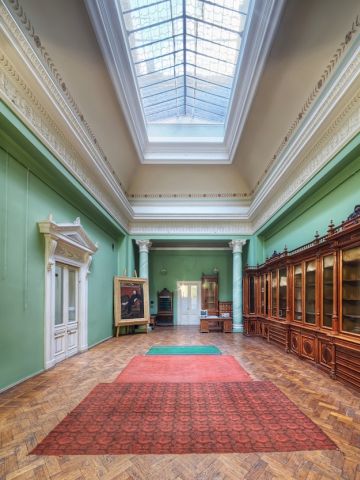
Of the other independent departments of the library, the elegant and vast hall of the upper floor deserves special attention, which is intended for the library museum, where rarities of the library, paintings, etc. are placed in special showcases, cabinets and on special devices.
 .
.
This hall is illuminated from above. Also of interest is an extensive room that houses everything related to the history of the library. Further, a number of other offices are noteworthy. The offices of the library trustee, librarian, assistant librarian, smoking room, restroom, doublet, unpacking room, etc., are also noteworthy.
The whole building is heated by an improved system of steam heating (with warm air) and is lighted by electricity….
No other city in Russia, not excluding the capitals, has such library buildings».
On September 17, 2009 by the Decree of the President of Ukraine the Library received the status of a national institution and changed its name. Now it is «Odessa National Order of Friendship of Peoples Scientific Library named after M. Gorky».