 In the very center of South Palmyra there is Brodsky Synagogue — one of the most remarkable buildings of the city, the most vivid symbol of Jewish Odessa.
Many notable pages of the city’s history are connected with this building, and the people who visited it and prayed within its walls made the glory and pride not only of Odessa, but also of many European and American cities.
It received its name from the community of natives of the western Ukrainian city of Brody (then in Austria-Hungary). In Brody, located on the border of Russia and Austria-Hungary, border trade (and smuggling) flourished, so the natives of Brody were characterized by business acumen and financial success. In addition, the Brod Jews were «Europeanized» to a much greater extent than their Russian counterparts, and all this led to the fact that in 1841, the Brod Jews who settled in Odessa decided to establish their own synagogue (before that, for almost 20 years, the Brod Jews had rented rooms in city houses for prayers).
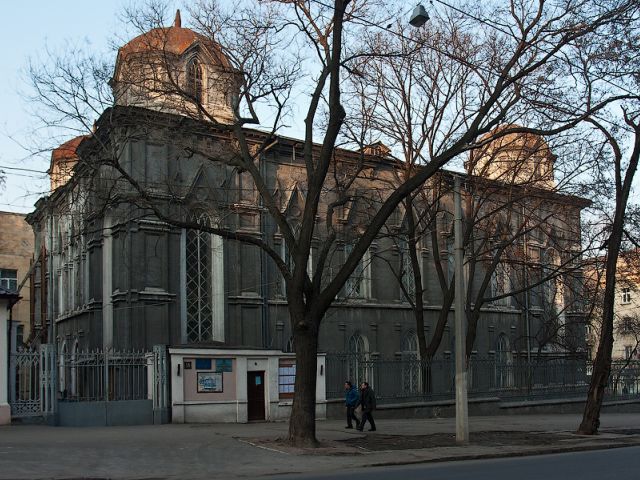 For almost a hundred years the Brod Synagogue served not only as a house of prayer, but also as a kind of cultural center of Odessa Jewish intelligentsia. In addition to wealth and respect in the community of congregants Brodsky synagogue was characterized by a love for the beautiful, in particular for music. The first synagogue organ in Russia was installed here, and the famous performers Nisan Blumenthal (who worked in the synagogue for 55 years!) and Pinchas Minkovsky served as cantors.
In 1863 it was decided to rebuild the building and since 1870 the new building of Gothic-Florentine style (architect F. Kolovich) received the worshipers.
In 1925 the synagogue was taken away from the Jewish community. And if originally the building had a spacious hall with a wooden plastered vault (where the organ was located), then during the Soviet period the building had internal partitions and the second floor was built inside, the entire area of which is occupied by the Odessa Regional Archive, so that only a small reminder of architect Kolovich’s plans has survived to our days.
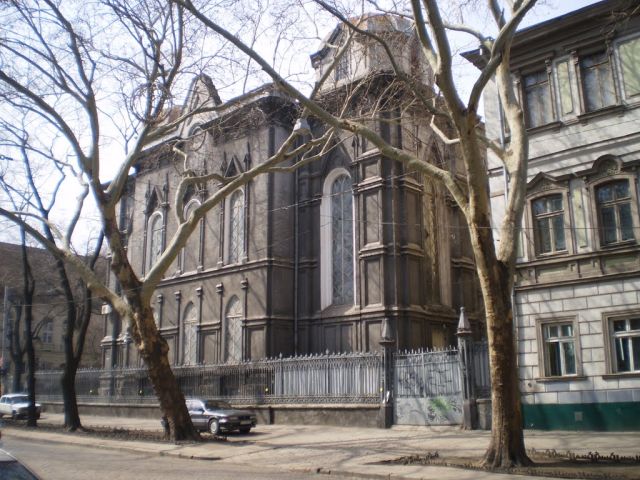 The archive, by the way, appeared in the building of Brod synagogue during the Second World War, when the Romanian occupation authorities moved here the state archive of Odessa region. Before the war it was located in the basement of the church, also taken away by the authorities, but after entering the city the Romanian authorities restored all the churches, and the archive was given a building, which, as they believed, in a few years there would be no legal owners and their descendants.
After the war, the authorities did not change anything, although they «awarded» the Brod synagogue the title of a monument of religious architecture of the mid-19th century.
In August 1985, the Odessa Regional Council of People’s Deputies made a decision № 480 «On approval of the additional list of architectural monuments of local importance», in which the building of the Brod Synagogue was listed under number 146.
However, this did not save the synagogue — in 1988 the building was recognized as an emergency building and has remained so for more than 25 years.
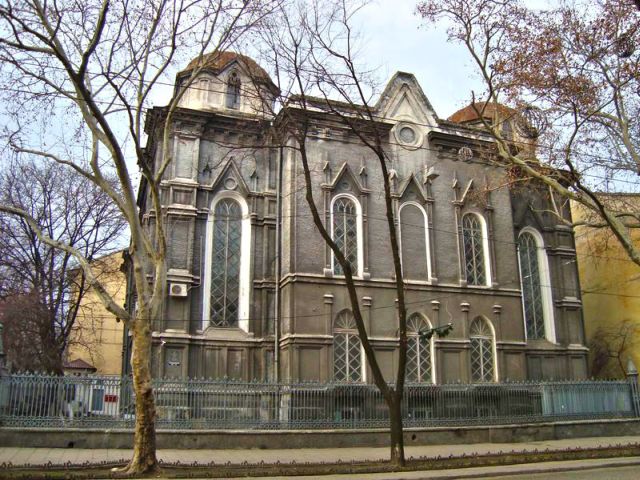 The 21st century began for the Brod Synagogue with a strong shrinkage. Cracks spread like a spider’s web along the walls (both inside and outside), and the plaster on the walls peeled off. In 2003 the last strong subsidence «finished» the building and the bearing beams in the archival vaults bent over. Then the director of the archive I. Nitochko said that «from time to time it still goes underground by 1-2 millimeters». The building smells of dampness and old paper. The building is in a dilapidated state, and the authorities have no money even for cosmetic repairs.
In June 2006 the Ministry of Culture and Tourism of Ukraine by its order #728/16-08 included the synagogue building into the State Register of Monuments of Ukraine, but the building continues to fall apart.
Now the archive is closed for visitors because of the building’s emergency condition.