
Due to historical reasons, many sights of Odessa, and the whole Ukraine, especially the iconic ones, were badly damaged, looted, or destroyed by the Bolsheviks.
In 1936 The Cathedral of the Transfiguration of the Savior, one of the main sights of the city, which was of great importance not only for the citizens of Odessa, but also for the architectural appearance of the old part of the city, suffered the worst fate — it was destroyed.
The role of the Cathedral of the Transfiguration of the Savior in the development of Odessa was huge, and its architectural development reflected the level of development of the city and even the entire region.
Its first stone was laid by Metropolitan Gabriel at the same time as the first stone of the port — in 1795, and the construction was completed in 1808. Over time, the cathedral became the largest religious building of the Russian Empire in the early XX century and could accommodate 12 thousand people at a time. The cathedral became the main temple of Novorossiya, and all the most important holidays were held on Cathedral Square.
The 80-meter bell tower of the cathedral, designed by D. Franolli in 1837, was a landmark for ships sailing to the port of Odessa; it was visible from the sea when the city itself was not yet visible.
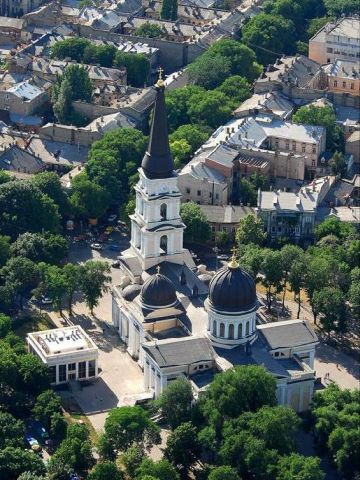
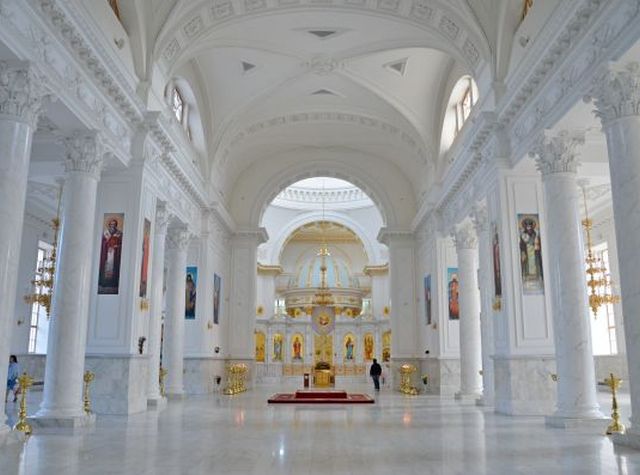
The architecture of the cathedral struck with splendor those who had the opportunity to see the construction with their own eyes, they wrote that it was similar to the basilicas of Europe. The interior decoration was also unique: the floor was lined with white marble, the interior columns were made of the same, the abundance of light and space in the temple made it seem to glow from within.
In the temple were buried Prince Vorontsov and his wife, Archbishops Innocent, Ioannicius, Dmitry and Nicanor, who played a significant role in the development of Odessa. After the destruction of the temple, the ashes of the Vorontsovs were transferred to the Slobodskoye cemetery.
For more than 80 years guests of the city and its residents wondered why there was no cathedral on the Cathedral Square. And only in 2001, work began to restore the lost monument of history and culture of Ukraine.
Today the Cathedral of the Transfiguration of the Savior once again stands in its former place, as if the tragedy of 1936 never happened at all. Its marvelous beauty and grandeur again delight Odessa citizens and guests of the city. The Cathedral Square has regained its sanctuary, and Odessa — the spiritual symbol of the city.
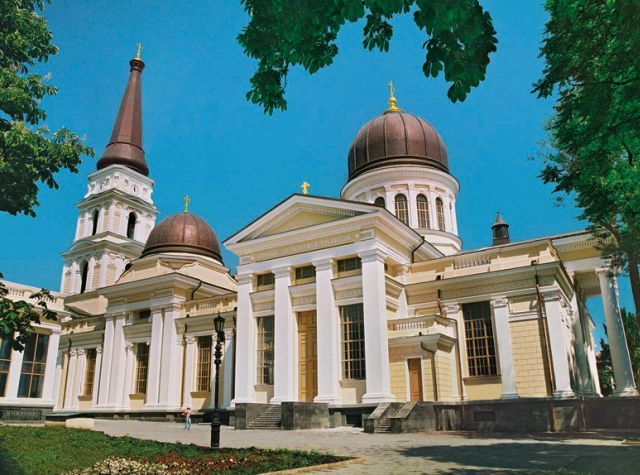
The main rule when restoring the Cathedral was to observe all the parameters of the former destroyed temple, the foundation of which was preserved and served as the main reference point during construction. The architects and builders were also guided by photographs taken after the last renovation of the church in 1903.
In plan the cathedral has the form of an elongated Latin cross, the building has a Russian identity, but at the same time its architecture reflects European motifs in the Empire style, motifs of Greek architecture and Russian classicism.
The bells for the new 77-meter bell tower were delivered to Odessa from Piraeus (Greece). They were cast from high quality bronze with silver added by some of the best craftsmen in the world. 13 small bells and one large bell (the largest in Ukraine) became the largest and most complicated order for Greek masters. The bells are unique, each of them corresponds to a certain note, and there was no lack of high technology — the role of the bell ringer is now performed by a computer with 99 melodies.
The appearance of the newly rebuilt cathedral exactly repeats the appearance and interior decoration of the destroyed landmark. The cathedral has two churches — upper and lower — underground (consecrated in honor of the Odessa wonderworker Innokenty), a high bell tower crowned with a cross of gold leaf.
The two-story underground temple can accommodate up to 1.5 thousand people, it has a double-light prayer hall, refectory, choir rooms, and administrative offices. The interior of the lower temple is made in the canonical style, combines Orthodox painting, ornaments of the times of Kievan Rus and Byzantium.
The decoration of the upper temple, as before, is made in the academic style — it is an amazingly beautiful room. The interiors are also bright and spacious, now the temple can accommodate up to 15 thousand people, the columns and floor are made of white marble, and the iconostasis is made of gray-white marble, as before.
Spaso-Preobrazhensky Cathedral also regained all its sacred objects: the remains of the Vorontsovs were returned to the monastery, and the miracle-working icon of the Mother of God of Kasper, painted in the XVI century or earlier (its exact origin is unknown), returned to its monastery again.
Don’t lose the opportunity to visit one of the most iconic sights of Odessa, and you will definitely be surprised by what you see, and your inner world will become even richer.