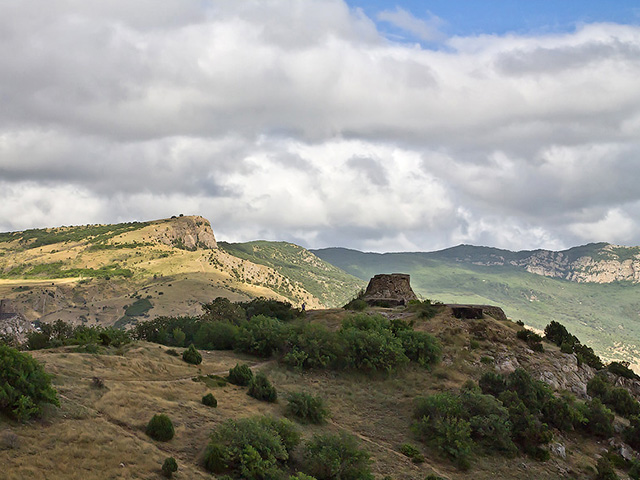
 Balaklava is an ancient and remarkable city in all respects. This polis was founded by the son of the Scythian king Palakom in the II century B.C., and Stalin deprived it of the status of a city by annexing Balaklava as a simple district to Sevastopol. Because of the peculiar shape of Balaklava Bay, which was an ideal base for surprise attacks and successful defense, this settlement has a long battle history.
For example, even Homer in his «Odyssey» mentioned about the locals — Lestrigonians, who stoned a Greek ship at the entrance to the bay. Pliny the Elder called the bay a place of dislocation of the Taurians, who were engaged in piracy and robbery. The excellent fortification qualities of Balaklava Bay were used by Genoese merchants who built a whole system of fortresses on the South Coast, the Turks and the Russian fleet, which won its first battle on the Black Sea in this bay.
Balaklava was no less gracious to the Soviet troops, holding back the Nazi attacks in the most difficult period for the Soviet Union — at the beginning of the war. We are talking about the legendary so-called 19th battery Drapushko. This four-gun battery was installed at the beginning of the last century on Cape Kuran, the extreme point of the western shore of Balaklava Bay. Thanks to it, Russian artillerymen could shoot foreign cruisers and battleships that were 20 kilometers away from them.
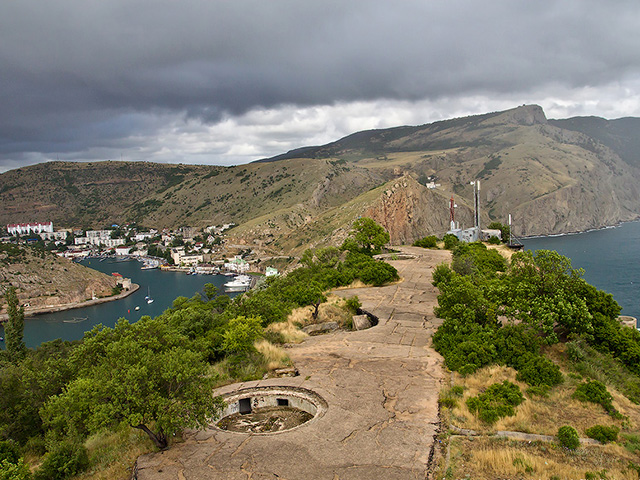 When Germany attacked the SSRSR in 1941, the nineteenth battery was commanded by Captain M.S. Drapushko. In November, his subordinates did not give the opportunity to turn around the fascists, capturing in the Crimea all new and new frontiers. On November 7, for accurate artillery fire Drapushko soldiers were set as an example to all soldiers fighting on the peninsula, and in the city for the battery secured the name «Mamasha», in the sense — the only protection and hope of local residents. By the way, the Germans called the same battery «Centaur-1».
Since November 13, the fascists were closely engaged in Balaklava. Spilia Mountain and Genoese fortress Cembalo were captured. But the six-inch guns of the 19th battery surrendered and shot two battalions of Wehrmacht soldiers, using the rapidity of naval guns over land guns. After that, the Germans deliberately pulled to the area of Balaklava Bay all their heavy guns and «ordered» air support for the attackers. In a day, up to 300 large-caliber shells rained down on the personnel and guns of the battery. Each soldier of «Mamasha» was a model of heroism and self-sacrifice — blind and deafened from the explosions people were loading and repairing guns to their last breath, leading calculations and pulling the trigger cords. For comparison, the 19th battery fired about 2000 shells per day, which significantly delayed the Germans’ breakthrough to Sevastopol.
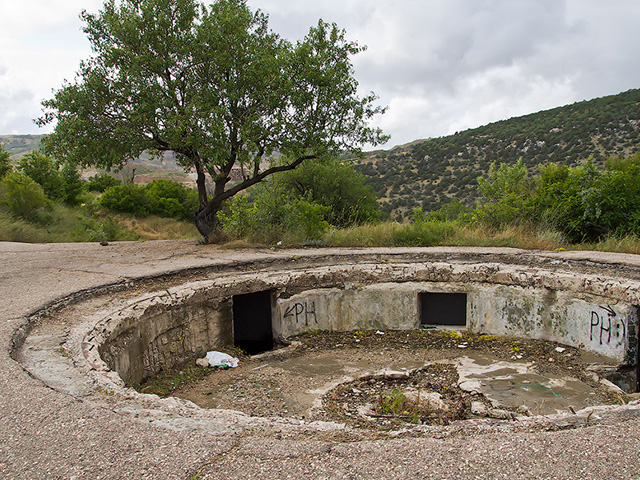 Despite the order of Major-General P.A. Morgunov to blow up the battery during the retreat, the remnants of the personnel under the incessant enemy fire dragged 2 of the 4 remaining guns to the 7th kilometer of the Balaklava highway, from where they again began shelling the Germans. During the third stage of the assault on Sevastopol — on June 7, 1942 (!) a direct hit of an air bomb cut short the life of commander M.S. Drapushko. On June 30, when the shells ran out, the last living artillerymen blew up their guns and withdrew to Cape Khersonese.
After the war, the battery at Cape Kuran was restored. Its main function was to protect against the alleged attack on the submarine base and on «object 100» — another secret underground complex of Balaklava. In it were hidden missile installations, the radius of action of which reached 100 kilometers.
But, in 1999, the command of the Black Sea Fleet of Ukraine «sentenced» the legendary battery to decommissioning. For 13 pieces of silver, or rather for 4 thousand hryvnias, this attraction of Balaklava in 2002 was «uprooted» from the ground and transferred for scrap metal. What the Germans could not do in their time, Ukrainian generals easily realized. The act of vandalism was timed to the 60th anniversary of the feat of arms of the soldiers of the 19th battery.