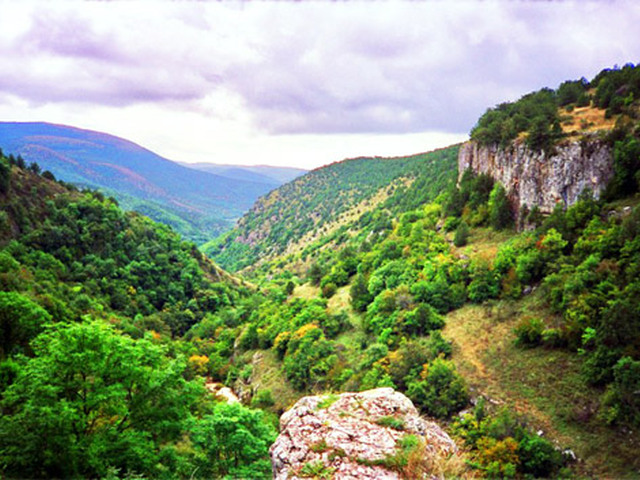
There is a famous canyon in Crimea. And it has a sound name — the Grand Canyon of Crimea. It is known far beyond the peninsula. And who has heard about Uzundzhi River Canyon? Even among Crimeans, not everyone! It is difficult to say why it happened so. It happened historically, and that’s it! There are several canyons in Crimea, but only one has become famous. Maybe the others are worse? No, they’re not worse. They’re just different.
Uzundzha means «quite long» in Tatar. In fact, it is a small mountain river, only 11 kilometers long. It flows down from the mountainsides into the Baidar valley and flows into the Chernorechenskoye reservoir near the village of Rodnikovoi. Uzundzha is not high-water. Its bed is filled with water only in the wet season, especially in spring, when the snow melting in the mountains begins. But summer begins, and its flow becomes less and less intense. At the end of June one can see only miserable streams «creeping» between the rocks, and after another month the lower reaches of the river finally dry up. Now, until the fall rains, there will be water only in the immediate vicinity of the source, further away there are only dry cobbles.
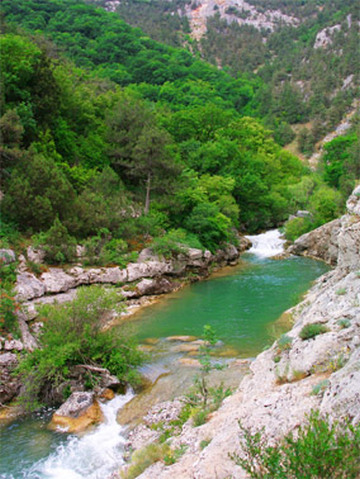
This small seasonal river has made a deep and picturesque canyon on its way in the mountains. It is more correct to say not even one, but two canyons, because in the middle course the Uzundzha flows through a spacious and wide basin, and in the upper and lower reaches it squeezes between steep mountain slopes.
The first canyon begins right after the village of Rodnikovsky. Here along the left side there is a good road, accessible even for transport. During May holidays the road resembles a busy avenue. Groups of tourists and single tourists move there and back. For someone the goal is to pass the canyon, someone is going further, on a multi-day hike through the tracts of Ai-Dimitrii and Tea House to the Grand Canyon, someone just walks around the neighborhood without any sporting purposes, and someone is interested in the Skelskaya Cave, located nearby.
The landscape in the vicinity of the first canyon is peculiar. The outlines of the mountains are gentle, without precipitous walls, the slopes are covered with a soft coat of forest. Landscape of these places reminds rather Carpathians than Crimea. The left side of the canyon is occupied by deciduous forests, the right side by juniper woods.
 .
.
About in the middle of the first canyon is the entrance to the Skelskaya Cave. It was discovered in 1904 by a local schoolteacher F.A. Kirillov. As speleologists later found out, the underground passages stretched for 700 meters, and go into the depths of 90 meters. The lower floors of the cave are watered. During floods, the water level in the cave rises by 10-15, sometimes 35-50 meters. It happens that a stream of water flowing into Uzundzha starts flowing out of the entrance.
Since the cave is easily accessible and located near a settlement, it was willingly visited by numerous amateurs. At the end of the 90’s it was closed, equipped, lighted, and now you can get there only for money and accompanied by an instructor. From the road to the cave is literally a short walk, so if you want, you can diversify your trip with a descent into the underground world.
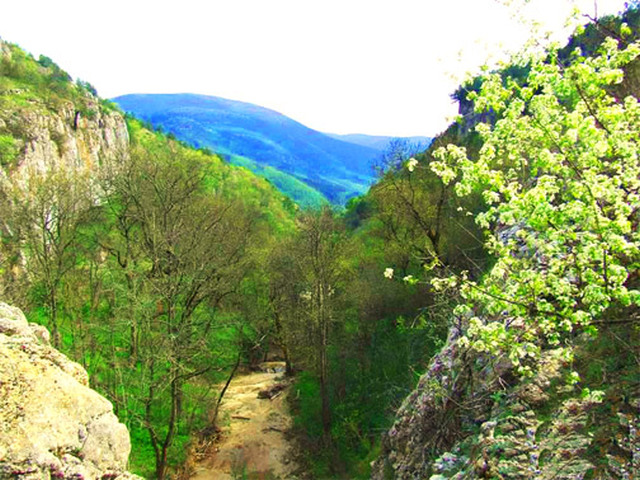
Behind the village Kolkhoznoe the second part of the canyon begins. Here there is no such a convenient road. You need to walk first along the path, and then along the riverbed. In spring, when there are flood waters, it is not easy, but in the second half of summer and in the fall, the riverbed is almost dry and the movement in it is not difficult at all.
 .
.
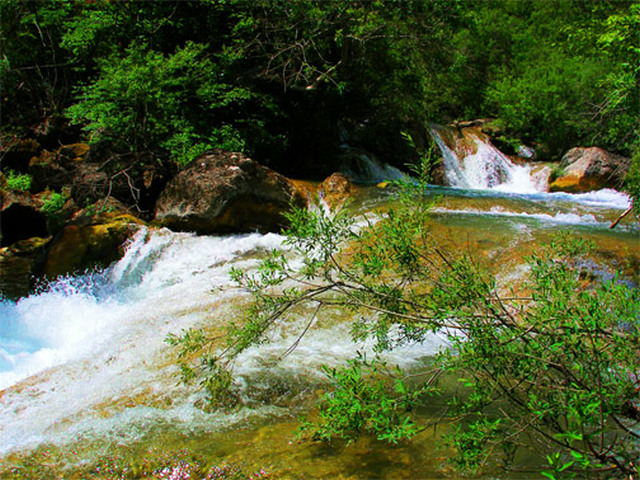
At any time of the year, traveling through Uzunja will be interesting. In spring you can admire the numerous cascades and waterfalls. When there is no water, the stones composing the riverbed are exposed. Their surface is covered with tuff, giving them smooth outlines, and small stones look like koloboks. In some places tuff covers tree roots, old leaves and moss with lime crust. Even an ordinary glass bottle thrown by a careless visitor becomes covered with tuff crust in a few years.
Part of the riverbed is easily traversed, where on stones, where on the bank. On the way there is only one difficult section, where the rocks come close to each other, forming a squeeze, and steep, and in some places, steep walls. To get through here, you need to have some climbing skills, and 10 meters of rope will not be superfluous. In the absence of both one and the other, you will have to bypass the difficult section on the right side. It is less interesting, but safer.
Starting from the clamp, water appears in the channel, even in the dry period. A little upstream is the confluence of the Uzundzha and its left tributary Topshanar.
 .
.
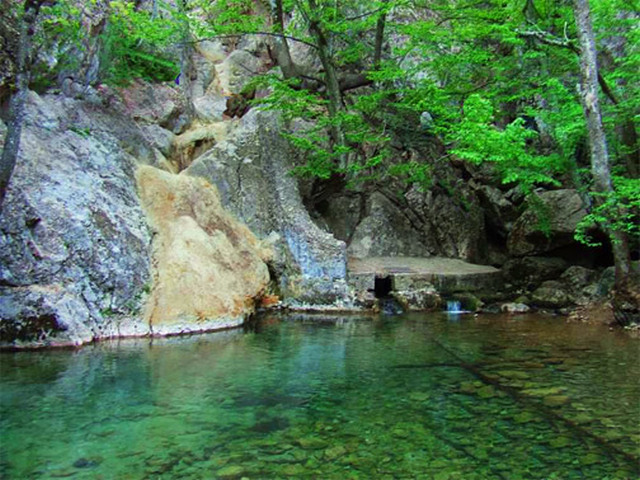
About 500 meters from the confluence of the riverbeds there is a tiny lake filled by the jets of the powerful Suuk-Su spring coming out of a concrete caphole. The water in the spring is cold. Sometimes tourists, having seen the green surface of water after a long crossing, rush to the lake determined to take a dip. But most of them lose this desire as soon as they step into the water. Transparent moisture burns with icy cold. But no one will refuse to fill the tanks with Uzundzhi water: its drinking qualities are excellent.
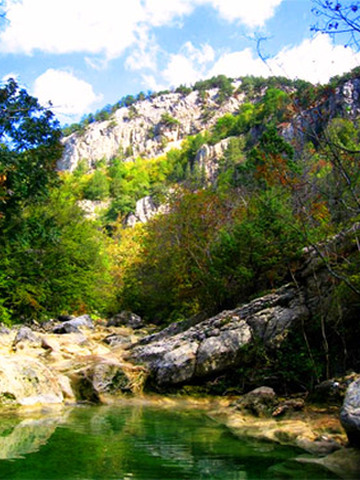
Three meters above the cave is the entrance to the Uzunja cave. Clinging to the twisted roots of an old tree and branches of the same old ivy sticking out of the rock, you can climb up to a small platform above the cave. There, in the left slope of the gorge, the entrance to the cave is blackened. The entrance is narrow, very quickly turning into a low corridor, which will take a long and uncomfortable climb, because the whole cave is a system of passages only 30-50 cm wide. These passages-cracks stretch for a total of 1.5 km. There are no beautiful tinctures here, so if you are not a fan of speleology, the cave is unlikely to be of great interest to you. But it is still worth looking into it without going very far.
 .
.
Above the spring, next to the cave, during the wet season, a cascade of waterfalls falls down the rocky bed. In summer it dries up and where in winter the stream flowed, in the hot season you can see only dry stone smoothed by water.
Thrill-seekers like to climb up the winding bed of the waterfall, riddled with tubs. When climbing up, you should be careful — the smooth surface is not very comfortable for climbing. Above the ledge of the first waterfall there will be the second one, equally uncomfortable. That’s why those who came here to admire nature and not to test themselves, it is better to bypass the cascade on the right side. Further on, for a kilometer, the riverbed remains dry most of the year, flowing in a canyon-shaped valley, clenched by steep mountain slopes.
At the end of the valley, the sides of the river close to form a high ledge, from which a beautiful waterfall comes down in spring. Sometimes it is called the upper Uzundzha waterfall, sometimes the waterfall on the Birinji-Su stream (First Water).
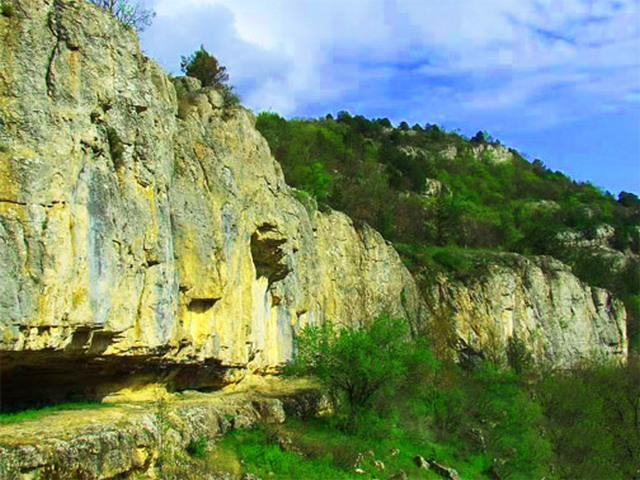
But regardless of the results of our toponymic research, the headwaters of Uzunji are an incredibly beautiful place. It is harsh in winter, when the mountains are covered with a white blanket of snow and carefree in summer. In July, the slopes of the gorge get bright yellow-green color. This is the blossoming of St. John’s wort, which spreads on the slopes in a solid yellow carpet. When you view the surroundings from the cozy lookout on the left bank of the gorge, it seems that you see a piece of paradise in front of you, because the landscape looks so cheerful.
If you move along the left tributary (Topshanar), in 10-15 minutes you can reach a deep bath, above which rises a steep rock wall 20-25 meters high. In spring and after heavy rains, jets of waterfall flow down this wall. But most of the year, there is no water here. That is why tourists call this place the Dry Waterfall.
If you bypass the Dry Falls on the tongue of rash on its left, you can again go to the stream, but already upstream. This part of the canyon, from the Dry Falls to its end, is called Dead Gorge.
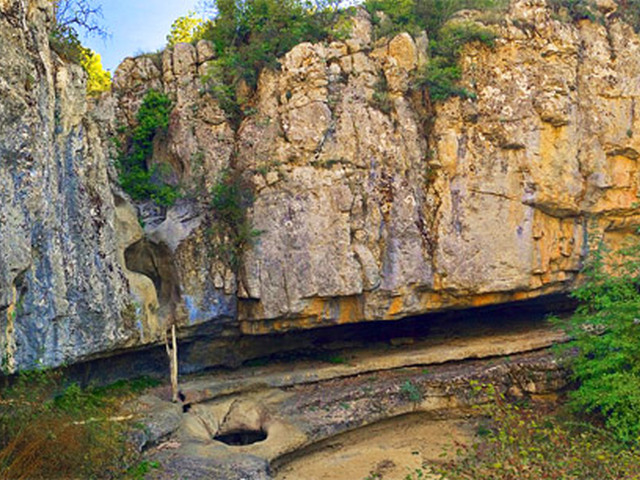
The name is not official, but a tourist name. In the Dead Gorge you have to climb on the rocks much more than in the channel below the Dry Falls, so the way along it is perceived as more difficult. Although, those who have already passed the Grand Canyon (completely), the Dead Gorge will not seem particularly difficult. There are two picturesque places: a dried up small waterfall, the upper ledge of which is overgrown with bright green moss, forming soft fluffy cushions, and another waterfall 10 minutes up from the first one. During the dry season, when there is no water in the channel, its location is recognized by a solid wall of fresh green moss on the left side of the gorge. The waterfalls «Moss-1» and «Moss-2» look very funny and, a little even, fabulous. But it is better to admire them from a distance.
From the second Mokh waterfall it is literally a few minutes to the exit from the gorge.