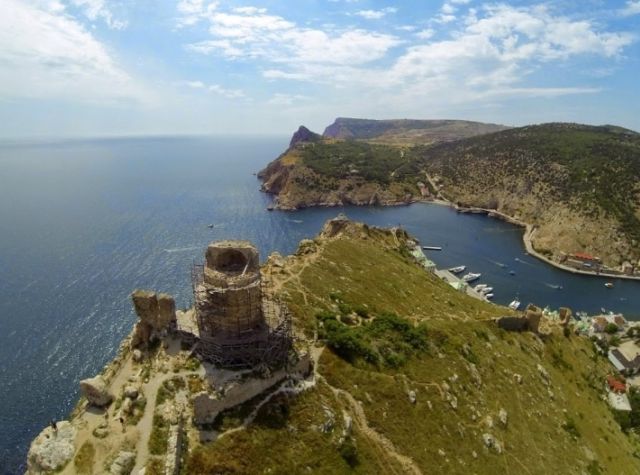
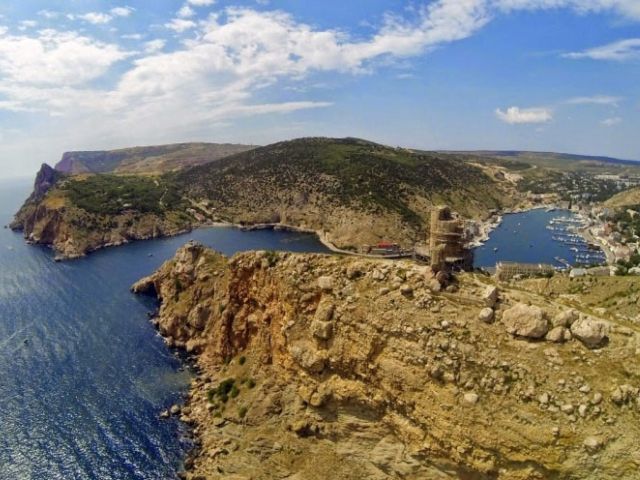
 Cembalo occupies most of Fortress Mountain (Kastron-Greek). Defensive walls «hug» the mountain from three sides, but from the sea side the cliff is so steep that the wall is not required here.
The Genoese captured Cembalo in the period from 1340 to 1357. Having founded a new colony, the Genoese on top of the cliff erected the city of St. Nicholas or the Upper City. It was the administrative part of Cembalo — consular castle, town hall and a small church. The consul’s castle stood on the very top of the cliff. It was a square tower about 15 meters high. In its basement was a water reservoir, which was fed by ceramic pipes from a spring on the slope of the neighboring Spilia Mountain.
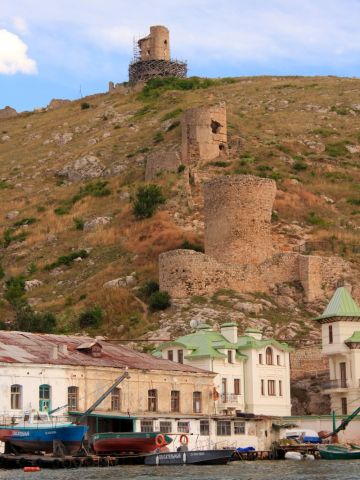 There was another round tower in the citadel, preserved to its full height. In its lower part there was also a cistern for water. There were two floors above — the second was residential, and on the third floor there was a watch. At night, a strong fire was lit here, and the tower became a lighthouse. The walls of the tower were sloping outward. This was a ramming belt, which protected the tower from attempts to break through its walls. Moreover, if a stone was thrown from the top of the tower, it would ricochet with tremendous acceleration straight into the crowd of besiegers.
At the end of the XIII century. Cembalo becomes an important western outpost of Genoa in the Crimea. In the fall of 1433 Mangup prince Alexei captured the city. In June 1434 the Genoese broke into the fortress. The city was looted and destroyed.
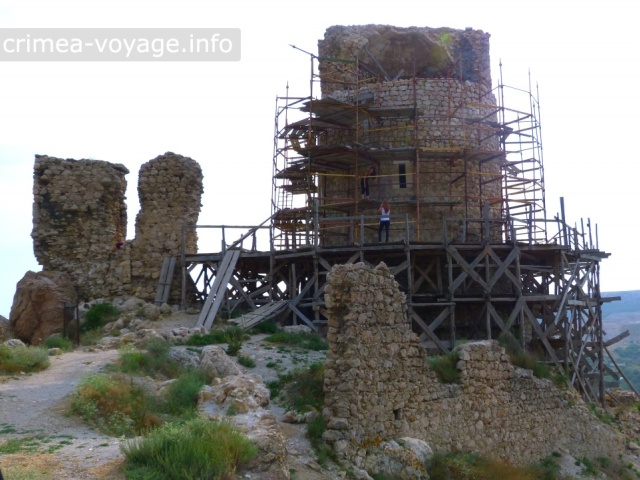 In 1453 the Ottoman Empire captured Constantinople and closed the Black Sea straits for Genoese ships. Weakened by the wars, the Genoese Republic could not help its colonies, so it was forced to sell them to its main creditor, the Bank of St. George. Letting in a course of all means of diplomacy, the Genoese achieved the permission of the Sultan for the passage of their ships through the Straits. In Cembalo reconstructed curtain walls and towers, built new structures and strengthened the wall of the Lower Town (or the city of St. George).
The Lower Town (or St. George’s Town) was surrounded on the western side by a wall with several towers. From the beginning, probably, some of them were half towers — open from the side of the fortress, and during the repair in 1467 they were made «full» towers. 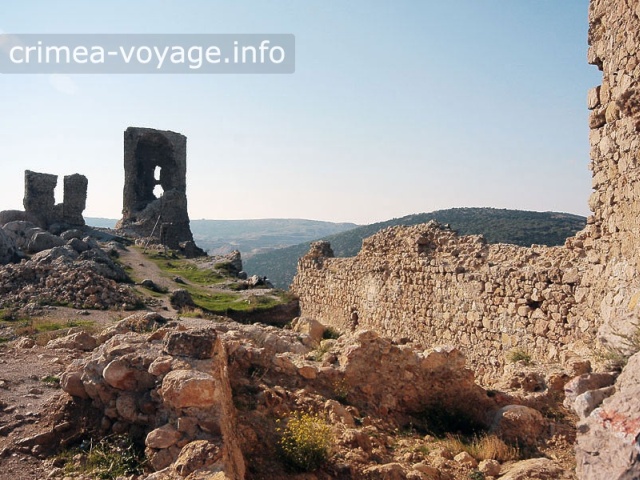 The half-towers were cheaper, and the enemy who captured them could not use the half-tower to fire at the defenders in the city, and was in full view. The top of the tower ended with a parapet with teeth. The defensive wall of the lower tier is worse preserved and requires restoration, just like the fortress towers.
The fortifications of Cembalo are made of local rubble stone on a very reliable lime mortar. It is known that during the Crimean earthquake of 1927, not a single stone fell from the walls of Cembalo. The upper and lower town were connected by a wall, which has been preserved quite well to this day.
 According to the statute of the colony, adopted in 1449, the fortress had 40 shooters armed with ballistae. In each of the fortresses, upper and lower, there was a commandant.
Consuls — rulers of Cembalo — until 1398 were elected for a year from the local nobility, and then began to be appointed from Genoa. The consul had two treasurers (one Genoese, the other from the locals) and an assistant vicar, who was responsible for the trial and reprisal. The consul had a council of eight elders and two trumpeters.
Cembalo, which was under threat of attack Theodorites, was the only fortress in the Crimea, armed with cannons. 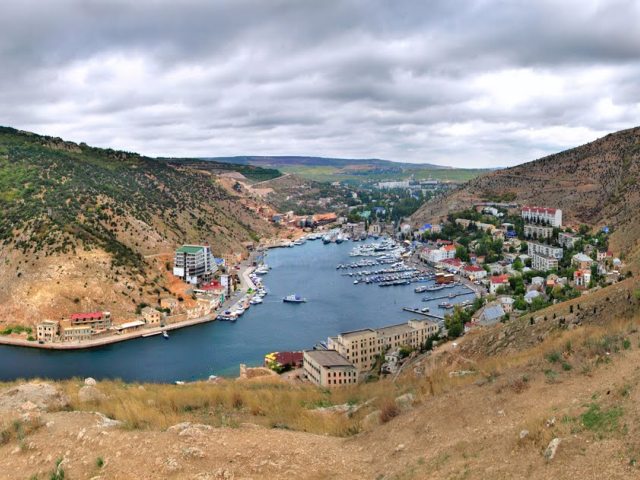 According to the charter of the city, here was established the post of cannon. But in such a small town there was no need for a large number of policemen (arguziev). In Cembalo there were only four of them.
Above the very entrance to the bay in 2001 the remains of a church were excavated, where ossuaries with numerous burials were found.
Nowadays, archaeological excavations are carried out in the Cembalo fortress, which is a branch of the national reserve «Chersonesos Tavrichesky».