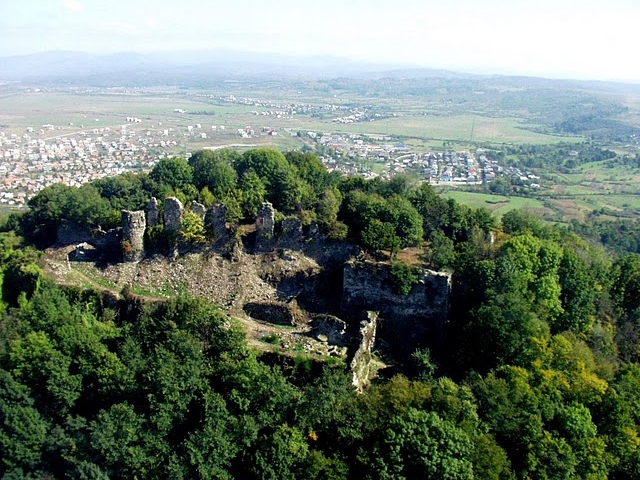
The ancient chateau in Khust, which started the birth of the city, is one of the most interesting sights of Transcarpathia. Remains of walls and defense towers, castle courtyards and houses — every stone of the once impregnable fortress keeps its history and memory of the former greatness of the local lands. Climbing the castle mountain is a fascinating excursion into the past, which will leave a lot of impressions and memories.
According to legends, the first fortress on Chust Castle Hill was built by robbers in times immemorial. The panorama opened from the almost 200-meter high mountain, which stood alone on the vast plain dissected by the valleys of the Rica and Tisa rivers, made it possible to spot trade caravans from afar, which was only to the advantage of the robbers. The massive stone outpost replaced its wooden predecessor only at the end of the 11th century.
In 1090, when these lands were subjugated by the Hungarians, King Laszlo I of Hungary ordered to erect a reliable fortification on a high mountain, which would protect the borders of the empire from the invasions of the Polovtsians and would allow to control the famous salt route along the Tisza River. The construction of the fortress was finally completed only in 1191, and by that time the small town of Khust had already grown at the foot of the mountain. For less than a century the inhabitants of the new town enjoyed a quiet life. The first shock hit Khust and its castle in 1242, when the cruel Tatars invaded. The most famous legend of the castle is connected with this event.
Unsuspecting of the coming troubles, the voivode went hunting, leaving very few soldiers in the castle,
his wife, son and daughter. When he returned, he was horrified: in the half-destroyed castle he found only his daughter alive, who managed to hide from the Tatars, and his wife and son were taken prisoner by those who plundered the castle. Years passed, the castle was restored, but the voivode never recovered from the loss of his wife and son — he swore that he would not leave alive any Tatar who would catch his eye. And one day his soldiers caught a Tatar who had saved the voivode’s daughter from a bear. Without delay, he ordered to cut off his head. And only his daughter, after the execution, was able to explain to her father that this Tatar was his son who had escaped from captivity. Unable to bear the grief, the voivode plunged a dagger into his heart and died next to the body of his son killed by his own order. Since then, the castle mountain has been called Red Mountain — the blood of the father and son stained the soil red, forever leaving a trace of the tragic story.
Tatars in the middle of XIII century really seriously damaged and partially burned Khust Castle, but in 1318 it was rebuilt and strengthened anew. But from that moment the quiet life in Khust stopped: after 1329, the city received the status of royal, to conquer it tried constantly. It passed many times from one Hungarian, Transylvanian, Austrian nobles to another. In the XIV century, even the grandfather of Vlad Tepes (Dracula), who became immortal because of his black glory, knight Drag, owned the castle.
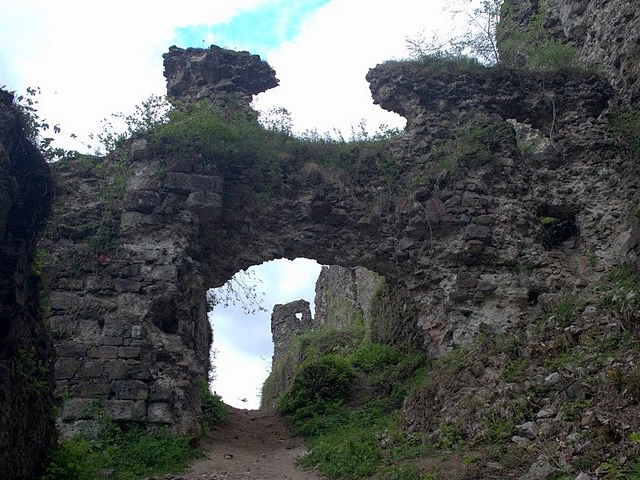
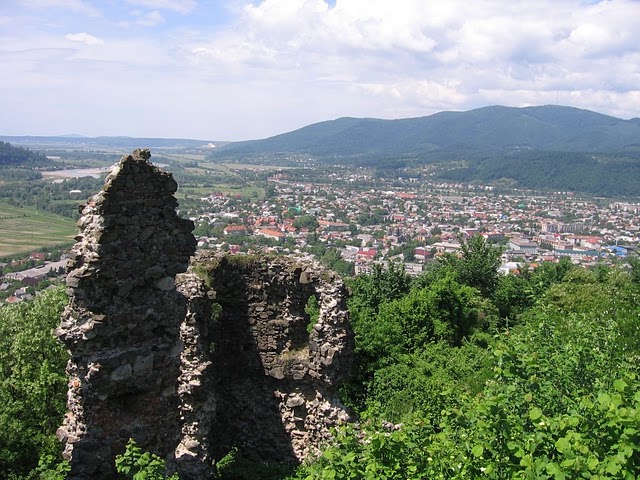
The huge complex of the fortress, with massive walls half a meter thick, was two-tiered, had a lower and upper courtyard. It was protected not only by the sharp slopes of the mountain, but also by moats, several gates, high walls and battlement towers. In case of siege, a 160-meter well was dug in the upper courtyard, and food and grain supplies were stored in numerous outbuildings. Centuries ago, the place was bustling with life. Today, visitors to the castle are greeted by ruins.
 .
.
On July 3, 1766, during a strong thunderstorm, lightning struck the gunpowder storehouse, the explosion seriously damaged the upper castle, and what remained was destroyed by fire. The damage was so severe that the castle could not be restored — from the 18th century it began to fall into disrepair.
Despite the fact that this attraction of Transcarpathia remains only ruins, it attracts many tourists. The stone sidewalks and walls are overgrown with grass, the remains of the castle and buildings are covered with trees, but the castle mountain continues to tell its guests its story, taking them to the distant past, to the disturbing but alluring Middle Ages.
Such sights of Ukraine as Khust Castle, despite time and destruction, remain unconquered, majestic, carry their history and wisdom: perhaps it was the endless bloodshed that was the reason why nature itself decided to destroy the object of human disputes. That is why their visit leaves many people with the brightest emotions and the most exciting memories. Khust Castle tells everyone about its fate in its own way, and to hear and see its history, you should definitely visit it.