 The village of Danilovo is located in the territory of the odious Khust district, formerly part of the Principality of Transylvania, considered the place of the invention of the combine harvester and the epicenter of the formation of Carpathian Ukraine, between the region’s tearing away from Austria-Hungary and its annexation to the USSR.
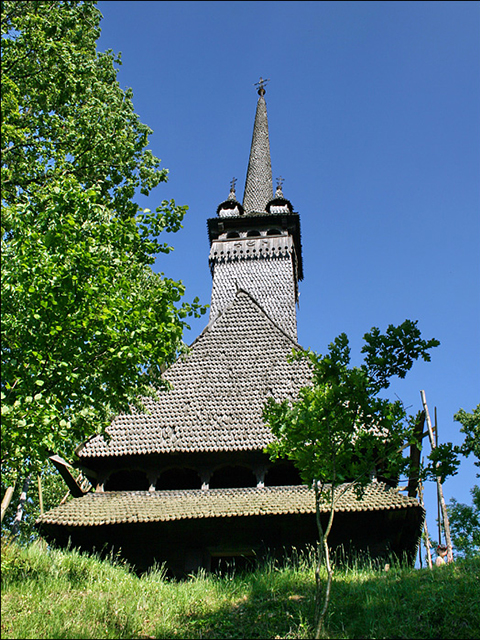
One of the main attractions of Danilov, besides its colorful history and amazing nature, is the local wooden church, built in 1779, at a time when the natives of Hawaii were «finishing» James Cook, the Peace of Tischen was concluded, and Spain was attacking Gibraltar, which provoked the terrible disgrace of the British Lion. At the same time, in the picturesque valley of the Black Tisza, the local Hungarian-Ukrainian community began the construction of St. Nicholas Church, one of the most beautiful churches in Transcarpathia. By the way, it was recognized as a «monument of architecture of the Ukrainian SSR» under the Soviet regime, which served it well, allowing it to retain its original beauty.
The individual features of this sacral structure include its dissimilarity to an ordinary Ukrainian temple. Most likely, it can be compared to the Gothic cathedrals of Western Europe, the watchtowers of the castles of the Transylvanian plateau or the fortified cities of Kievan Rus. Such a militarized and gloomy appearance of St. Nicholas Church in the village of Danilovo is connected with the «somewhat» troubled history of the region itself, located in the place where the Transcarpathian and Verkhnetiska lowlands converge, and which was a transit territory for rock salt transported from Solotvin to the territory of the Hungarian kingdom.
 The St. Nicholas Church was built in 1779. This is evidenced by the carved inscription on its entrance doors. Oak timber was used as a material. This favorably distinguishes the Danilov church from the sacral buildings of other villages in Transcarpathia, which were built using mostly spruce and pine. In addition, it was built on a stone foundation, the mortar of which took more than 5 thousand chicken and goose eggs «torn from the heart» by local gazdyns, i.e. housewives.
The temple consists of two log cabins, the logs of which are connected with logs. Above the babinets is the main decoration of the church — a tall thin tower. It seems that it pierces the Transcarpathian sky with its sharp spire and strings clouds on four pinnacles located at the corners of the faceted top. Under the roof of the log cabin with the tower there is an arcade — it is easier to imagine flirting ladies and gentlemen in medieval clothes than Danilov peasants in homespun attire, but that is exactly how it is. The same associations are evoked by the openwork porch, the carved windows and the arch between the babinets and the nave. The interior of the marvelous temple is decorated with murals painted on the walls in 1828 by the artist I. Kornmaer.
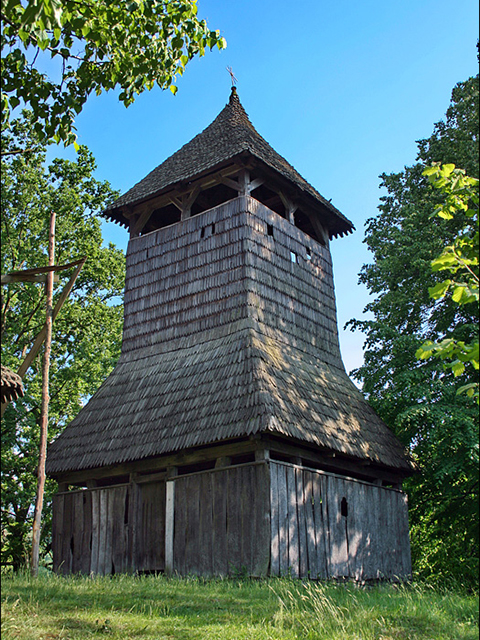
The impression that the church makes on visitors is enhanced by the powerful bell tower. It bears little resemblance to the traditionally elegant European campanelles. This bell tower is massive, two-tiered, covered with shingles and seems to be an eerie, sprawling monster guarding the peace of its semi-Gothic lady.
Unusual for Ukrainian land, the church and its beast-like bell tower underwent a quality reconstruction in 1968, so they are among the best examples of wooden churches of the Carpathians of the XVIII century. Though they are not alone — the local Khustovsky and Vyshkovetsky castle are just as well-preserved and bear little resemblance to traditional Ukrainian fortifications. More like Dracula’s nest. You can see for yourself by organizing your holiday in Khust.