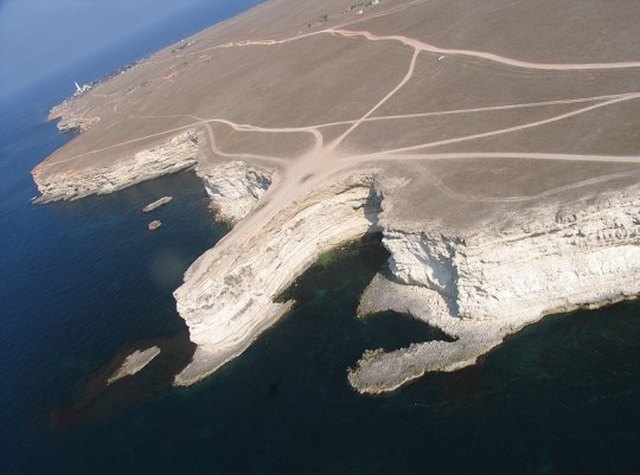
Each of us has our most unforgettable place. The place that you sometimes dream about at night, that you want to return to time and time again. Surely for you will be such a place Tarkhankut. In the common speech of tourists under Tarkhankut means the village Olenevka, and the mys Tarkhankut and the sprawling precipitous coastline, and Dzhangulskoe tract. That is, everything that is located on the Tarkhankut Peninsula.
Where is it, the mysterious, magnificent Tarkhankutsk peninsula? On the extreme western part of the Crimea.
Probably one of the few places, on the seashore of Crimea, unaffected by civilization — Cape Tarkhankut…
This part of the peninsula is the least developed by tourists and vacationers, there is poorly developed resort and tourist infrastructure. Accordingly, there are far fewer vacationers than in the traditional resort and tourist centers of Crimea. This is what allowed the nature of this region to preserve its pristine beauty and purity. Today it is the most ecologically clean water area of the Black Sea.
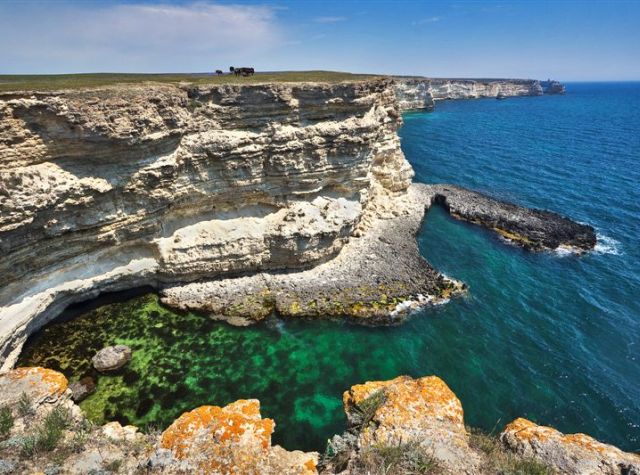
Located on the Tarkhankut peninsula, the cape of the same name is the westernmost point of the Crimean peninsula with enchanting rocks, caves, the clearest sea, mysterious underwater world, relentlessly attracting fans of outdoor activities and extreme tourism.
The most unusual thing on Tarkhankut is the sea. Such a clear, bright sea on the North Black Sea coast is not found anywhere else. And the inhabitants of the sea, not being modest, not shy and not afraid, show themselves and their home to all comers. If you go to Tarkhankut, be sure to take a mask and snorkel, it will allow you to plunge into the wonderful world of the sea.
And if you dream to know the sea and deeper, then on Tarkhankut you can do it for a reasonable fee. After all, the best, most experienced divers of Ukraine are going to dive there. Tarkhankut is a place of passionate strong people.
Transparency of sea water allows you to hold competitions in underwater photography.
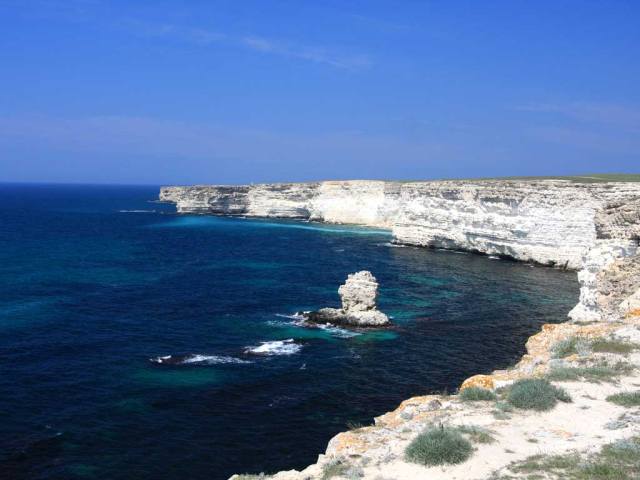
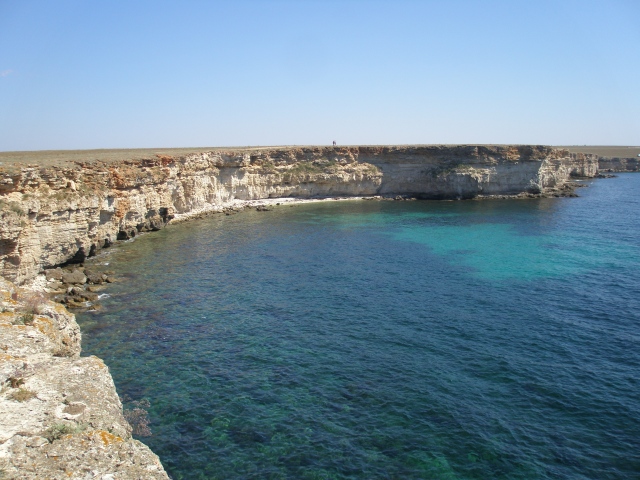
The coastline of Tarkhankut is also of unusual beauty: strictly vertical lines of limestone cliffs that drop down to the sea. It seems that the boundless steppe, heated under the Crimean sun, decided to bathe and immediately, without delay, jumped into the cool waters of the sea.
When traveling by car, in 15 minutes, you will get from Olenevka to the Big Atlesh. Before you opens an unusually beautiful picture: snow-white 40-60-meter coastal cliffs, yellow beaches in small cozy coves, blue sky and sea, greenish-white caves and grottoes. The coastline here curves in an arc, forming small bays. It is hard to imagine, but white rocks, limestone deposits are the bottom of the ancient sea. Here you can trace how sedimentation (the process of deposition on the bottom of the sea or lake of the remains of organisms living on the bottom and in the water mass, as a result, over time from these remains of sedimentary rock is formed) in the remote geological past. The rock sections above sea level are younger.
Boulders detached from the shore rise bizarrely above the water.
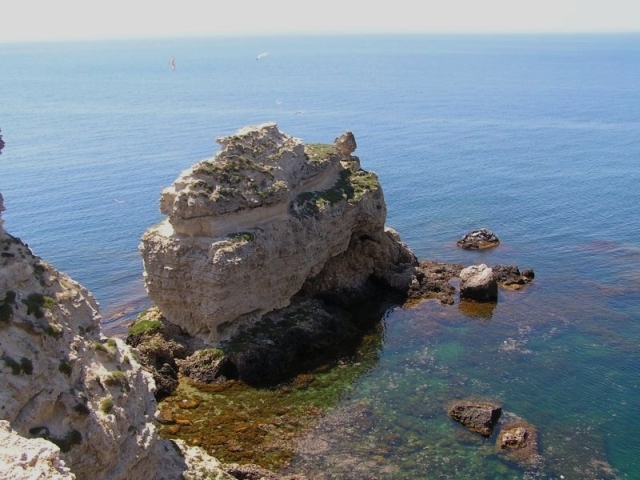
One of these rocks goes by the name Turtle Rock. At the western end of the Big Atlesh Bay a rock protrudes into the sea, in which waves and winds have broken through a huge Arch — the symbol of the Big Atlesh. There is a metal staircase leading to it, which was built recently. Not far from the Arch another two-step staircase, which in ancient times was cut down in the limestone by unknown creators, falls into the sea. The main heroine of the movie Taman (based on the novel of the same name by M. Y. Lermontov) went down it to the boat. The lower part of the staircase was collapsed by the waves. Not far from the Arch there is a grotto, which has a peculiar shape. Episodes of the movies «Amphibian Man» and «Pirates of the XX century» were filmed here.
Atlesh is divided into two parts: Big (located 6 km southeast of Olenevka) and Small (one kilometer from the Big). The name Atlesh comes from the Persian word atesh (fire). The name is obviously connected with the fact that from ancient times on the coast of precipitous rocky areas laid out fires, which in inclement weather and at night indicated the way to the coast for ships. The rocks of Tarkhankut are very dangerous for seafarers, and the coastal waters can quite rival the water area of Sevastopol and Kerch in the number of sunken ships. At the same time, since ancient times, the small bays of Atlesh have served as a safe haven for pirates and smugglers.
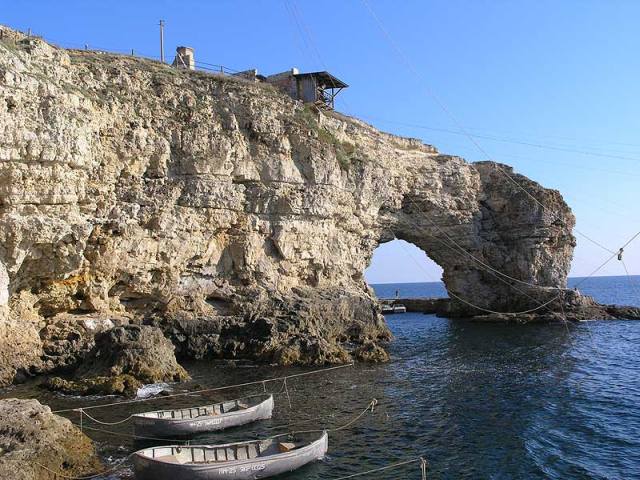
Between the capes Bolshoi and Maly Atlesh there is a three-kilometer cliff of Sarmatian limestone. It can be easily recognized by the changed color of the stone. Before that the cliffs were yellow, yellow-orange in color. And between the capes Big and Small Atlesh clumps of milky, almost white, color. And the whole coast is full of caves, grottoes and bizarre blocks.
On Malyi Atlesh the attention is attracted by a colossal 98-meter tunnel, broken by waves in the thickness of the cape. The height of the tunnel from the water level to the top of the vault is 8.51m, the thickness of the vault is about 10.7m. This is an amazing natural formation, traveling through which is breathtaking. The hero of the movie «Pirates of the XX century» goes through this tunnel to the pirate island. The fishermen of Atlesha used to be uncomfortable with the fact that they had to drag the caught fish up the steep and dangerous stairs on their shoulders. They came up with the idea to punch a wide vent into the tunnel from above, which made the fishermen’s work much easier. Now the boats with fish entered the tunnel and there they piled them into large baskets, which were easily pulled through the vent to the surface of the ground by means of a gate. You can see the tunnel opening, or in other words, the through-well on the surface of the earth, by swimming through the tunnel itself. This fascinating journey can be made on a small boat, an inflatable mattress, or by swimming. From above, the area where the well is located is not fenced, so it is better not to get close to this through hole. Do not throw stones down, remember — there may be people swimming below.
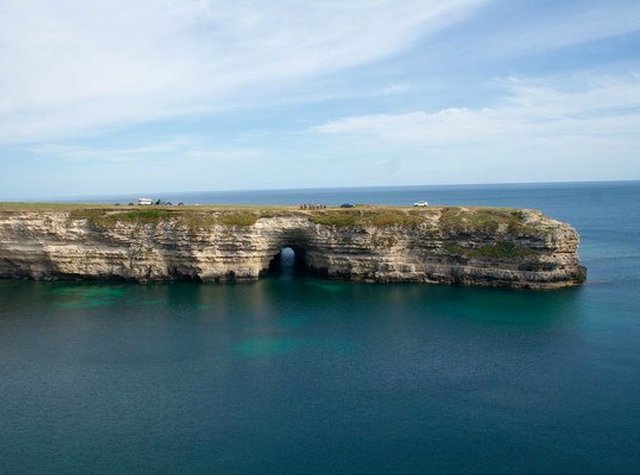
Near the entrance to the tunnel is the lowest in the Crimea 150-meter cave, known to specialists, but not yet explored, its entrance is 10 meters below sea level. It ends with a small hall with a miniature sandy beach. The cave can only be visited in calm weather.
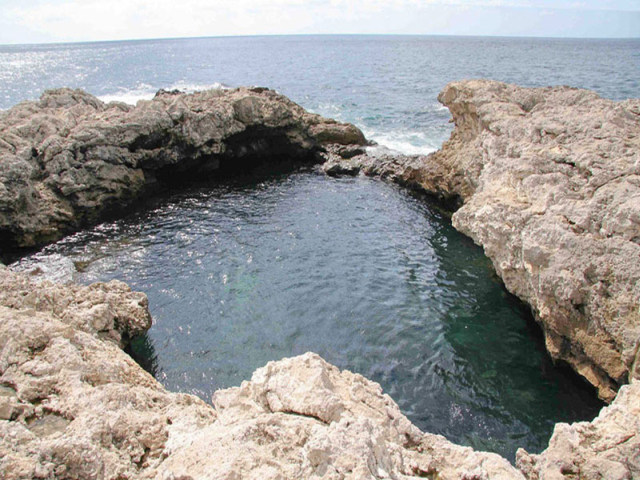
Be sure to swim in the cove — aquarium «Bowl of Love». This is a natural pool surrounded on all sides by stone blocks. And it got its name because of the shape of a heart, which is formed by the surrounding stones and natural rocks. The depth of the sea here reaches 6 meters. With the open sea «Cup of Love» is connected by a small underwater tunnel. The main character of the movie Amphibian Man — Ichthyander — used it to get to his father’s house. Folk belief explains the name of this picturesque site as follows: before getting married, local young people had to check whether their union would be strong. Holding hands, they would jump together into the Cup of Love. If their hands were to break underwater, the marriage bond would not be strong. If not, the union would be strong.
Since ancient times this area has been favored by fishermen. The Atlesh shores have excellent fall and spring runs of mullet and mackerel. On the territory of the Big Atlesh and nowadays there is a fishing camp.
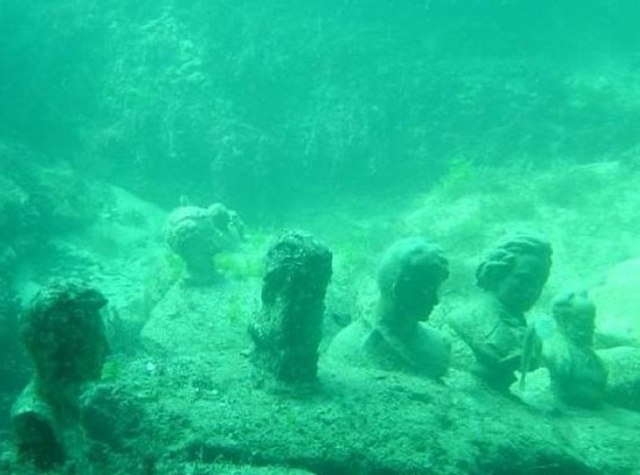
In the area of the Atlesh the water is clean and transparent. The picturesque underwater world beckons and attracts. Amazing and unusual creation created here and people. This is a museum at the bottom of the sea, an underwater gallery of busts — «Alley of Leaders», which is located a hundred meters from the shore at a depth of 12 meters. Scuba divers have embedded busts of Lenin, Kirov, Dzerzhinsky into the rocks… Nearby there is a plate with a record that the museum was opened by Vladimir Borumensky on August 25, 1992. Then the first bust was installed. His endeavor was supported by his aqualungist friends.
Sculptural images of cultural figures, writers, poets, composers appeared next to the busts of revolutionaries. You look with interest at familiar faces: Pushkin, Esenin, Dobrolyubov, Beethoven, Blok, Mayakovsky, Tchaikovsky. And around — piles of boulders overgrown with algae and mussels. There is no such underwater museum anywhere else in the world.
 .
.
The area of the Atleshes attracts not only those who like to relax, sunbathe and scuba dive. Scientists also come here: archaeologists, hydrologists, biologists, paleontologists. Tarkhankut can rightfully be called an inexhaustible storehouse of various scientific discoveries. So scientists-paleontologists in one of the outcrops of limestone found a print of fossil fish inhabited in the distant geological past. The length of the fish is more than 1 meter. Another unique find — a colony of fossil oncoliths (rounded limestone scabs) — the size of individual specimens reaches more than 40cm in diameter. Such a paleontological museum on the Atlesh.
The sea is perceived here in a special way. Harsh in its pristine beauty, it delights and attracts the human eye, at the same time alarms and as if warns of the unpredictable power lurking in it. The light glare of the sun rays crashing on the rocks is intricately reflected in the azure surface of the sea, as if competing with the grandiose shadows cast in the depths of the waves by stone blocks. And near the shore, among the rocks and small sandy islands, the sea surf, subject only to its known laws. In inclement weather, the water boils and foams, the waves slam into the rocks, crashing with great force against the limestone piles. Do not try to compete with the sea element at such a moment.
Tarkhankut attracts more and more lovers of wild vacation every year. However, there are few convenient places for parking here, and the descents to the sea are not very convenient either. But not to visit this magnificent beauty of the coast, to bypass it is simply impossible. The inconvenience of access roads, dusty roads — all this will pay off a hundredfold the positive emotions received. The splendor of Tarkhankut will leave no one indifferent.