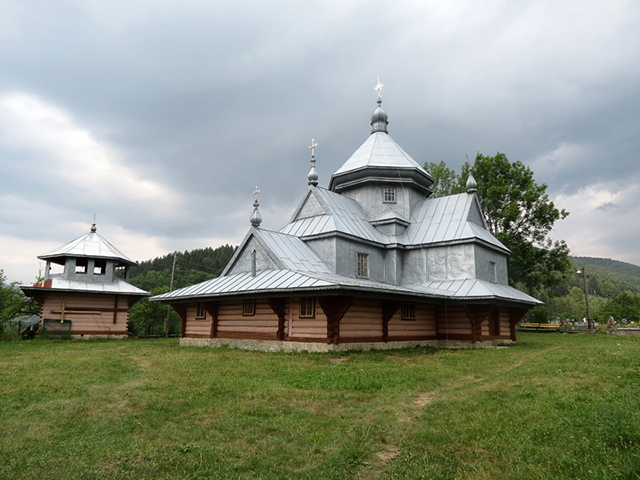
Yaremche is a powerful, almost cult-like resort. It received the official status of a «forge of health» in 1928, under Polish rule. But it was only a paper recognition of its power. After all, the healing properties of this settlement have been exploited by Galicians for a good hundred years, using the combination of mild climate and aesthetic landscapes, drinking mineral water from springs and exploring the cohort of local sacral-architectural sights.
By the way, the town of Yaremche was formed when the latter separated from the village of Dory. This happened in 1902, and today the famous resort has simply devoured its parent, as the mythical Kronos once devoured his own children. Dora itself was first mentioned in 1618, and the name of its «ancestor» Yaremche was given by the owner of the local tavern — Dora Haikini. By the end of the XIX century in the village were built a railway station, 18 villas, 35 hotels, 2 boarding houses, as well as 300 huts, the owners of which provided services of «green tourism». In addition, Dora had a «Senior Citizens’ Club», 2 baths on the Prut, a pharmacy and excursion routes to nearby Yaremche, Mikulichin, Vorokhta and the Chernogorets Ridge. The story of Dora is told not by chance. After all, it was in this Hutsul-Jewish-Polish village of modern Yaremche that one of the most characteristic Carpathian temples was built — Mikhailovsky Church. Sometimes it is also called the Church of Archangel Michael.
In the eve of the four-volume «Monuments of Town Planning and Architecture of the Ukrainian SSR» Michael’s Church is called the oldest sacral building of Dora. It was built in the beginning of XVII century by unknown masters, and in 1844 it was restored and enlarged by one V. Gnyshyk. It was depicted on old Polish postcards many times to lure the public to vacation in the area.
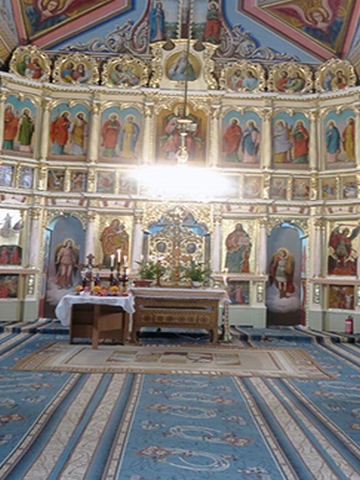 When you look through black-and-white postcards, fresh photos or admire the Church of Archangel Michael in person, you will notice that it has a clearly defined shape of a Greek cross, single-domed and made of wood. A vestibule adjoins its voluminous babinets. The whole structure is surrounded by a vestibule, which should protect the foundation and parishioners from heavy fall rains. The church preserved a unique, carved iconostasis and several icons, the age of which exceeded three hundred years. Inside the temple is painted with ornament, in which there are plant motifs and clearly expressed pagan symbols. In the ХІХ century a campanella with a bell kept company with the temple. Even under the Soviets, the most hustling boys of Dora climbed the bell tower on Easter and rang until their hands fell off. But in 1970 the bell tower was deliberately set on fire, and the bell melted in the fire.
By the way, even under the Soviet Union, the Church of Archangel Michael was functioning, not turned into a warehouse or another museum of atheism. Among its shortcomings, connoisseurs of sacred buildings, include the tin roof, which replaced the blackened shingles, and its location in the middle of a functioning cemetery.
Among the sights of Yaremche, St. Michael’s Church does not look like an orphan. It is ancient, wooden and is an excellent example of Hutsul architecture. Coming to holiday in Yaremche, you can attend the service in this ancient temple. The place here is mothballed, so communication with the Almighty can be as effective as at Jerusalem’s Wailing Wall. Such are Karpaty — nature pleases the eye, water heals the body, and local temples can soothe and heal any soul.