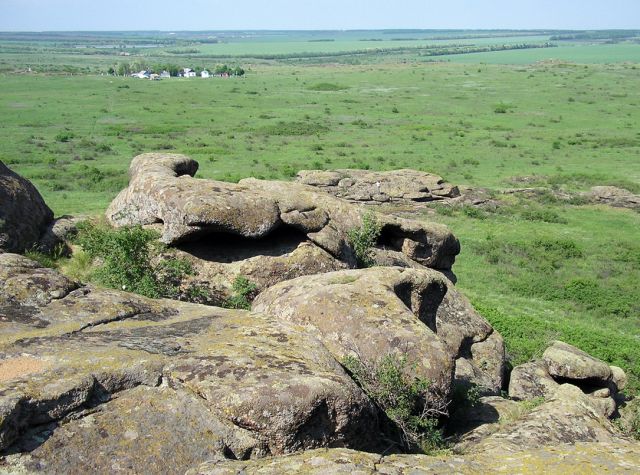
The Stone Graves Reserve is one of the oldest cultural monuments in the history of mankind — it is more than 12 million years old.
This reserve is located mostly in Volodarsky district of Donetsk region near the village of Nazarovka (300 hectares), and about a hundred hectares of it fall on Kuibyshev district of Zaporozhye region along the right bank of the river Karatysh, the left tributary of the river Berdy. The reserve was founded in April 1927, and received the status of reserve in 1961. In 2008 the reserve «Stone Graves» was included in the Top-21 of the all-Ukrainian competition «Seven Natural Wonders of Ukraine».
Stone Graves was once called Bestash-Gora (the word «Bestash» is Turkic and means five stones, respectively five main granite humps of Stone Graves).
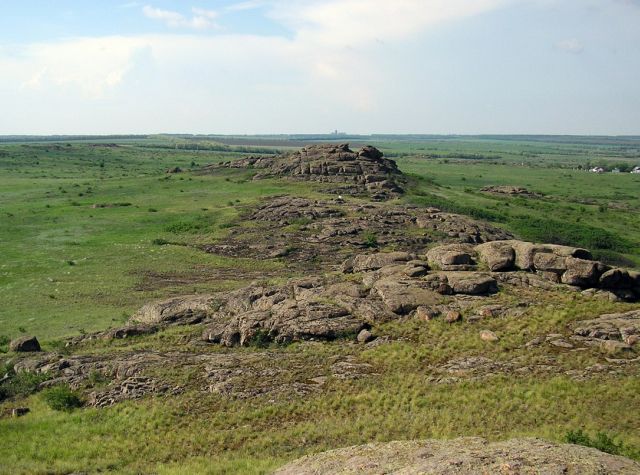
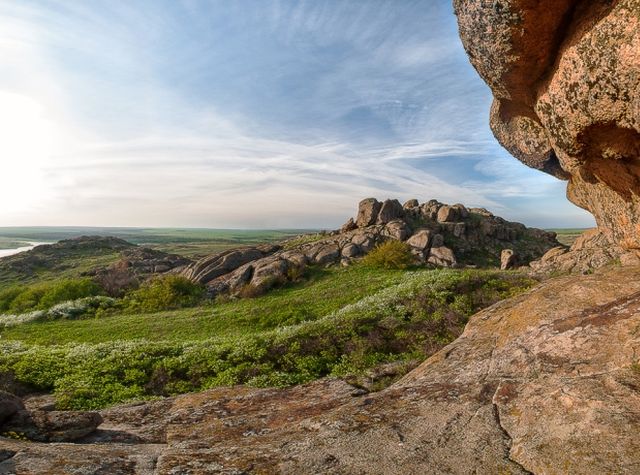
The reserve is a 50-70 m high rocky outcrops in the middle of the steppe. A volcano erupted here 2 billion years ago. The chain of mountains consists of the Western and Eastern ridge. This is an island outcrop on the plain surface of the steppe of the Ukrainian crystalline shield, the so-called Mariupol-Berdyansk uplift, where separate protrusions of crystalline rocks rise above the steppe surface. They have long been called Graves — Tokmak-Mohyla, Belmak-Mohyla, Korsak-Mohyla, Saur-Mohyla and others. In the western ridge there are peaks «Frog» and «Sharp», «Bear with little Bear», «Dinosaur». In the eastern ridge are the summits «Little Panoramic» (or «Mouse»). There are also peaks «South», «Sorrowful Widow», «Vityaz» «Panorama». The height of the peaks is 200 meters. Granite ridges by chemical composition and physical structure have no analogues on our planet.
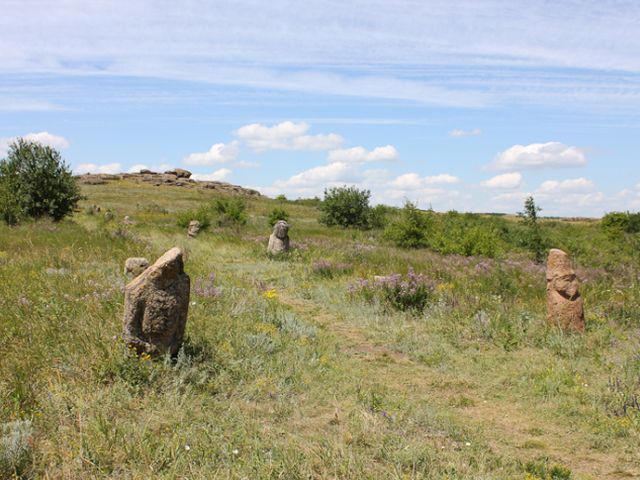
The Stone Graves are also of great value from the historical and archaeological point of view. In ancient times this place was a cult. All around its perimeter are burial mounds in two rings, nine and eighteen kilometers in diameter. Scientists have found here many inscriptions of different times and rock drawings, some echoing by analogy with the inscriptions of ancient Mesopotamia, and others left by Sumerians and Scythians. Numerous «babas» — ancient cult stone sculptures — are exhibited near the central farmstead of the reserve.
The biggest attraction of the Kamenny Mogily Reserve is undoubtedly the stone on the top of the Ostraya Mountain, the western side of which is covered with mysterious writings. The linear dimensions of the stone are 130 by 80 cm.
The furrows that make up the inscriptions are about 1 cm wide and up to 1 cm deep. The edges of the recesses are relatively smooth and even. The stone is entirely pink granite, and the surface is 80% covered with various species of mosses, making it particularly difficult to analyze. The main mystery is the pronounced trident with symmetrical dimensions in the center of the composition. Alas, despite the obvious uniqueness of the symbolism and style of execution, the stone is not included in the guide to the reserve and is not mentioned in any reference book or encyclopedia on Ukrainian culture and history.
Many historians believe that it was here that the battle on the Kalka River took place in 1223, known for its sad outcome for the Russians. In memory of the 300,000 killed in the battle, a memorial has been built, including a tombstone with a cross and a chapel. The inscription on the chapel reads: «The Chapel of St. Illi Muromtsy.
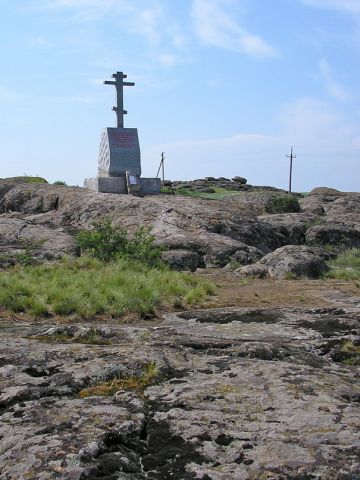
Commissioned by the Spilko Kozak Spilko Zaporizke (Zaporizka Military Association) and the Spilko Kozak Spilko Svoboda (Freedom) of the Donbas…in honor of the 2000th anniversary of Christmas, the 777th anniversary of the Battle of the Kaltsi River, the 55th anniversary of the victory in the Great Patriotic War. This event will remind the future generations that history is the blood of ancestors, and it teaches them not to follow inglorious paths.
30% of the total area of the reserve rests under stone blocks, and the remaining 70% is a blooming virgin steppe, untouched by human hands, so the plant and animal kingdom here is very diverse. The peculiarity of the relief, the peculiarities of rock stratification, the diversity of flora growing conditions on Stone Graves — all this has long been of interest to scientists. In the reserve grows 29 species of flora, listed in the Red Book of Ukraine.
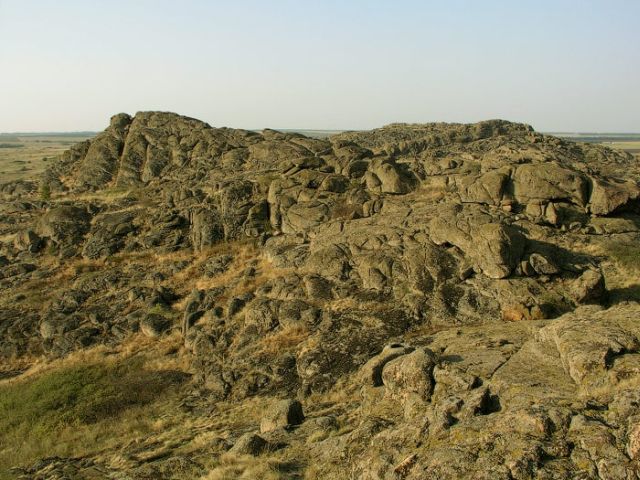
Protected are virgin mixed-grass-typchak-sooty steppes and vegetation of granite detachments. On the slopes of the eastern ridge to the river Karatysh in gorges and among granite accumulations one can see rather dense thickets of trees and bushes. There are quite a lot of rose hips, hawthorn, mulberry, joster, cotoneaster, black cotoneaster and Vysotsky elm. In general, the flora counts 468 species of vascular plants, 50 species of mosses, 38 species of algae, 78 species of lichens and 182 species of fungi. The surface of granite rocks is covered mainly with lichens, and mosses and higher plants are found here only in cracks filled with fine-grained soil. Several species of plants grow here, which, except for the reserve, are not found anywhere else. These are bare wood, false pale cornflower. The alpine fern Woodsia alpine, except for the Reserve, is not found closer than 1000 km from it.
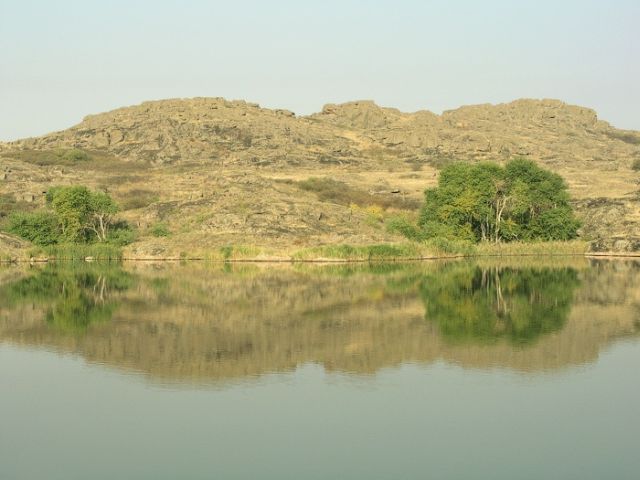
The animal world of the reserve is also interesting. There are foxes, hares, hedgehogs, moles. From rodents there are a lot of gophers. There are species of voles, mice. Among predators, except for foxes, there is a rare steppe ferret — the rarest species listed in the Red Book. Among reptiles such «red-listed» species as the steppe viper lives here. There are many lizards, and in the valley of the Karatysh River there are several species of amphibians. The reserve is especially rich in birds, as it is a wonderful shelter for them. Larks, buntings, julan magpie, stonechats and many birds of prey live here. Besides, from time to time beautiful cranes appear here. It is interesting that during migrations, especially in spring, only pink starlings fly here.
Stone Graves is a unique natural and historical monument, unfortunately, almost unknown to the general public. Only in recent years its popularity among tourists has somewhat increased.