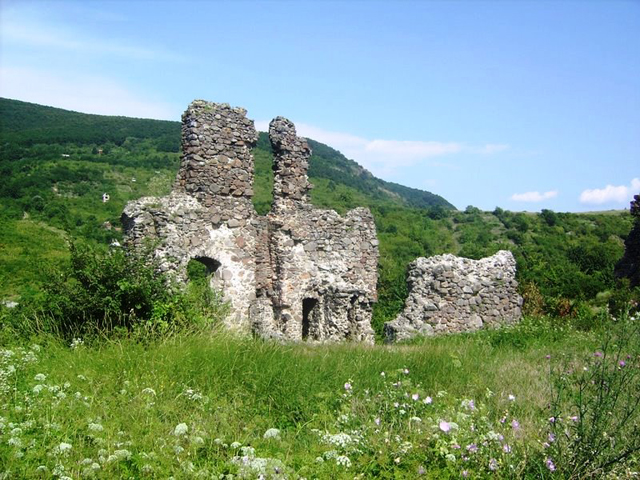
 On the outskirts of the town of Vinohradov at the foot of the Black Mountain there is an amazing ancient landmark worthy of any tourist’s attention — the ruins of an ancient castle that witnessed the Middle Ages and Renaissance. Its walls are almost a thousand years old, this place remembers many turbulent events, conspiracies and bloody battles.
Kankov Castle, Ugochanski Castle, Vinogradovski Castle, finally Sevliushki Castle — all these are the names of once powerful fortification, an important outpost on the famous salt route that once passed along the Tisza. Today, all that remains of it are picturesque ruins and pages of history replete with dramatic events.
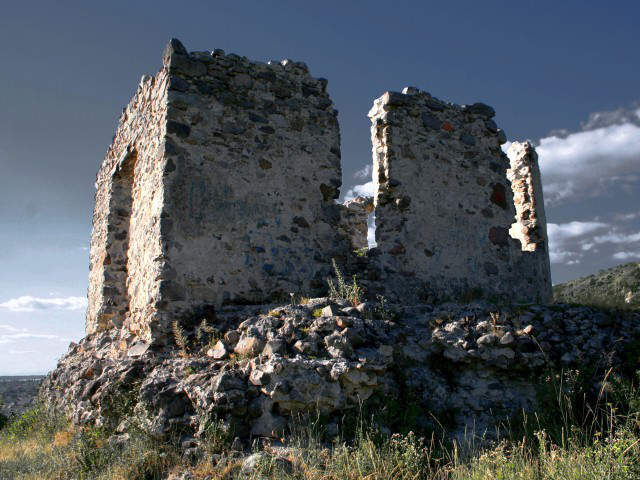 The fortress on the rocky terrace of the Black Mountain was first mentioned in a Hungarian chronicle in 903. At that time there was a fortified Slavic stronghold on the place where the silent ruins stand today. With the arrival of the Hungarians and the annexation of this part of Transcarpathia to the Hungarian kingdom, a stone castle was erected on the site of the mud-brick fortress in the XII-XIII centuries, and the settlement at its foot grew. Vinogradiv Castle became a border outpost, the center of the Ugochanska zhupa.
In the middle of XIII century Ugocha suffers the invasion of the Tatar-Mongols and is destroyed for the first time, and in 1262 a new period in its history begins. The Hungarian king Istvan V gives the town with a population of about two thousand people the status of royal, its inhabitants get solid privileges, thanks to which the town, renamed Sövlüsz, begins to develop and grow actively, turns into an important trade center on the salt route. It was during this period that the main castle complexes were built, many of which can be seen today on the Black Mountain in the form of ruins.
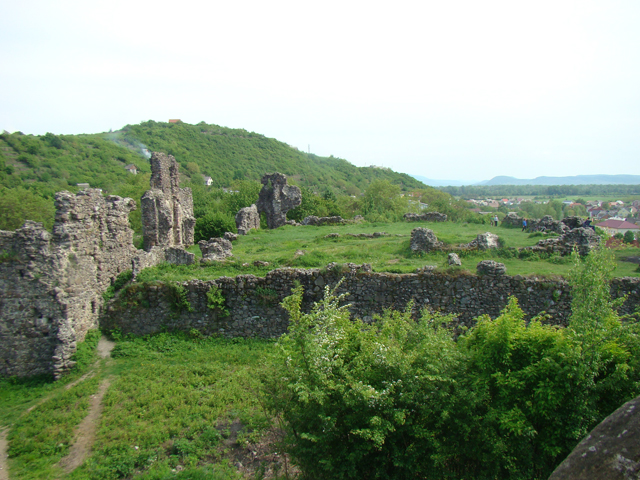 The later years of Kankow Castle’s history are a continuous series of transitions from one nobleman to another, betrayals involving treason against kings in the turbulent times of the Middle Ages. At the beginning of the XIV century the owner of the castle B. Borsho betrays the king Charles Robert, going to the side of the front, the castle is stormed by the royal troops, partially destroying it. The king gives the castle to his wife — Queen Mary, it is partially restored, one of the most preserved today castle buildings — the chapel — is built. At the turn of the century, the new king gives the castle to the magnate Pereni, it is strengthened and rebuilt, then Pereni gives it to the Franciscan monks. The monks rebuild the castle and turn it into a monastery, but soon a descendant of Pereni, who was a Protestant, attacks the monks, brutally killing those who resist him. This page of the castle’s history is connected with a legend according to which a curse fell on the monastery because soldiers desecrated the relics of St. John Capistran during the attack on the monastery. The castle begins to deteriorate, and two years later it is destroyed to the ground by Austrian troops. This is how the history of the castle of Sevljusz ends in 1557, and it has been doomed to destruction ever since.
Today only fragments of walls, towers with loopholes and a chapel remain from the once powerful fortification, which in 1976 became a filming location for one of the episodes of the movie «The Tabor Goes to Heaven». Massive stone ruins clearly tell about how big the fortress once was, and the view of Vinogradov from the castle mountain allows you to appreciate the beauty of a small town — sights of Transcarpathia, being surrounded by ruins to fantasize about what picture could be seen from here by the inhabitant of the castle two hundred, three hundred, five hundred years ago… Visiting such places is memorable for a long time, such ancient fortresses, castle ruins are priceless sights of Ukraine, carrying the most amazing, unlike anything else atmosphere through the centuries.