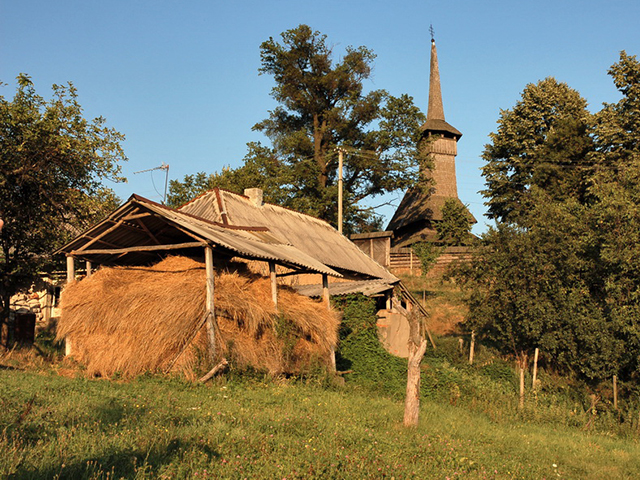
 In the small village of Novoselytsya there is an amazing monument of religious architecture, for the sake of which tourists from all over Ukraine and abroad come here specially. It is The Church of the Assumption of the XVII century, which is a unique example of wooden folk architecture.
Erected from wood small church and two-tiered bell tower, standing next to it, are located in the very center of the village. The modest territory of the ancient monastery is enclosed with a wooden fence and is located on an elevation, which makes a very special impression — the church dominates over all the surrounding buildings, although it is very small and modest in its scale. The exact date of construction of the Church of the Assumption is known thanks to the inscription above the Babinets: «tsei temple robiv Kochalovich u 1669 r.» — almost four centuries have stood this seemingly very fragile structure!
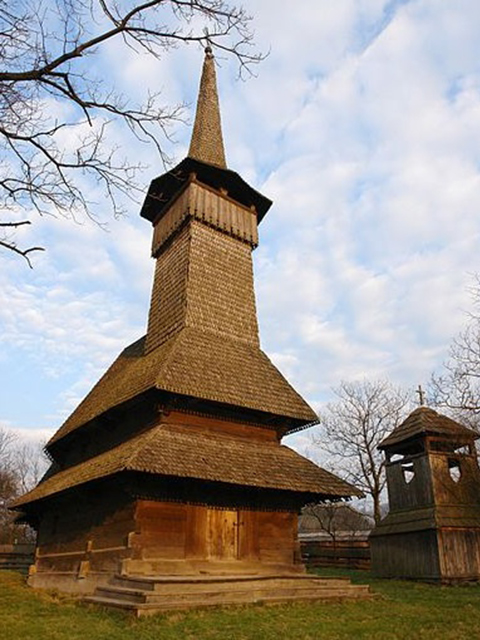 The Church of the Assumption, as well as other similar churches in Transcarpathia, was built by local Orthodox Slavs, who used Gothic stone churches built by Catholics as models for their temples. As a result, such wooden Orthodox churches became an amazing phenomenon — in their architecture, being built of wood and, in fact, representing folk architecture, they echo the monumental churches of Catholics, including in the severity of forms, sharpness of high peaks and towers, sharp lines and clear proportions. So is the Church of the Assumption: its small but tall building is crowned by a sharp spire of a tower pointing far into the sky, overhanging the entrance, the roof, going at a very sharp angle, is several times higher than the building itself, the structure has proportional, proportionate, ideal forms, making the gloomy building graceful and light. From the outside, the walls of the church are decorated with carvings, making the temple even more pleasing to the eye and mesmerizing — you want to see it from all sides. Interestingly, this church is the smallest wooden temple in Transcarpathia, built in the Gothic style. Well, tourists are also attracted by the fact that the interiors of the temple are almost completely preserved from the XVII century in its original form!
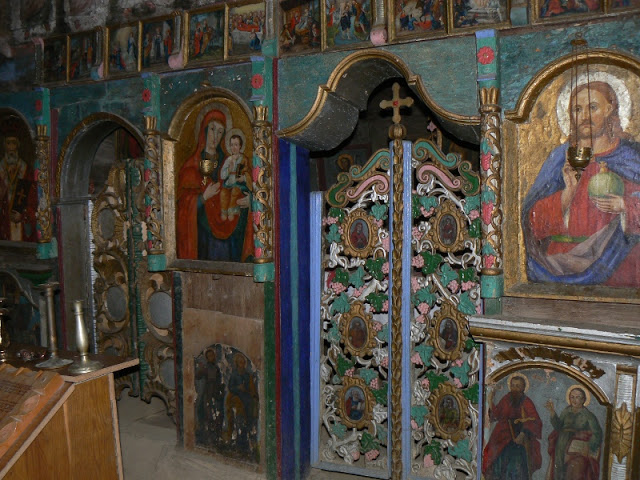
Inside the modestly sized room for its entire height, which is much greater than the area, are decorated with paintings by artists of the Galician painting school and local Transcarpathian artists of the XVII-XVIII centuries. The technique of the paintings is glue painting, they are applied directly to the wood and depict various biblical events, among which the best preserved is the Last Judgment. In addition to the original paintings, the wooden iconostasis and chandelier have been preserved in the interior. In 1979-1981 the monument and the paintings were partially restored under the supervision of architects I.R. Mogytych and G.P. Kruk and artists G.P. Druzyuk, L.S. Skop and others.
 Of course, legends and myths cannot but run around such an ancient building. So, local residents tell several legends. According to one of them, wanting to save the church bell during one of the attacks, the villagers removed it and buried it in the ground near the village, and when they came for it to return the bell to its place, they could not find it. Now once every 7 years a bell rings at the place where the bell was buried. Another legend tells about an axe that the robber Pintya used to hit the iconostasis, and since then the axe became invisible forever.
Whatever legends may surround the Church of the Assumption, first of all the attention to it has always been attracted by its marvelous architecture. Erected from oak, as well as other wooden churches of the Carpathians, attracts connoisseurs of unusual ancient monuments, and all tourists who came on vacation in Vinogradovo, necessarily go to the village of Novoselytsya, wanting to see such an ancient temple with their own eyes. Few attractions of Vinogradovo can compare with Novoselitsa Dormition Church, it is really a unique monument of cult architecture, and such stunning structures in Transcarpathia can be counted on fingers.