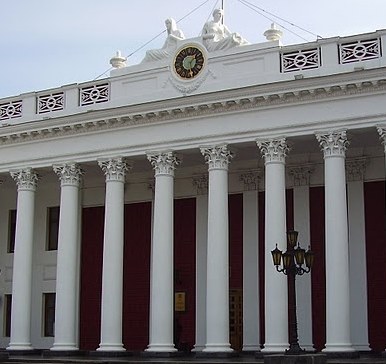
 The building of the Old Exchange is one of the main sights of the city. From the point of view of architecture it is a magnificent example of the best traditions of classicism, and from the point of view of history — it is the most important building in the city, because it was here that meetings were held, at which the fate of the government and the whole Odessa was decided.
Erection of this landmark of Odessa began in 1829 and was completed in 1834, the project of the building belongs to the architect who played an important role in solving the architectural appearance of the city — F.K. Boffo. He gave the city more than one building striking with its splendor.
The building of the first stock exchange in the city became the architectural completion of the Seaside Boulevard. Boffo approached the work very creatively, the building turned out to be airy, light, even temple-like, and many travelers, writers and poets could not resist to devote a few lines to it in their works. It is mentioned in the novels «Catacombs» by V. Kitaev and «Stages» by the writer Skitalets, A.M. Deribas wrote about it in «Odessa leaflet». Poetic lines were dedicated to him by poets Y. Olesha and V. Bershadsky, and the traveler from America Steffens wrote: «even in Italy or Greece…. rarely seen a more charming landscape in the moonlight than the columns of the stock exchange through the gaps between the trees that frame the boulevard».
The two-story building of the old stock exchange, and from the end of the 19th century to the present day it is the building of the City Council, has the shape of an elongated letter «P». The main facade, decorated with two rows of Corinthian columns, was flanked on both sides by two rectangular buildings crowned with huge two-story semi-circular windows. These windows were like the eyes of the building, as if they were looking into the seaside boulevard, watching the city grow and develop for almost 40 years.
In 1871-73 the building of the trade exchange was rebuilt. Its original appearance was changed by architect F.I. Morandi. The second row of columns was replaced by a wall with a front entrance, the former open courtyard behind these columns turned into the White Hall, where today people’s elected representatives meet before the session. Huge windows were closed, as if the eyes of the building were closed, anticipating the coming difficult events for the city, revolutions, coups and protests that would engulf Odessa for decades. In place of windows were installed two sculptures created by Luigi Iorini — Mercury (patron of trade) and Cecera (patroness of agriculture). And the 12 columns, which remained the main decoration of the facade of the building, were topped by a clock made in England with a diameter of 2 meters, together with the figures of two women sitting on both sides of the clock, denoting Day and Night. The whole composition became a symbol of the eternity of time. Expressing respect for the building and its history, this clock is now called a chime, and every day it beats a melody from I. Dunayevsky’s operetta «White Acacia» on the Primorsky Boulevard.
The building of the old stock exchange is no less beautiful inside. Thanks to the restoration of 1946-49 the main hall — the Pink Hall — has survived to our days, the ceilings of the premises are finished with wood as before. The main motif of the interior decoration is the Corinthian order. The interior is refined and rich, light and spacious.
The building of the old stock exchange was always in the center of political events and suffered a lot. It was here on January 14, 1918 after the meeting of the Soviets of workers in Odessa proclaimed Soviet power, here it had to defend it in bloody battles. In the story «The Green Van» writer A. Kozaichinsky captured a portrait of the building that became the heart of political unrest.
Nevertheless, despite the events that once raged here, the building has survived to this day almost in pristine condition. And today everyone can see this magnificent landmark of Odessa and an outstanding architectural and historical monument of Ukraine.