 Odessa has long been famous for the fact that representatives of many ethnicities and religions have taken root in it and feel themselves perfectly. Orthodox and Catholics, Lutherans and Jews, Muslims and Baptists, Charismatics, Pentecostals, Jehovah’s Witnesses and pagans, Old Believers and Karaites pray to their Gods in the «fairy-tale city, garden city» for the third century in a row. Some of the temples could not withstand the test of revolutions and occupations and were destroyed. Some, however, especially after Ukraine gained independence, managed to restore their former grandeur and bring back their original splendor.
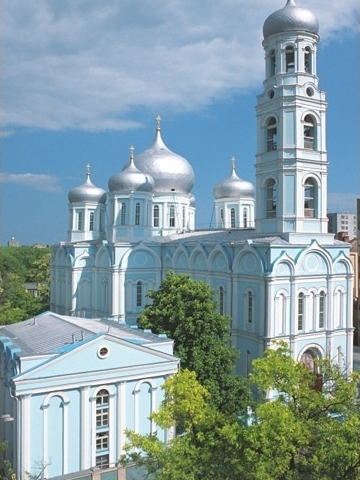
One of the most spectacular of the preserved temples in South Palmyra is considered to be the Svyato-Uspensky Cathedral. Today it is under the jurisdiction of the Odessa and Izmail Diocese of the Ukrainian Orthodox Church, established in 1946. This «Odessa Duomo» is located on Preobrazhenskaya Street, giving its positive energy to the entire historical center of the «pearl of the Black Sea».
 The current cathedral appeared in Odessa on the initiative of Archbishop Innokenty of Kherson and Tauris (Borissov). He urged the public to build a new church and organized fundraising. The main financial donors were Odessa merchants Jacob and Nicholas Cherepennikov, and to create a project and make estimates for the future citadel of Orthodoxy in the Black Sea region was invited baptized German L.C. Otton. Otton.
June 17, 1855 was laid the first stone of the future temple. The construction lasted only 14 years, so in 1869 the completed building was consecrated by the new Archbishop of Kherson and Odessa Demetrius (in the world Muretov).
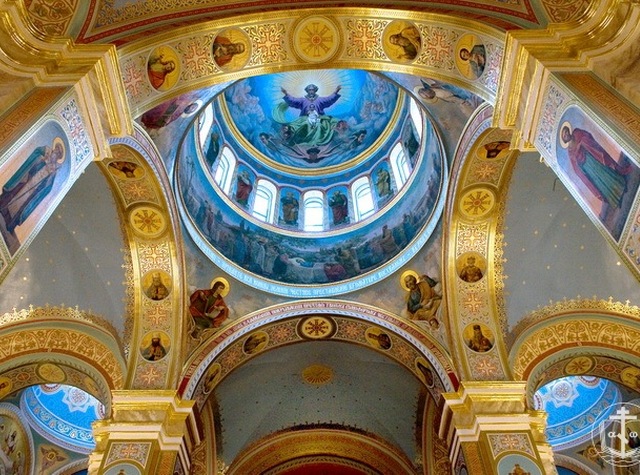
 So, what did Odessa see in 1869? A voluminous building (it was designed for 5 thousand people), made in the best traditions of sacral architecture of Kievan Rus. Spectators are conquered by the beauty and grandeur of the snow-white solid hull-ship, decorated with bas-reliefs in the form of apses, copying elements of the ancient masonry of St. Sophia of Kiev, built by Constantinople architects.
One head drum with four corner ones rises above the Holy Dormition Cathedral. In all drums windows are cut through for improvement of illumination of a temple. By the way, this «innovation» in design of orthodox temples also belongs to Kiev princes. On the drums are put domes in the form of onions. To the body of the temple is attached bell tower, the height of which reaches 56 meters.
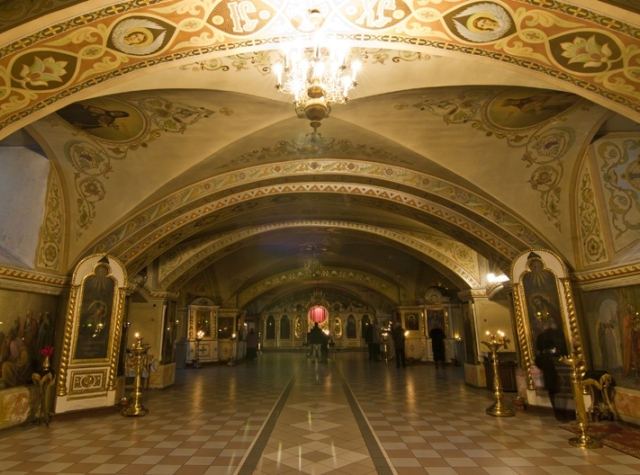 If you decide to visit the temple, you will see that it is divided into 2 parts — upper and lower. In the lower part there are 2 thrones — in honor of St. James and St. Xenia. It was here that Archbishop Nikon (in the world Petin) was buried, who governed the diocese during the Romanian, Hitler occupation and the Soviet era until 1956. Besides, there is one of the two temple shrines here — the relics of Righteous Archpriest Ion Atamansky, one of the most famous Odessa priests. He was born in 1855, was the rector of the Port St. Nicholas Church, and until 1924 he performed a great number of good and God-pleasing deeds.
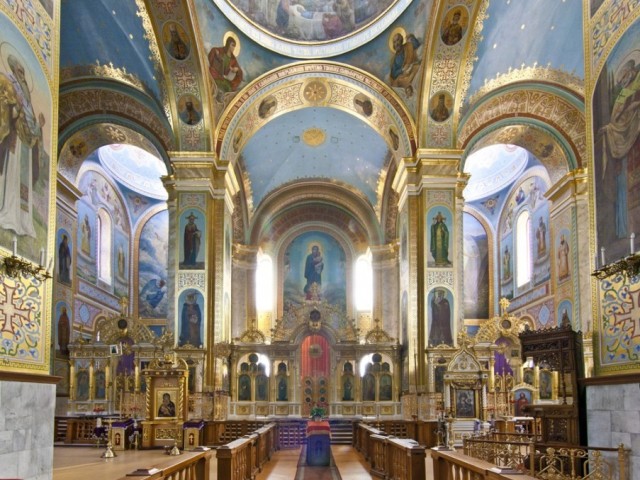
In the upper part there are 3 thrones dedicated to three Saints — Basil the Great, Gregory the Theologian and John Chrysostom. Here, in the upper part, is the main shrine of the Holy Dormition Cathedral. 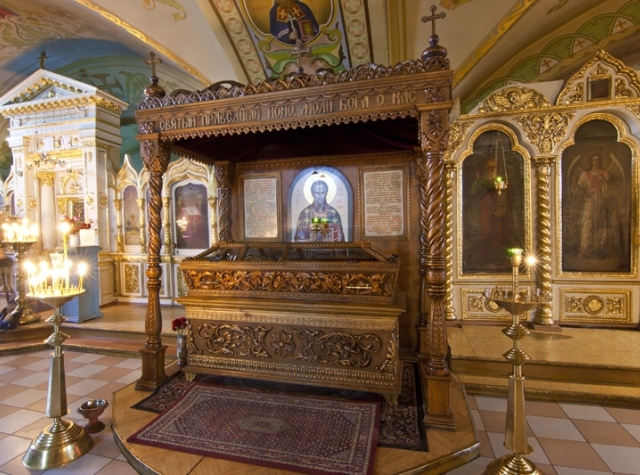 This is the Kasperov Icon of the Mother of God, brought to Russia by Transylvanian Serbs in the 16th century. On the account of the icon 3 confirmed healings, which allowed to rank it to the sonnet of miracle-working. This icon is executed in the iconographic type «Pacification», and experts note its similarity to the Korsun icon of the Mother of God, whose origin is attributed to the work of Evangelist Luke.
The Holy Dormition Cathedral, the Kasper Icon and the relics of Ion Atamansky took a worthy place in the list of the best sights of the Black Sea region. You have the opportunity to see them in person and attach yourself to the miracle-working icon, choosing this year holiday in Odessa.