 In 1884, the St. Elias Skete of Mount Athos purchased a house in Odessa, where it gave shelter to pilgrims traveling from the Russian Empire through Odessa to foreign holy places of Orthodoxy, and helped to draw up the necessary documents for departure. Soon the necessity of building a church at the hermitage became tangible: not only monks with pilgrims, but also Orthodox laymen of Odessa, who lacked churches, needed it. In 1890, the skete received permission to expand its Odessa farmstead and erect a church there.
The laying of the church took place on November 10, 1894. It was performed by the abbot of the skete Archimandrite Gabriel. A native of Kiev region (1849), in 1869 he took monastic tonsure in the hermitage, in 1887 he became the abbot of the monastery, in 1891 he was awarded the dignity of archimandrite, in 1893 he arrived in the Russian Empire to raise funds for a new cathedral church in the hermitage.
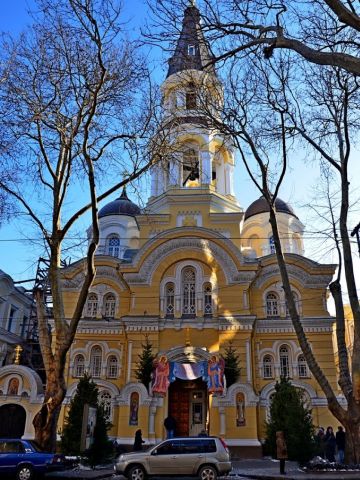
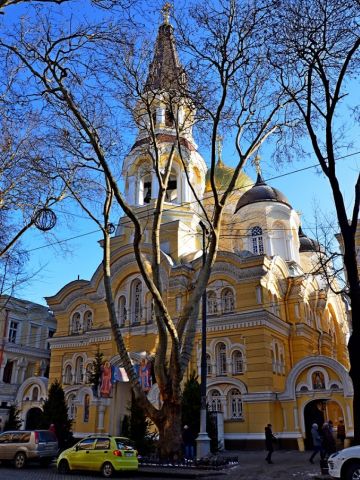 The church of the hermitage was built in such a way that the lines of the front western facade of the building and the front facade of the manor coincided. Above the narthex of the temple superstructed tapered upward 2-tiered 8-sided bell tower with a hipped top. The main part of the temple was crowned with 5 chapters with helmet-shaped domes. December 22, 23 and 28, 1896 were consecrated respectively 3 thrones of the temple: the main — the Icon of the Mother of God «Mammal», right — St. Prophet Elijah, left — St. Archangel Gabriel.
In the church Fr. Gavriil placed the relics that he had brought from Mount Athos: a list of the Skete icon of the Mother of God «The Mammal Bearer», the left foot of St. Andrew the Apostle and a part of the Holy Cross.
Two 3-storied buildings are built along the sides of the church. Their western ends are on the line of the front facade of the temple and are connected with it by arches over the passages deep into the yard. 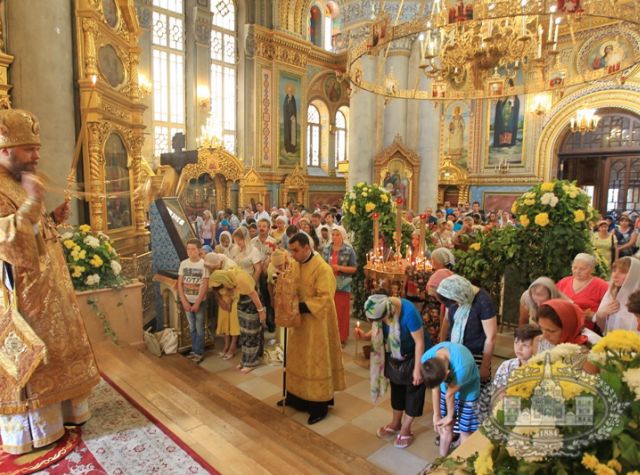 Thanks to this the front facade of the manor was a slender architectural ensemble. A number of buildings were erected behind the altar of the church.
On October 19, 1901 Fr. Gabriel died in the city of Novonikolayevsk during a visit to another Skete farmstead there, and on November 2 he was buried at the Odessa farmstead.
In 1922 the Soviet authorities abolished the monastery as a monastery, the temple remained active until the turn of the 20-30s of the twentieth century and in 1942 it was reopened as a parish. In 1942-1962 it was the Odessa diocesan office, in 1946-1949 monks ascended, after 1946 for some time was treasurer Hieromonk Pimen (Izvekov) — the future Holy Patriarch of Moscow and All Russia, in 1950-1961 housed a dormitory of the Odessa Theological Seminary. 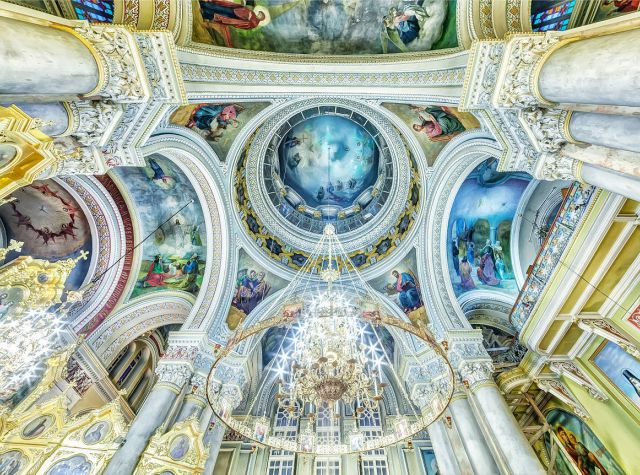 While the Dormition Cathedral of Odessa, damaged during the Great Patriotic War, was being repaired, its role was for a long time performed by the church of the former St. Ilyin’s suburb. Its thrones since 1942 changed names: the central one — St. Elijah’s, the right one — the Icon of the Mother of God «Mammal Bearer», the left one — St. Archangel Gabriel. In 1960 and 1975 new iconostases were installed in the church — respectively the central and side iconostases.
Hearing mysterious knocks in the basement of the temple, and knowing that there, according to tradition, buried the builder of the building, the clergy of the parish on July 22, 1994 surveyed the alleged place of burial under the baptistery. At that time, a demon-possessed young man brought to the church was healed in the baptistery itself. In the evening under the baptistery they found the bricked up coffin of Archimandrite Gabriel. Those present at the discovery of the coffin felt something like a breath of fresh air. 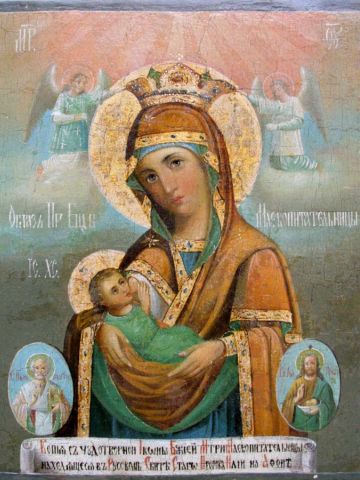 In the next few days new healings took place at the relics of the ascetic transferred to the church. October 23, 1994 in the temple was held a solemn rank of glorification in the countenance of saints of St. Gabriel of Athos.
In 1995 the parish was transformed into Svyato-Ilinsky Monastery. Since 1997, it is again the Odessa Diocesan Office. In 2011 consecrated the lower church of St. Paisios Velichkovsky and Gabriel of Athos. Since the same year, free courses of foreign languages (English, French, Arabic, modern and biblical Hebrew) have been opened at the Sunday school of the monastery.