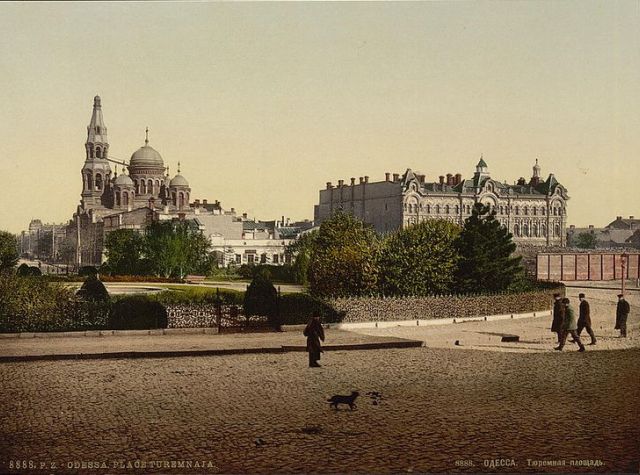
At the end of XIX century the business of pilgrimage to the shrines of Jerusalem and to the Holy Mount Athos was put, we can say, on a professional basis. Before the revolution Odessa was the gate of the Russian state and served as a central transit point for pilgrimages from all over the Russian Empire, going by ship to Jerusalem, Constantinople, Mount Athos, Sinai, Bar, Rome, etc. The geography of pilgrimage routes was all-encompassing.
For the needs and requirements of the pilgrims on July 16, 1885 «against the prison castle was laid the foundation of the house of the Russian St. Andrew’s Skete». His Eminence Bishop Nicanor (Brovkovich, 1883-1890) of Kherson and Odessa performed a prayer service at the site of the altar of the future church.
The construction of the «elegant, even luxurious building» was carried out according to the project and under the supervision of architect Yuri Dmitrenko and progressed quite quickly.
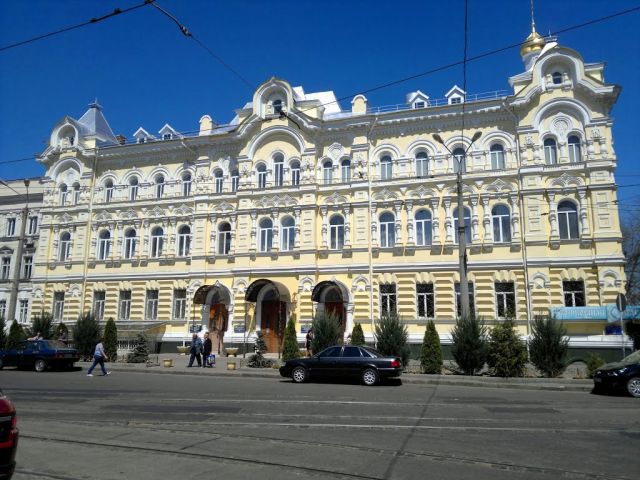
By the way, it was the first work of Yuri Dmitrenko, which attracted public attention with its beauty. The construction of the palace was completed by May 8, 1896. However, work on the temple and interior decoration of the building continued for almost a year. The building Andreevsky podvorye occupied a large space at the corner of Rybnaya Street and Prison Lane. The left part of the whole building was intended for living quarters, in the right part on the first floor was a hall and several more rooms for religious readings, dining room, as well as the lower church — in the name of St. Andrew the Apostle, on the second and third floors was arranged church in honor of St. Sergius of Radonezh, the solemn consecration of which took place on April 19, 1897.
The consecration of the church was performed by His Eminence Nicanor, Archbishop of Kherson and Odessa, in the company of the Bishop of Novomirgorod, His Grace Justinian, and the Bishop of Elisavet Grad, His Grace Memnon, as well as the highest clergy.
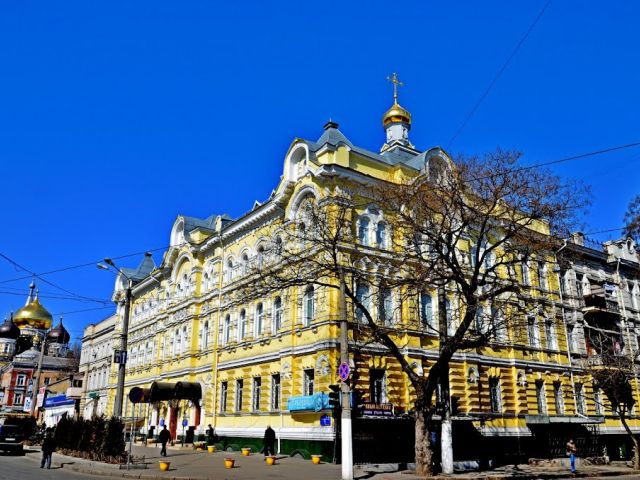
The consecrated church was characterized by great splendor. The magnificent carved wooden iconostasis, all gilded, executed with great taste and elegance, amazed the imagination. All the artistic works were painted on Athos and sent by the abbot of St. Andrew’s Skete. On the right side of the choir was placed a large copy of the miracle-working icon «Consolation in sorrows and griefs», sent to the temple by Grand Duke Sergei Alexandrovich. On this icon there was a very valuable silver gilded risa with the coat of arms of the Grand Duke. The icons on the iconostasis and in the altar were painted in the Byzantine style, and the church utensils were striking in their elegance and beauty.
From the street one could enter the church by a wide marble staircase, at the entrance to the church a special aisle was created for selling candles, from where the staircase led to the choir. A three-storied wing adjoined the main building from the courtyard side. There were 24 cells for 2 people each, and one common room for 100 people, for wanderers.
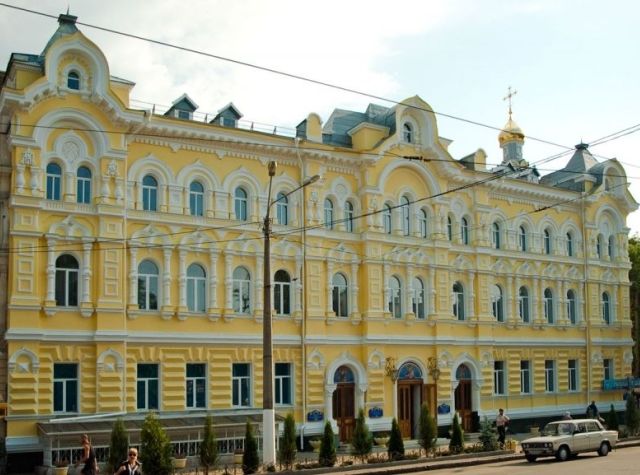
There was also a rather beautiful building in Prison Lane, where private apartments were set up for rent.
In time the farmstead accommodated more than 300 pilgrims and 50 members of the brethren. Two book and icon shops were organized, where publications of the skete were sold. Information about it could be obtained from the «Guide to Monasteries», in the section «Kherson Diocese» here it was also stated that the monastery was subordinate to «the consistory and its hermitage on Mount Athos». Daily divine service was held in the podvorye. For the pilgrims, whose numbers increased from year to year, there were common rooms and separate rooms.
After 1917, communication with Athos was cut off, but the farmstead continued to operate as a monastery. On April 18, 1922, all church valuables (expensive icon covers, church utensils, etc.) were confiscated.
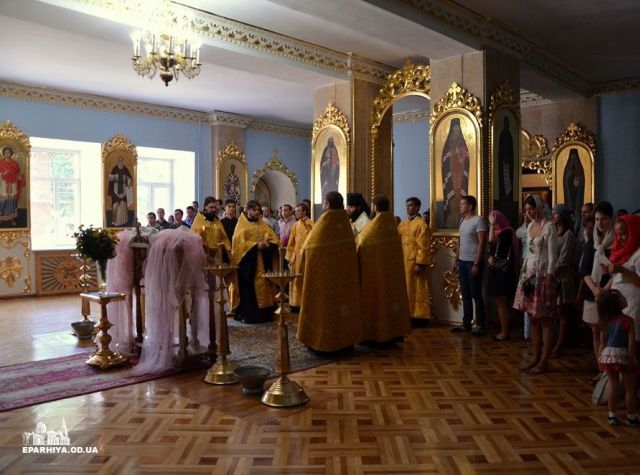
About the further fate of Svyato-Andreevsky podvorye in the archives of Odessa information could not be found. Most likely, in the 30s of the twentieth century, when many churches and monasteries were closed, the building was used as a club or other public institution.
The most important event for Odessa was the revival and reconstruction of the church of the Tikhvin Icon of the Mother of God of St. Andrew’s churchyard. After the urgent requests of the Orthodox faithful, through the care of Metropolitan Agafangel and by the will of God, the building was returned to the Odessa Diocese. His Eminence Metropolitan Agafangel of Odessa and Izmail took a direct part in the restoration of the churchyard. The new iconostasis of the church of the Tikhvin Icon of the Mother of God, the gilded vestments of the altar, and the painting of the church were made with the Vladyka’s personal funds.
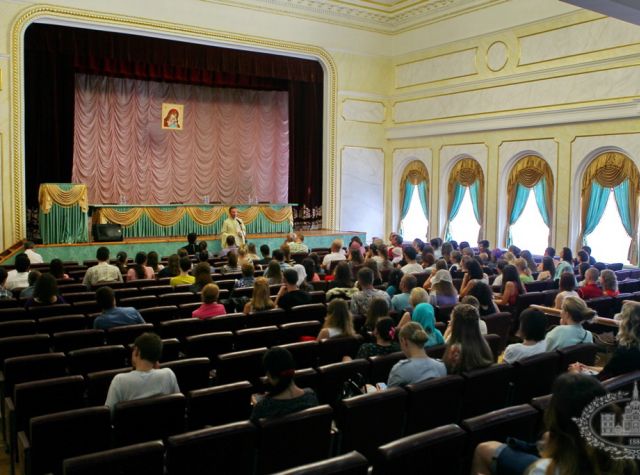
The news of the opening of St. Andrew’s Farmstead spread joyful tidings among the faithful. On June 9, 1999 His Eminence Metropolitan Agafangel of Odessa and Izmail in the company of the city clergy and in the presence of a huge gathering of pious Odessans and pilgrims consecrated the church. Now the churchyard has become the spiritual center of the Metropolis. Diocesan meetings, conferences and festive celebrations are held in the assembly hall.
And today, in the words of the Apostle Paul: «Give thanks for everything» (1 Thess. 5, 18), the faithful offer prayers to the Savior, the Mother of God, the Apostle Andrew the First-Called and other saints. The Divine Liturgy is celebrated every Saturday at 8:00 a.m., and every Wednesday at 7:00 a.m. the Akathist chanting is performed before the Tikhvin Icon of the Mother of God.