
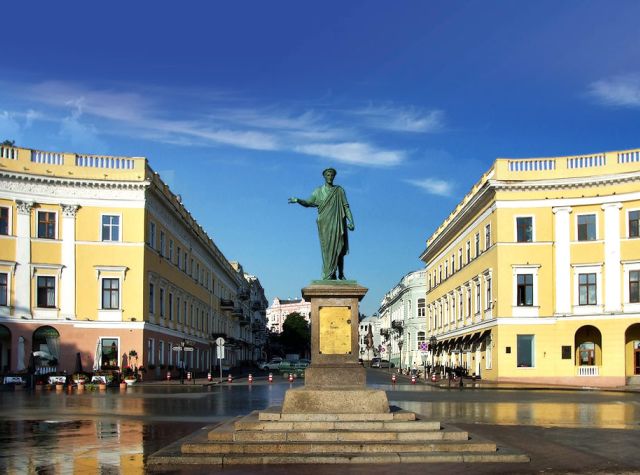
When people keep the memory of a person from century to century — it is the most valuable recognition of the importance of a person in the history of a country or a city. Such memory after almost two centuries keep Odessa residents about Arman Emmanuel du Plessis — Duke de Richelieu. And the confirmation of the fact that this outstanding personality, who played an important role in the history of Odessa, is not forgotten, is the famous monument to the Duke de Richelieu, installed on Primorsky Boulevard.
The Duke was the first governor-general of Odessa, for 11 years in this position (1803-1814) he did a lot for the development and well-being of the city and its inhabitants, even for a time released the city from taxes, thanks to which began its active development. It was Richelieu who turned Odessa into a major commercial port. In 1814, after the return of the throne of France to the Bourbons, Richelieu returned to his homeland and for the second time became prime minister of the country, serving the government of Louis XVIII until his death in 1822.
The importance of this monument for Odessa is as great as Richelieu’s deeds for the good of the city. «Bronze Duke» («Duke» — translated as Duke), as they call this landmark, was the first monument in Odessa — its grand opening took place on April 22, 1828.
The story of the discovery of the Bronze Duke is very interesting. When news of Richelieu’s death came to Odessa, the new mayor, Count Langeron, urged the population to raise funds to create a monument in honor of the deceased benefactor of the city. Not only dignitaries who knew and worked with Richelieu, but even movers and simple laborers responded, which was very rare at that time!
First, a plate was cast, which to this day adorns the monument. It bears the date «1826». — Due to the fact that it was hurriedly created, the monument bears the wrong date. Then the work on the sculpture was entrusted to I.P. Martos and A.I. Melnikov — the creators of the monument to Minin and Pozharsky in Moscow. The figure of the former mayor Martos decided to make a full-length (but it turned out to be higher) and to dress the prominent figure in a Roman toga, in the style of the sculptor preferred classicism. Casting of bronze sculptures and high reliefs decorating the pedestal of the monument was entrusted to V.P. Ekimov. The sculptures arrived in Odessa from St. Petersburg.
When laying the foundation of the Bronze Duke in its base placed coins created under Louis (XVI and XVIII), Catherine II, Paul I, Nicholas I, as well as a medallion with the image of the Duke, created in Paris after his death.
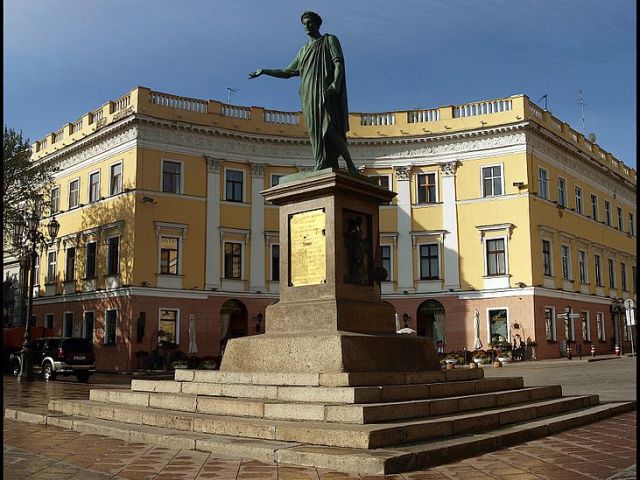
The figure of Richelieu was placed on a four-sided pedestal made of granite brought from Voznesensk, and the pedestal was placed on a truncated granite pyramid with four steps.
Richelieu’s figure faces the sea and rises above the Potemkin Staircase, and the three sides of the pedestal are decorated with sculptures representing justice, commerce and agriculture. But history has ordered so that the Richelieu monument was destined to acquire one more detail: after the bombardment during the Crimean War, when in 1854 one of the nukes damaged the pedestal, the resulting splinter was fixed with a cast-iron «patch» in which the nucleus was inserted in memory of the incident.
Years go by, Odessa is blooming and fragrant, and its first benefactor is still with her — the Richelieu monument is perceived by the residents not only as a beautiful sculptural composition, reminding about the role of this outstanding man in the history of South Palmyra, many consider it a lucky mascot of the city, it is sung in poems and songs. The value of this attraction of Odessa for its residents is boundless, it is cherished, loved and appreciated. And all those who come to Odessa on vacation necessarily strive to see the monument to the man, thanks to whom one more wonderful city became on the Earth.