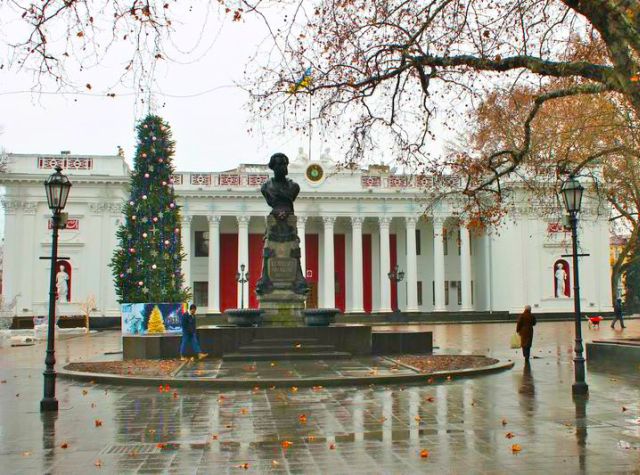
At first the monument was going to be erected on the Theater Square between the building of the English Club (Museum of the Navy) and the City Theater. But the square was considered cramped and the place near Nikolayevsky (Primorsky) Boulevard was chosen.
In 1882 there were 5 applications-projects. The best was recognized as the project of architect Khrisans Vasiliev. The bust of Pushkin was executed by Josephine Polonskaya, familiar to us as the author of sculptural portraits of Voltaire, Yakov Polonsky (her husband, a famous poet), Sophia Kovalevskaya, Afanasy Fet. A bust of I.S. Turgenev by Polonskaya is installed on the writer’s grave.
In March 1885 in Odessa was created a commission to build a monument, and February 2, 1887, his solemn laying took place. Then the collection of donations began. Contributions were very diverse: from 9 kopecks to 100 rubles. Categorically refused to take part in this Alexander Grigorievich Stroganov — «eternal citizen of Odessa» (an honorary title awarded to him as a former governor-general of Novorossiysk). A. G. Stroganov (one of the city bridges is named in his honor) was a third cousin of Natalia Nikolaevna Pushkina.
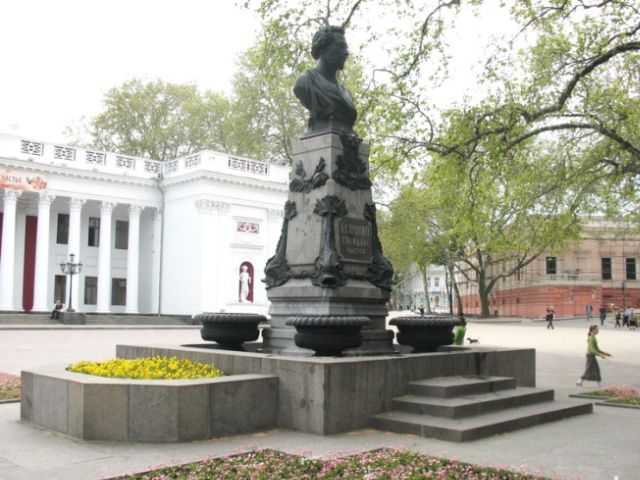
Alexander Grigorievich’s father was in charge of the guardianship of Pushkin’s family after the poet’s death. Stroganov was outraged by the anti-government poem «Dagger», written by Pushkin in Kishinev in 1821 and said that he would not give money for the «dagger». But the funds were raised without him.
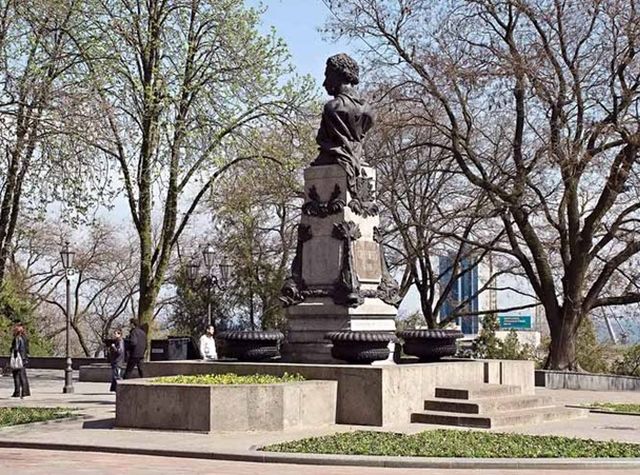
Donated not only money, but «labor and materials»: slabs for the foundation, sand, granite, cement, free of charge performed «asphalt and water works», cast iron bowls in the workshops of the society «Labor». A huge excavation was dug, stone was put into it, landslide control works necessary in the coastal zone were performed. The bronze bust and stylized dolphins were cast at Moran’s factory in St. Petersburg (the same factory where the «Bronze Horseman» was created). The monument was built «under the gratuitous guidance» of architects F. Morandi and Y. Dmitrenko.
 .
.
Together with a famous calligrapher in Odessa A. Kossodo Dmitrenko made sketches of inscriptions, each of which reveals some page of the monument’s history.
The inscription «To A. S. Pushkin. Citizens of Odessa» emphasizes on whose funds it is put. Above, on the ribbons at the base of the lyre is inscribed: «1820-1824» — the years of the poet’s southern exile. On the top step on the front side of the monument is a semi-erased inscription: «Granite of Gnivanskie lomoki Vinnitsa district of Podolia province… donated…» On the semicircular roller, edging the base of the bust, on the side facing the sea, carved: «On the project Khr. Vasiliev molded Zh. Polonskaya, cast. A. Moran.» On the drapery of the bust where it falls on the old coat of arms of Odessa, engraved inscription: «Zh. Polonskaya.» Below, on the granite pedestal is engraved: «Built in 1888».
April 16, 1889 at the 12th hour was the grand opening of the monument. Before the eyes of the crowd of thousands of people appeared bronze Pushkin. Under the bust — a lyre, behind it, diagonally — a feather and a five-pointed star with a ray turned downward.
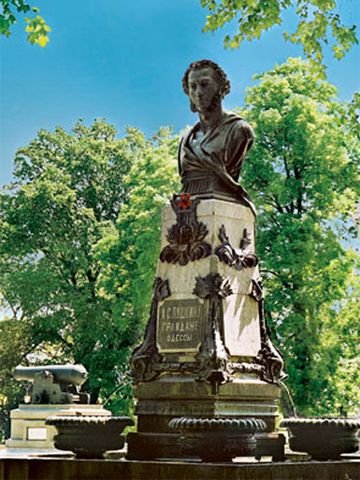
Its unusual position symbolized the poet’s connection with the Polar Star magazine. Once the star on the monument was crystal, it was even supposed to illuminate it with an electric bulb, but the wire was never brought …
On four sides of the pedestal there are sea creatures (dolphins). Water jets flow from tubes hidden in their mouths into massive cast-iron bowls.
The author of the decorations is architect Reutov. Works on the design of the pedestal was advised by Academician Chizhov….
«Odessa. This is the sea. These are chestnut trees. These are country roads. It is dreams. This is the memory of Pushkin,» wrote Yuri Olesha.