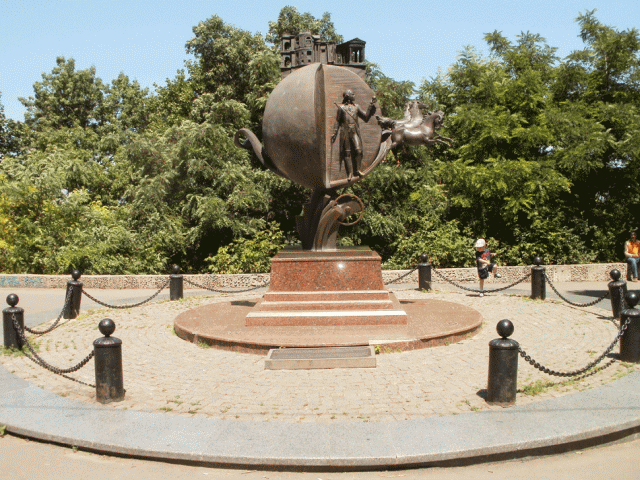
The fact that geese saved Rome is common knowledge. But about the fact that oranges saved Odessa — I think few people know. And the story is actually interesting.
The case was at the end of the XIX century. For 1.5 years before her death, Empress Catherine II issued a decree on the construction of a commercial seaport, which was to become the largest in the south of the empire. However, Russia did not like to hurry at that time, and during Catherine’s lifetime this project was not realized.
Paul I, who succeeded his mother on the throne (who already did not support many of his mother’s deeds) ordered an audit. As it turned out, there was no tangible progress in the construction of the port, despite the generous funding from the treasury. But many abuses and embezzlement of Odessa officials were discovered. In anger, the Emperor summoned Vice Admiral de Ribas to the capital, and the first builder of Odessa engineer de Volan and dismissed altogether.
You have to give credit to the ingenuity and ingenuity of the Odessa magistrate. It was the beginning of January. Either it was not customary two hundred years ago to celebrate New Year’s Eve as long as it is now, or the officials had no time for fun, but a meeting was held on an emergency basis, the main (and only) question at which was «What to do?».
In whose head came the idea to present the Emperor, who adored oranges, a gift of overseas fruit, history is silent. However, from reliable sources we know that it was ordered to the local quarantine chief, as soon as they arrive in the port «orange fruit», not to allow them to sell, but to select first 3,000 pieces of the best variety and send to the court. Moreover, each fruit was wrapped, as rumor has it, in a paper on which were written the advantages of Odessa as a commercial seaport.
 .
.
We can only applaud the sagacity and efficiency of the Odessa residents: on February 8, the oranges left Odessa, and already on February 26, Paul I signed the highest rescript. The Emperor’s mercy was almost immeasurable — the city not only received money for construction, but also a loan of 250,000 rubles for 14 years. All benefits to the city were extended for the same amount of time. This is how exotic fruits saved the capital of laughter.
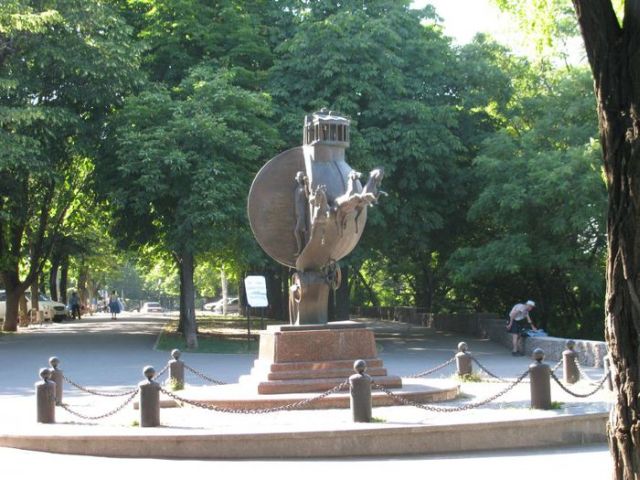
Monument to the orange in Odessa put only in 2004, timing the opening to the Day of the city. The author of the composition is Alexander Tokarev.
The whole area of the sculpture is about 12.5 meters in diameter. The monument was cast in Kiev, it took almost a ton of bronze. And the cost of the «citrus fruit» amounted to $20000.
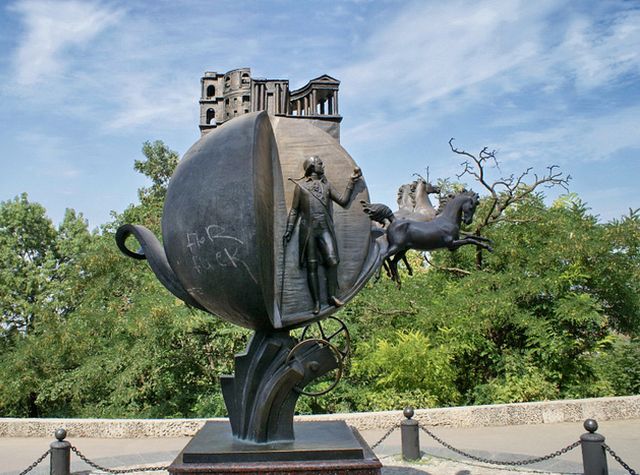
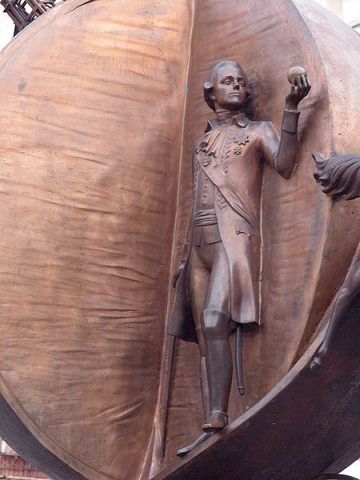
In the orange installed on the pedestal, sculptor Tokarev took out a slice, placing Emperor Paul I himself in its place.
The orange has a trio of horses with a cart rushing to the capital (although given that it was winter, in reality it was probably a sleigh).
And the composition is crowned by the Opera House, the colonnade of the Vorontsov Palace and the Transfiguration Cathedral — the most recognizable buildings of Odessa.
Odessians themselves call the Orange Monument «monument to a bribe» and quietly chuckle when discussing the relocation of the monument from City Hall to Zhvanetsky Boulevard. Allegedly, the hint was too transparent… Well, Odessa is Odessa. Even the monuments here are linked to anecdotes!