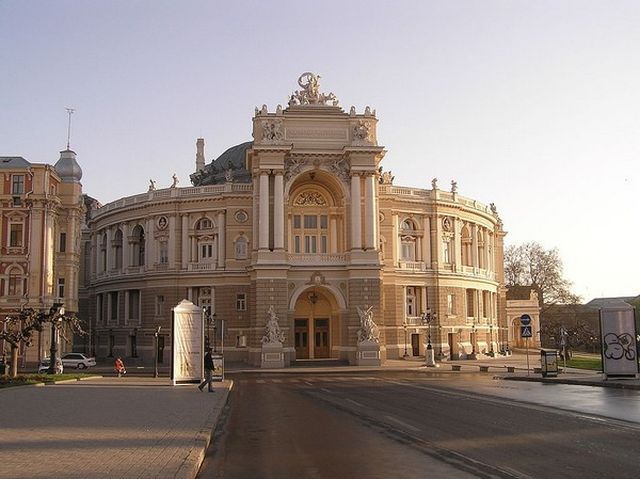
 Ah, Odessa…. You amaze us with your exquisite simplicity, you delight us with your picturesque landscapes, and then we freeze in awe at the grandeur of your buildings. Here, for example, Odessa National Academic Opera and Ballet Theater can rightfully be called a European pearl, for the sake of which they even built an AC power plant to illuminate the city’s treasure for its residents and guests. The theater is first of all famous for its architecture, and in its layout and technical data is not inferior to the best theaters in Europe.
Theatrical life in Odessa dates back to the early days of the city. Odessa Opera and Ballet Theater can be proudly and respectfully called the oldest among a number of its cultural institutions.
Odessa received the right to build the theater in 1804, and in 1809 it was already erected according to the project of the French architect Tom de Toman, the author of a number of buildings in St. Petersburg. On February 10, 1810 the opening took place, which was represented by the Russian group P. Fortunov with the one-act opera «The New Family» by Frelich and the vaudeville «The Consoled Widow». In 1823-24 it was this building that A.S.Pushkin visited during his stay in Odessa.
 The newly built young theater was located slightly above the modern theater, closer to the Palais Royal square, and was perceived as a monument to the young city. The architecture of the building was in the classical style, with a Corinthian order portico and pediment facing the building of the Museum of the Ukrainian Navy, then the English Club. The auditorium at the time seated only 800 spectators, and there were only 44 chairs in the parterre, so 700 spectators watched the productions standing up. There were also 17 boxes, which were arranged on three tiers and where dignitaries usually rested.
The theater was constantly trying to improve and repeated additions were made to correct the building’s shortcomings. As a result of these rebuildings, a stone wall along the axis of columns appeared, which allowed to expand the space in the foyer. A one-story stone vestibule was added to the side of Rishelievskaya Street. The works on the last remodeling of the building were finished on December 31, 1872, and on the night of January 2, 1873 the theater, to the greatest regret, burned down because of the gas horn lighting the clock at night.
It took almost 11 years from the time of the fire to the laying of the first stone in the new theater building. This time the construction was led by Viennese architects F. Fellner and G. Helmer. 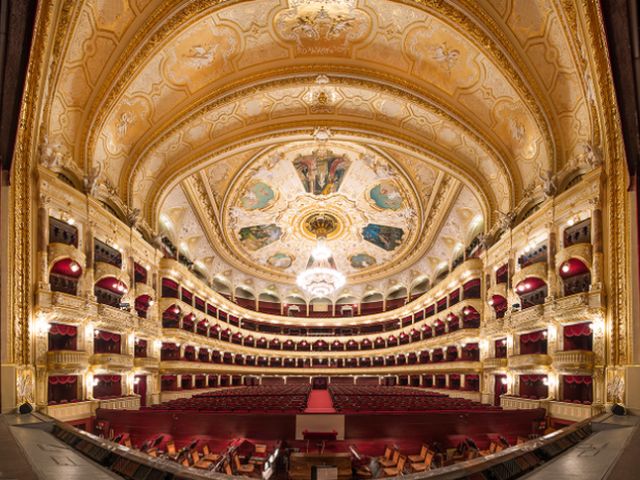 The building was modeled on the Dresden Opera House built four years earlier by architect Gottfried Semper. The building was constructed by contractors from local building materials, mainly from Odessa limestone-coquina.
The opening of the new theater was held on October 1, 1887. The building is executed in the Viennese «baroque» style. Above the facade sits a sculptural group depicting the muse Melpomene, the patroness of art. She sits in a chariot drawn by four furious panthers, which she has subdued. Near the central entrance, two sculptural groups representing comedy and tragedy are mounted on high pedestals. Along the front of the building there are busts of genius creators and founders of Russian literature and music: A.S.Pushkin, M.I.Glinka, A.S.Griboyedov, N.V.Gogol, which represent poetry, music, drama and comedy.
Visiting the Odessa Opera and Ballet Theater, you will be pleasantly surprised by its elegant interior decoration. The architecture is in the Rococo style. The most beautiful part of the building is the auditorium. It is luxuriously decorated with stucco ornaments with fine gilding. Kupala, columns, arches, sculptures, candles and candlesticks perfectly harmonize with each other. 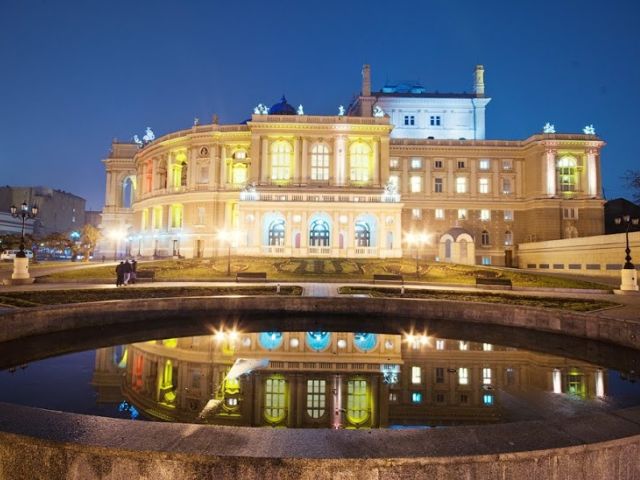 The seats and boxes are upholstered in dark red velvet, mirrors in gilded frames. Raising your head up, you will freeze in delight at the painted ceiling. Its composition is based on medallion paintings by the artist Lefler. They depict scenes from Shakespeare’s works such as Hamlet, A Midsummer Night’s Dream, The Winter’s Tale and As You Like It. In the middle of the hall majestically illuminates a large crystal chandelier decorated with many openwork details, weighing 2.5 tons. The unique acoustics of the horseshoe-shaped hall allows even a whisper from the stage to be carried to any corner of the hall. There is also an organ, the pipes of which are located above the boxes of the second tier. On the floor of marble chips of special pattern for each floor walked and enjoyed the beauty and majesty of talented and famous people such as: P.I. Tchaikovsky, N.F. Rimsky-Korsakov, S.V. Rachmaninoff, Eugene Izan and others. They performed their works on the stage of the theater, which later burned down (in March 1925) and was rebuilt a year later. Fyodor Chaliapin, Solomeya Krushelnitskaya, Mattia Battistini, outstanding opera singers sang here. On the same stage danced prima ballerina of the world Anna Pavlova.
All this unforgettable and striking beauty, pleasing and caressing the ear music, you can feel and take for yourself a spiritual share of art in the Odessa National Academic Opera and Ballet Theater, which is located at the crossroads of Langeronovskaya and Rishelievskaya streets.