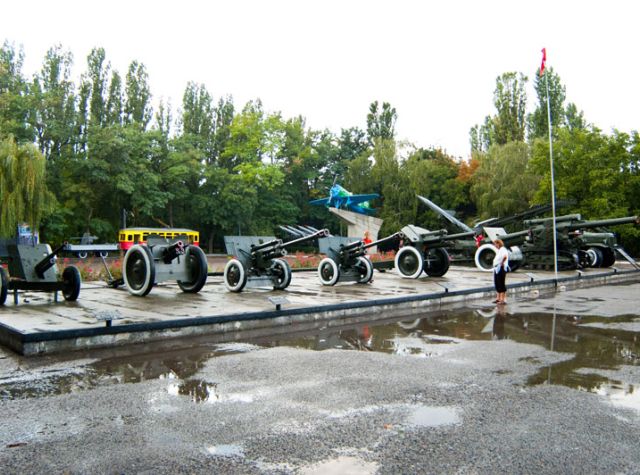
 During the Great Patriotic War Odessa residents showed courage and heroism, defending the city from Nazi troops. Since May 1, 1945 Odessa was called a hero-city, and on the 30th anniversary of the Victory over Germany in the city was founded Museum-Memorial of the heroic defense of Odessa.
The place where the museum is located (150 Dacha Kovalevsky St.) is a historical monument and occupies an area of about 16 hectares. During the war here was located 411 battery, for 73 days defending the city from the onslaught of the Germans.
The 411th battery began construction in May 1934 and was ready by June 1936. The main volume of works, both earthwork and reinforced concrete, was carried out manually by the two thousandth team of builders of UNR-87. 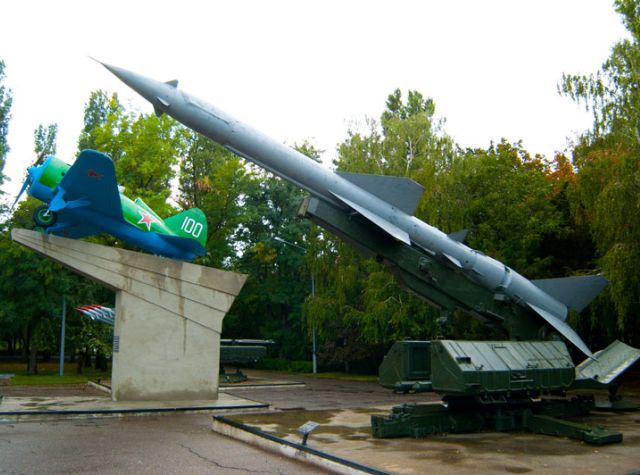 At the same time the personnel was trained to master the complex military equipment, coherence and interaction of all units of the battery.
The battery consisted of three 180-mm guns with a range of up to 40 km. In addition to them there was a separate anti-aircraft platoon: anti-aircraft guns — 3 45 mm guns and anti-aircraft machine guns — 3 7.62 mm machine guns. The personnel of the battery numbered 356 people.
In general, the battery was a complex complex of structures with many services. The structures, built at a depth of 10 to 23 m, were surrounded by two layers of armored steel 30 mm thick, and the thickness of reinforced concrete in some places reached up to 1 m 75 cm. At that time there were no weapons capable of destroying such structures. 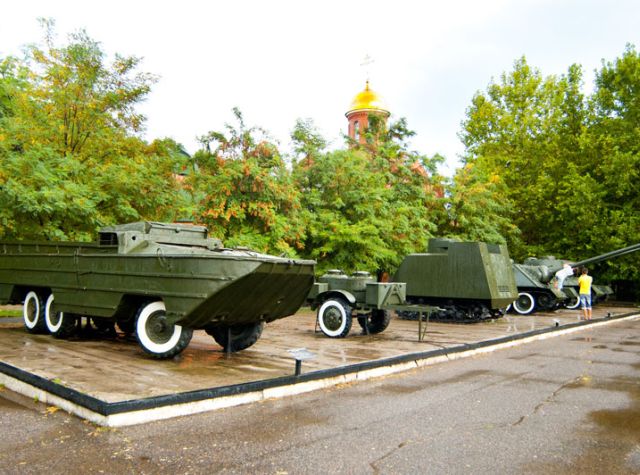 Beneath the thickness of earth, iron and concrete there was a whole town with its own power station, radio telephone, complex ventilation system, groundwater pumping, boiler plant, water supply, artesian well, steam heating, rooms for personnel, warehouses for fuel, food and ammunition.
On the surface, in the reinforced concrete gun emplacements there were only guns with metal houses built on top, imitating peasant huts for camouflage. All 3 gun yards were connected by an underground passageway, and the battery had a central gunnery post, which was located at the command post on the seashore, connected by an underground passage through the power station (a three-story building under ground and concrete with three powerful diesel engines) to the guns.
 To disinform the enemy, a false battery with mock-ups of guns made of logs was built 500 m towards Chernomorka.
The first salvo on fascists 411-th battery made at 9.00 on August 5, 1941. At that time our command received intelligence that in Akkerman fortress accumulated a large number of Hitlerites. The commander of the battery Captain Ivan Nikitenko was ordered to destroy the enemy group by the fire of the main caliber guns.
The height of the trajectory trajectory of a flight of a projectile at firing on a limit range made 18 km, therefore, when the first projectiles falling almost plumb, exploded on territory of a fortress, fascists have decided, that they are bombed by the Soviet aviation. 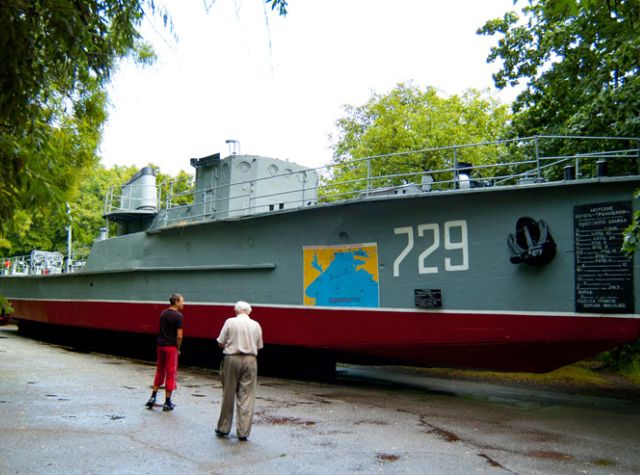 A barrage of all kinds of anti-aircraft fire was opened, but the shells continued to burst, sowing panic and death in the enemy camp. The operation planned by the Nazis was thwarted. The battery commander Captain I.N.Nikitenko received a thank-you telegram from the Commander of the Southern Sector of Odessa defense.
During the defense of Odessa large naval forces of the enemy in the Black Sea was not, and our land forces had negligible artillery (a little more than three guns per 1 km of the front), so the coastal batteries shifted fire to support the land forces, in order to destroy manpower, artillery, tanks, command posts and other enemy facilities.
 411 battery of coastal artillery during the period of defense of Odessa made 220 combat firing, including on:
— concentrations of manpower and equipment — 108,
— command and observation posts — 24,
— artillery batteries — 72,
— automobiles and tanks — 16,
2119 shells were expended, more than 200 tons of deadly cargo were dropped on the enemy’s head and more than 3000 enemy soldiers and officers and a lot of military equipment were destroyed. 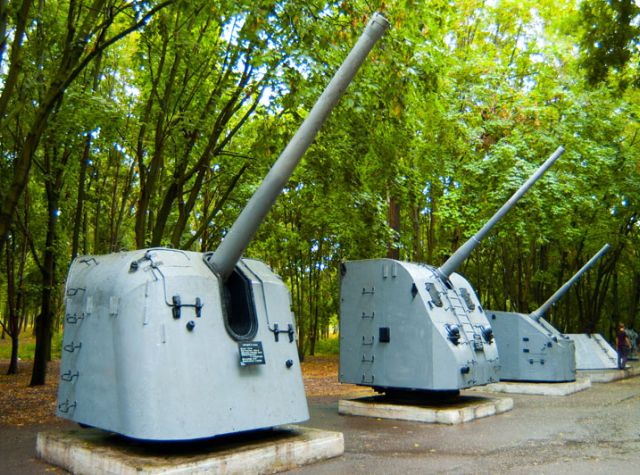 In the night of October 16 the battery covered the withdrawal of our troops from Odessa. That night 230 shells were spent. At 4 a.m. on October 16, 1941 by order of the command the battery was blown up (2 tons of tol was used to destroy the battery), the personnel was evacuated to Sevastopol. This is how the 411th battery ended its existence, having made a worthy contribution to the seventy-three-day defense of Odessa.
Today the Museum of Heroic Defense of Odessa is a unique historical complex. This complex includes an open-air exhibition, representing military equipment of the Great Patriotic War, the memorial «Sad Memory of the Century», the park, in which the defense line with firing positions of mortar and artillery batteries, trenches, opened in 2009 the Church of St. George the Victorious, 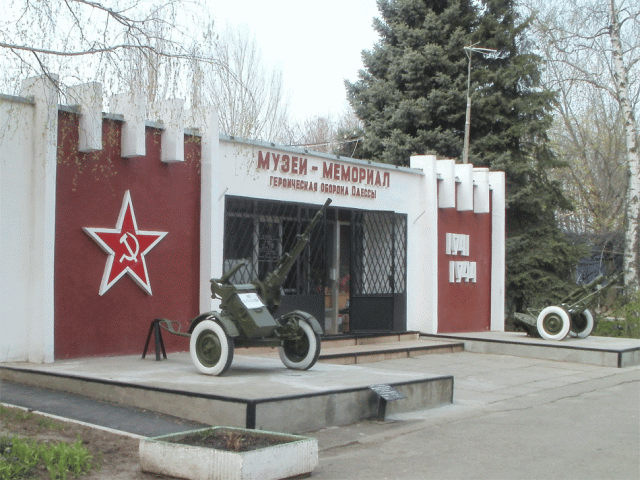 as well as the building of the museum itself. A concrete stele «Katyusha» is installed at the entrance to the museum’s territory
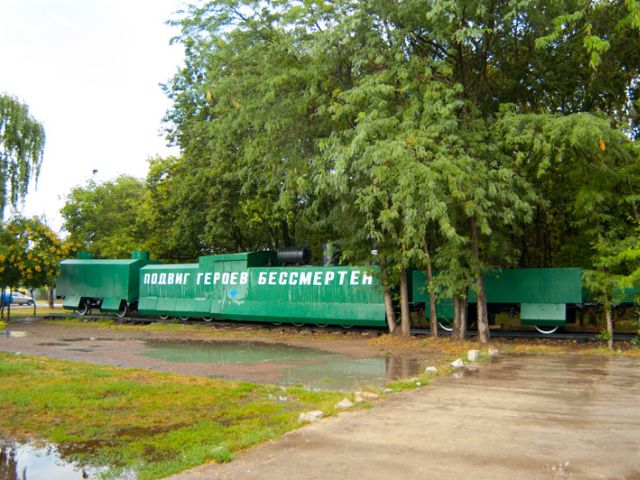
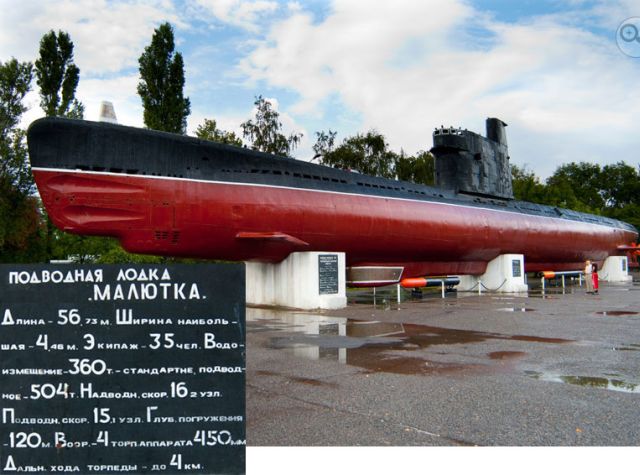
The open-air exhibition presents visitors with the most interesting exhibits, including the famous Odessa tank «On the scare». The tank is an ordinary tractor with cannon or small arms, covered with boiler iron armor. Also here you can see a tramway running along the route Odessa-front, on the section of railroad tracks there is an armored train. The submarine «Malyutka», T-34 tank, torpedo launchers, mortars, cannons and many other things that can be seen in the open-air military museum in Odessa are of great interest to the lovers of technology.
In 1989, in the north-western part of the memorial, an Alley of Memory was created by the parents of the military men killed in Afghanistan. Together with the sculptural composition this complex was called «Sad Memory of the Century». 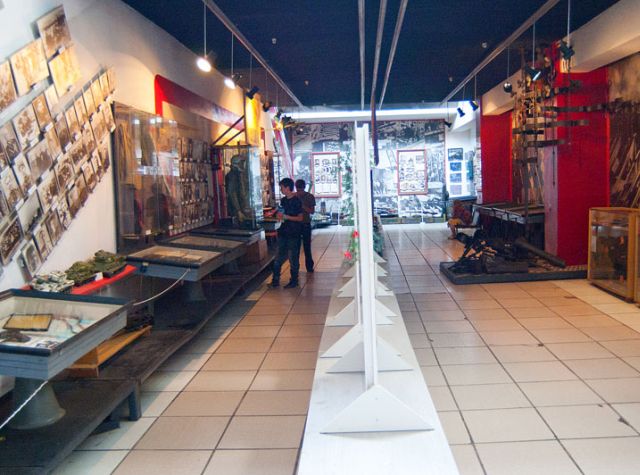 The alley, planted with oak trees, is about 500 meters long, with metal emblems of hero-cities along it.
Walking through the park, thanks to the restored line of trenches, firing positions of artillery and mortar batteries, you can see how this place was almost 70 years ago, when the citizens of Odessa heroically defended their homeland from the enemy.
In the museum building, consisting of four exhibition halls you can get acquainted with the «soul» of wartime — personal belongings of soldiers who heroically defended Odessa, see their weapons, military maps. There are also important documents, photos, models of military equipment: 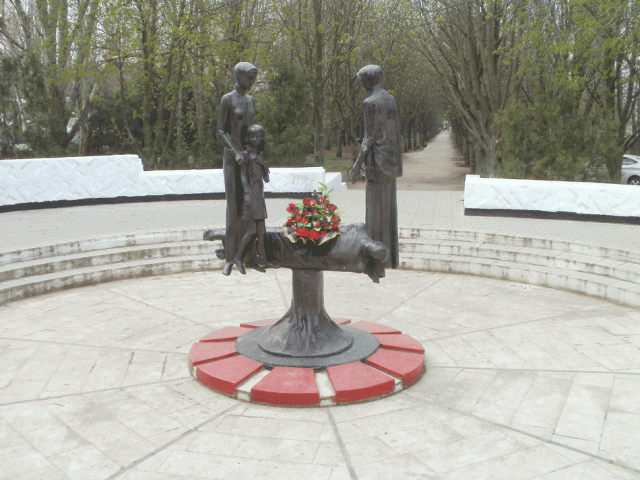 aviation, tanks, ships of the Black Sea Fleet with stories about the crew, dioramas «Command Post of 411 Battery» and «Battle for the settlement».
The thematic exposition in the museum building was called «The years of the Great Patriotic War go farther and farther into the depths of history, but time has no power to forget them, to erase them from people’s memory». Memorial to the heroic defense of Odessa — a place designed to preserve the memory of the hard years of war, the bravery and courage of people. Here you can see a lot of interesting things, remember your ancestors, thanks to whom the Germans could not subjugate free people. That is why in the Museum-Memorial of the Heroic Defense of Odessa you can always see not only veterans and their families, but also students and tourists who want to see the important sights of Odessa, keeping a piece of its soul.