Odessa has always been a cosmopolitan city. For centuries, it has been home to Greek and German colonists, descendants of French aristocrats, Moldovan and Ukrainian peasants fleeing from their masters, and Russian officials exported here by Catherine the Great to better oversee the fertile Black Sea coast.
A special layer in the ethnic «pie» of Odessa has always been occupied by Jews, attracted by the commercial potential of this city. But, from the «pre-revolutionary» 124 thousand Jews, who constituted almost 37% of the population of South Palmyra, only 12.4 thousand remained until the beginning of our century, which is only 1.2% of the current ethnic structure of the city near the Black Sea.
The main reason for the almost tenfold decrease in their numbers is the Holocaust. This terrible word refers to the mass extermination of Jews and Roma, which was initiated by the National Socialists who came to power in Germany. In 1935, the Nuremberg Laws were passed, which gave the go-ahead for the crystal nights, Jewish pogroms, ghettos and concentration camps. The Holocaust came to Ukraine and directly to Odessa in the fall of 1941, when the territory from the Dniester to the Southern Bug was occupied by Romanian troops.
They formed the Governorate of Transnistria here, ideologically completely subordinate to the government of Nazi Germany.
Already on October 19, 1941, more than a thousand Jews and prisoners of the Red Army captured on the street were burned alive in artillery warehouses on the Lustdorf Road. After that, 10 thousand hostages accused of terrorist attack in the NKVD building on Marazlievskaya Street were executed. Further 5 thousand people gathered at the Dalnik outpost were killed in different ways. At the end of 1941 there were only about 60 thousand Jews left in the city. They were obliged to wear Stars of David on their chests, and the process of extermination was «improved» by creating ghettos and concentration camps (Golta, Bogdanivka, Domanevka, Sirotske).
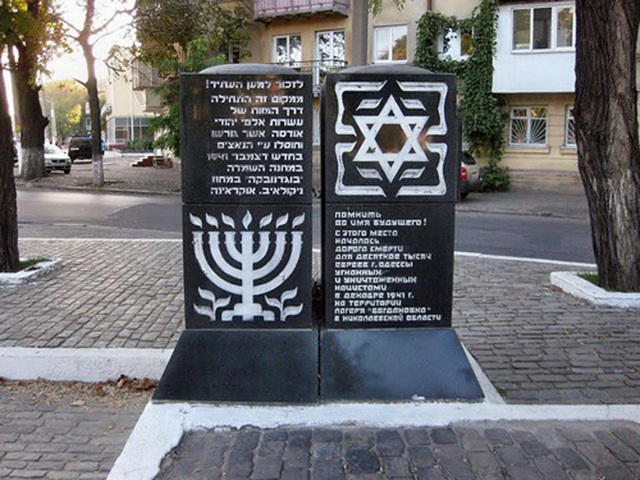
In 1990 in Odessa, at the place where the «death march» of Odessa Jews once started, initiative groups began to create Memorial to the victims of the Holocaust. The construction of the memorial complex began with a memorial sign — a paired granite stele with a magendovid, a menorah and an enumeration of all black dates in the history of the Jewish community embossed on it.
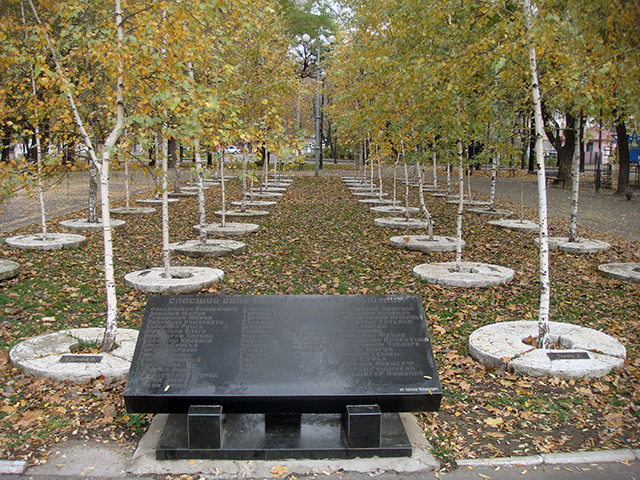
Later, the «Alley of the Righteous of the World» was created. The number of trees on it is equal to the number of Odessa residents who saved the lives of people of other nationalities. Each tree has a nameplate in honor of whom it is planted. And the general list of Odessa’s righteous people is imprinted on a huge granite slab that opens the alley.
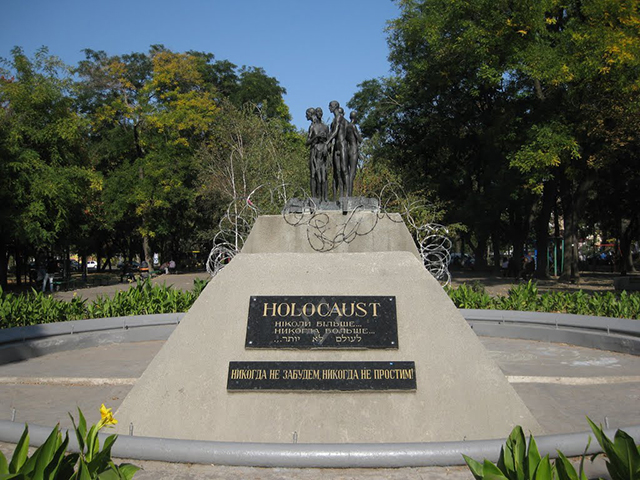
The last step in the creation of the memorial was the monument made by Zurab Tsereteli. The famous Russian sculptor of Georgian origin created a monumental composition that demonstrates the horror of what happened.
Tsereteli’s monument is a three-stage cone with a wide base and a cut top. It is fenced with barbed wire. The cone symbolizes the number of people killed by the Nazis. On the upper platform of the cone there is an imitation of a bonfire. In it, holding hands, but chained together, stand five emaciated naked men. People who see this memorial begin to realize the magnitude of the crime without any explanation. The memorial was unveiled in 2004.
The Holocaust Memorial and, opened in 2009, the «Odessa Holocaust Memorial Museum» cannot be called attractions of Odessa. They are much higher. They are a memory of a genocide that must not happen again. Thousands of Jews, citizens of the United States, Israel and Australia travel to the Black Sea region every year to worship the victims and tell their children the story of their people.