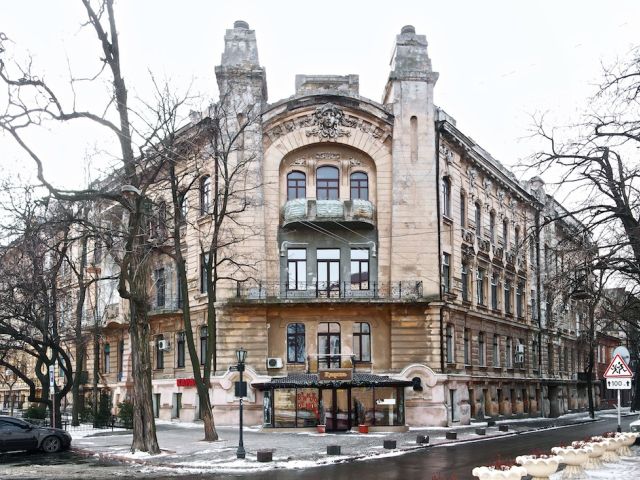
The mystical sculptural depiction of a girl’s head with a noose around her neck that decorates the house on the corner of Marazlievskaya Street and Nakhimov Lane is unique. This element of the facade is called a mascaron. And this particular mascaron is also the largest in the city. But this is probably the least of the reasons for its uniqueness.
The rope twisted in a bizarre pattern around the girl’s neck has been making Odessa local historians and art historians puzzle over the general meaning of the sculpture for decades. There are several legends about what this beautiful lady with a noose symbolizes. According to one version, the bas-relief on the building is a reminder of the hanged girl. According to another version, on the site of this mansion was once a house in which beautiful girls were lured under various pretexts and later transported by sea to Turkish harems.
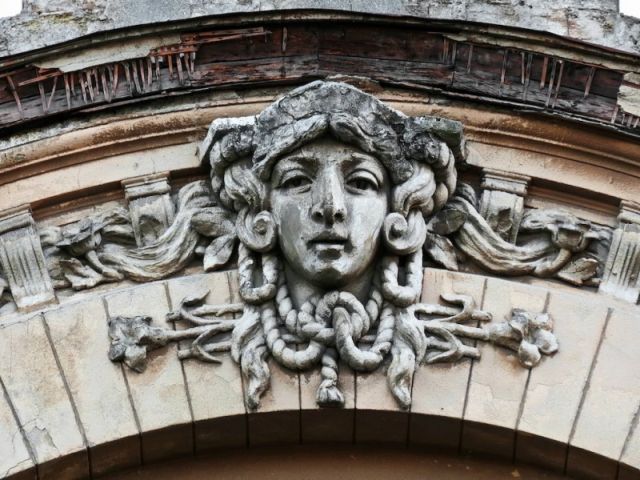
It is said that there was even an underground tunnel beneath the house that went from the building to the seashore. But none of these speculations have yet been documented.
According to the reference book «All Odessa», the house was built in 1903 on the site of the plots of A. Faltz-Fein and P. Mavrokordato. In the register of monuments of cultural heritage the house at the address Marazlievskaya, 2 is listed as «The House of M. D. Lutsky«. It was designed by one of the best modernist architects of Odessa — Moisey Isakovitch Linetsky in co-authorship with Samuel Savelyevich Galperson. Subsequently, the building changed owners at least twice. In 1908 the house was purchased by a certain O. V. von Besser, and, according to the directory «All commercial and industrial Odessa» for 1914, the house is already listed for G. E. Fukelman. According to the author of the article «Along Marazlievskaya…» Tatiana Zayarnaya, the house once housed «a branch of the Noble and Peasant Banks, located in the house of Marazli, located in Baryatinsky Lane, facing Marazlievskaya».
 .
.
The Peasant Land Bank later moved to a specially built building for it at 34-a Marazlievskaya Street, while the Noble Bank operated in this house until the Revolution.
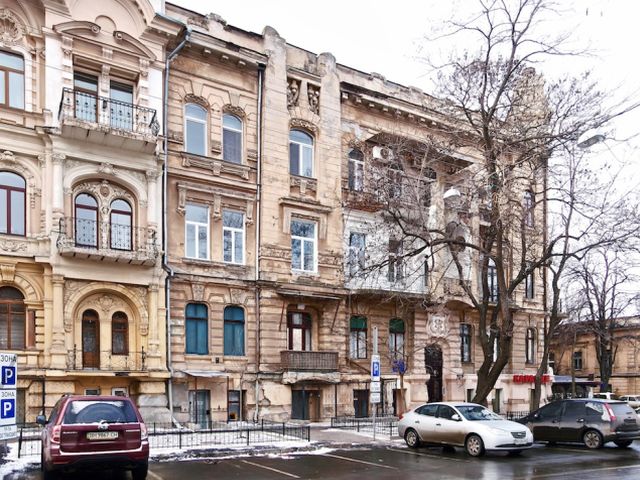
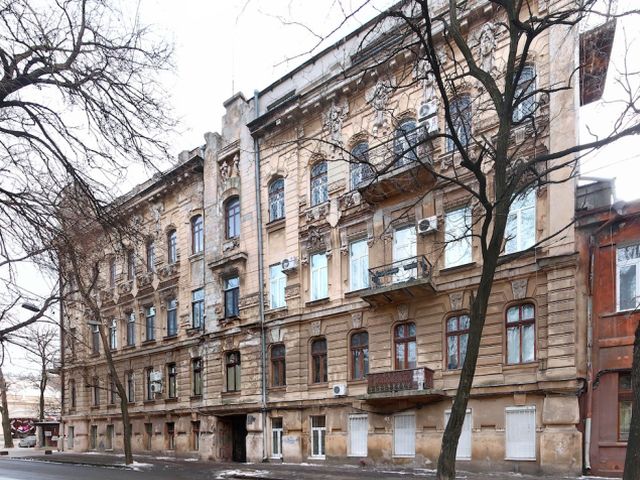
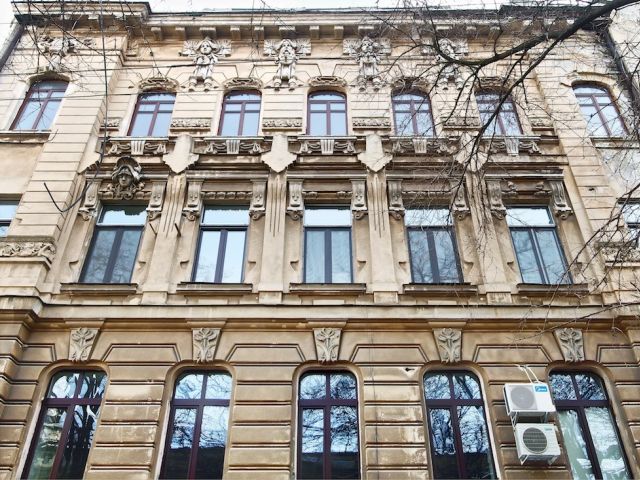
Lutsky’s house in plan has a rectangular shape, stretched along Nakhimov Lane, with a large courtyard and a cut corner at the intersection of the streets. In general terms, both facades along the red lines of the streets are decorated identically, but there are differences. The entrance to the apartments located in the Marazlievska wing is equipped directly from the street. Although the house under consideration is made in «pure» Art Nouveau, echoes of eclectic architecture are still present to a small extent. These include the shapes of the window openings, staircase railings, the platbands of the first floor windows, vases (borrowed from the Baroque period, once crowning the attic of the house and now lost), carved window frames and the decoration of the courtyard facades.
 .
.
In addition to the vases, the house has lost some truly significant elements over time. The corner part of the building was once crowned with a massive attic-postament, which served as a base for the sculpture of a reclining lion. The pylons flanking the corner were exquisitely and lavishly decorated, ending with large sculptures of eagles. The mascarons of the last floor on the side of Marazlievskaya were lost every single one, but preserved on the side of Nakhimov Lane. Most of the balconies have lost their stone fence posts, however, for the most part, the wrought iron elements have been preserved. On the corner, on the first floor, there was a commercial premise and the house had a corresponding solution of the facade in that place, but now it is closed by an annex or destroyed.
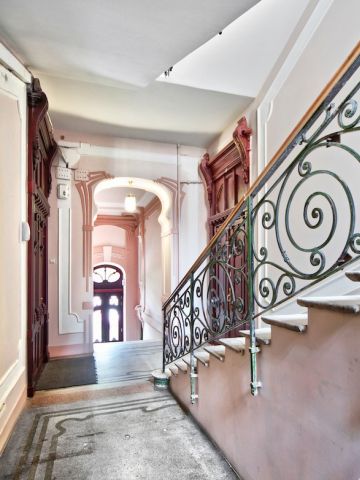
Despite its impressive size, the Lutský house has only two entrances and one back door, which can be accessed from the courtyard. The facade decoration finds a logical continuation in the interior of the entrance on Marazlievska Street.
Even the frames of the concrete-mosaic platforms are in the Art Nouveau style. The most interesting of them is located at the foot of the stairs, in the sluice, and nowhere else in the pattern is not repeated. Here Art Nouveau in stone ends and Art Nouveau in wood begins. The stairwell has marble steps and concrete-mosaic platforms. The railings are eclectic, of a common pattern. The walls are covered with classical frames, found in some buildings of the late Eclectic period. Only the magnificent carved doors and window frames, as well as the framing of the concrete-mosaic platforms, remain modern. Some of the apartments still bear in their design echoes of the former splendor. On the fourth floor, for example, a niche with an antique statue and, supporting the floor beams, paired brackets with small mascarones inscribed in them have been preserved.
The most significant chapter in the history of the house is now captured on a memorial plaque on the corner of the building’s facade: «In this building, in 1910-1911, lived the Russian writer Oleksandr Ivanovich Kuprin». A portrait bas-relief of the writer is also installed here. Lutskiy’s house is also connected with another outstanding name. In 1925-36 in this house lived a scientist in the field of hydraulics Prof. V. N. Pinegi.
Today the Lutsky House is a rattling mixture of residential apartments mixed with various offices and companies: from a travel agency and the Consulate of the Republic of South Africa, to an industrial waste recycling company and even a fabric and accessories studio.