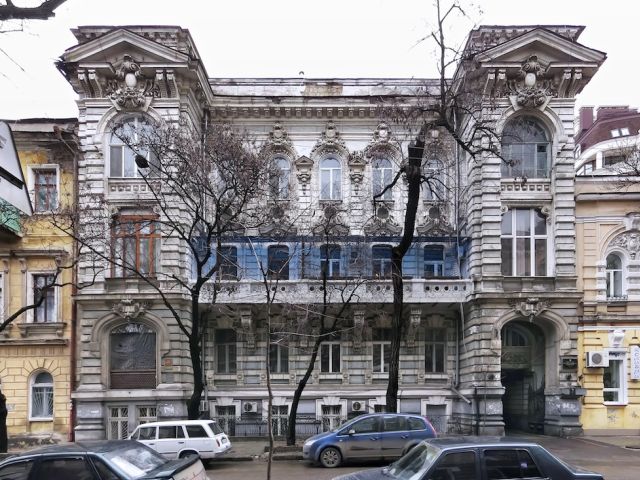
The Korone Income House can be considered one of the most beautiful residential buildings in Odessa and the best creations of the bright and talented architect Moisey Isakovitch Linetsky.
In 1899 S. Kuzminsky, who owned the plot on Kanatnaya Street, 7, sold it. Kuzminsky sold it to Nikolay Georgievich Korona, a well-known merchant of the first guild in the city, who owned the famous restaurant in Alexandrovsky Park.
The order for the project went to the architects M. I. Linetsky and G. F. Lonsky. It is quite curious that Lonsky, who lived two blocks away from Korone’s property, designed and built mainly for the owners of plots located nearby. The expressive and ornate Korone house was completed in 1901, during the heyday of modernized eclecticism and the birth of Art Nouveau traditions of decorative and ornamental stylistics in the city. The large courtyard wing was completed by the end of 1903, and the development of the Coronet site ended there.
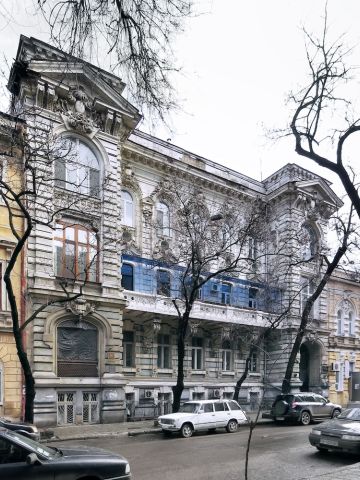
M. I. Linetsky and G. F. Lonsky were completely equal co-authors of the project, and the handwriting of both architects is clearly visible in the design of the main facade and interior decoration of the house. The idea of a large-scale and expressive facade with two powerful risalites on the edges of the facade plane and a number of elements of decoration (for example, a continuous linear rustication) undoubtedly belongs to Lonsky, while Linetsky is characterized by huge loggia openings, very rich relief rustication (including heavy mascarones), a lot of decorative details brought here from other works of the architect and transferred to subsequent ones.
The main facade of the building can be referred to as one of the most exquisite in Odessa.
Its spatial layout is very simple. The facade has a width of seven window axes, the outermost of which are emphasized by the risalites extended on the red line, while the facade plane between them is shifted deep into the site. The interconnection of the elements is achieved by a spectacular second-floor balcony that visually unites the risalites.
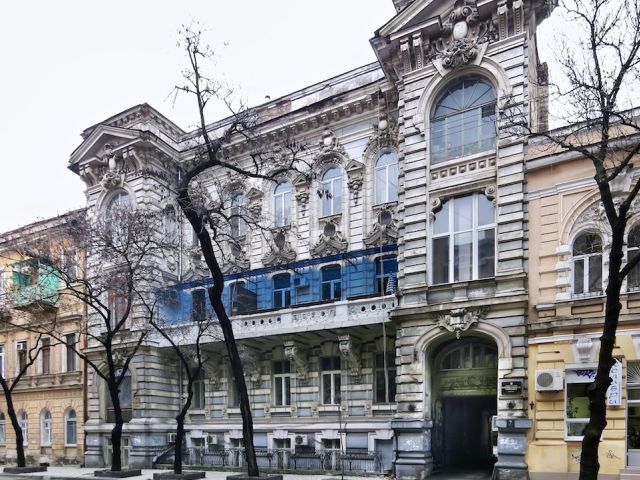
The first floor is lavishly decorated, but the vast majority of elements here are deliberately enlarged and simplified compared to the decoration of the two upper floors. On the front planes of the risalites outlined two huge openings of modernized outlines, the left-hand side of which is a deep loggia, and the right-hand side plays the role of the portal of the passage arch. Their capstones are in the form of opulent Baroque cartouches, the composition of which consists of unfolded parchments and palm branches on the sides.
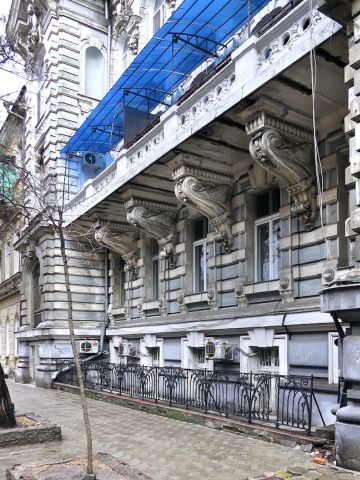
The house is equipped with a semi-basement and its windows are highlighted by massive platbands with simple capstones. The windows of the first floor are similar to those of the semi-basement, but the platbands are rusticated and the sills are decorated in the Early Modern manner and supported on small consoles. The lines of continuous rustic partitions and platbands are inseparable.
 .
.
The basement and first floor are separated by a simple but distinctive cornice that extends the full width of the facade, including the risalites. The same cornice is located between the first and second floors at the level of the balcony platform.
On the following floors, the degree of lavishness of the decoration increases. The above-mentioned second-floor balcony is equipped with a fence in the form of a continuous stone balustrade, the number of sections of which is equal to the number of window axes outside the risaliths. The balustrade is heavily decorated and visually facilitated by a rhythmic row of small round openings. The balcony is supported by large consoles located in the partitions of the first floor. Their opulent decoration and general outlines echo similar elements in the house of M. I. Ambelikopulo on Diedrichson Street (for a long time erroneously listed as the creation of architect A. O. Bernardazzi), built by M. I. Linetsky in the following year 1901, for which the Corone house served as a direct prototype in the design.
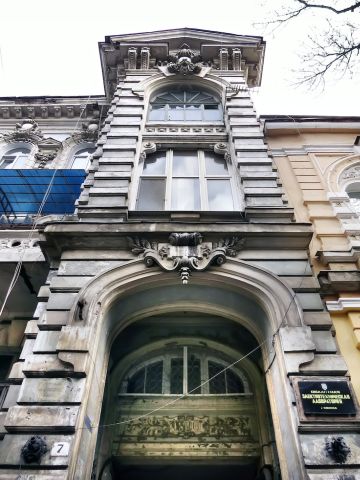
The walls of the second and third floors, as well as of the first floor, are treated with spectacular horizontal pulls of linear rustication, which enhance the expressiveness of the facade and counterbalance the pronounced verticality of its composition as a whole. The front planes of the risalites are occupied on the second floor by rectangular openings of large loggias, in the upper corners of which small figurative consoles are placed in order to give them elegance and picturesqueness.
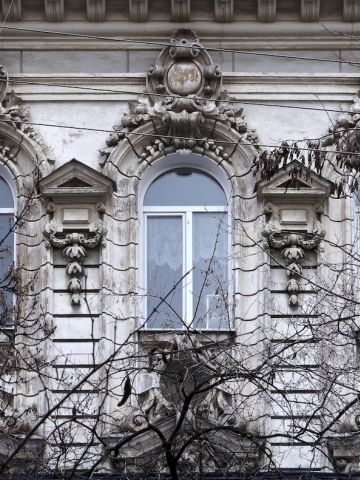
Probably, according to the original plan loggias were not glazed, but nowadays their openings have been turned into huge windows. The loggias are compositionally united with large semi-circular windows of the third floor, the apertures of which are supplemented with massive capstones and impressive cartouches. Under them are mascarons of mythical creatures, the image of which is probably a figment of the architects’ imagination and has nothing to do with canonical mythology.
 .
.
The rich baroque plasticity of the third floor contrasts with the heavy decoration of the first floor, creating a contrast that transforms the building into a living organism filled with the dynamics of invisible movement.
If we evaluate the Korone income house as a whole, it is worth noting its undeniable architectural and town-planning significance for this part of the city. The level of architecture of the building corresponds to the best examples of exquisite revenue houses on the neighboring Marazlievskaya. Thanks to the plasticity of the volumes and the original spatial layout of the main facade, the architects managed to distinguish the house from the continuous frontal development of the red line of the quarter.
Due to its high architectural and artistic qualities, the Korone House can rightfully be called one of the most beautiful residential buildings of Odessa of the turn of the XIX-XX centuries.