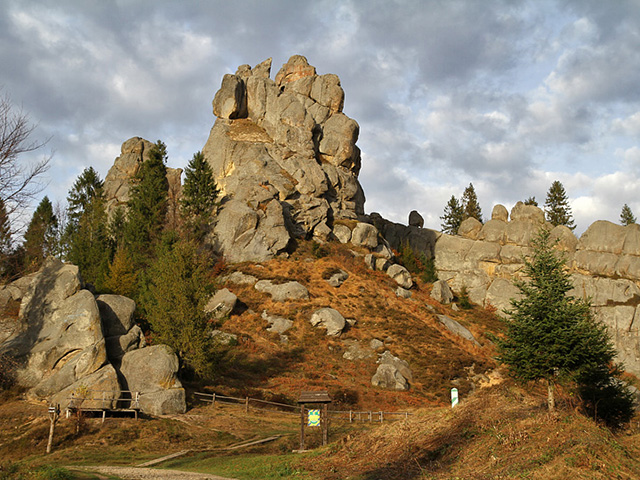
 Tustan is the only Carpathian dragon in the world
As the treasury of King Croesus is filled with countless gold and semi-precious stones, so the intermountain valleys of the Carpathians are filled with the best sights of Ukraine. There is the «valley of daffodils», Dovbush rocks and Rozgirche cave monastery, wooden Lemkovsky churches and myriads of liters of precious water that can heal any body. A separate place in this Carpathian treasury is occupied by Tustan Reserve, which combines the bounty of nature with the titanic work of the first Slavs.
The reason why a fort appeared in the picturesque valley of the Eastern Beskid was the peculiarities of the local relief. These are the Urich rocks, raised above the valley to a height of about 55-75 meters. They were formed in the Mesozoic-early Cenozoic period by sedimentary rocks that fell to the bottom of the Tethys Ocean, which once raged over the area. During the Alpine epoch of mountain formation, the ocean receded and the soft sandstones were crushed into folds. Because of the low hardness of the sedimentary rocks, they were easily exposed to weathering and water erosion. Those who visit these places will be surprised by the number of cracks, caves and potholes in the rock mass formed by the destructive forces of wind, water and temperature surges. Thanks to such «work» of exogenous forces of nature, the profile of the reserve looks like a dragon lying down on vacation in the Carpathians.
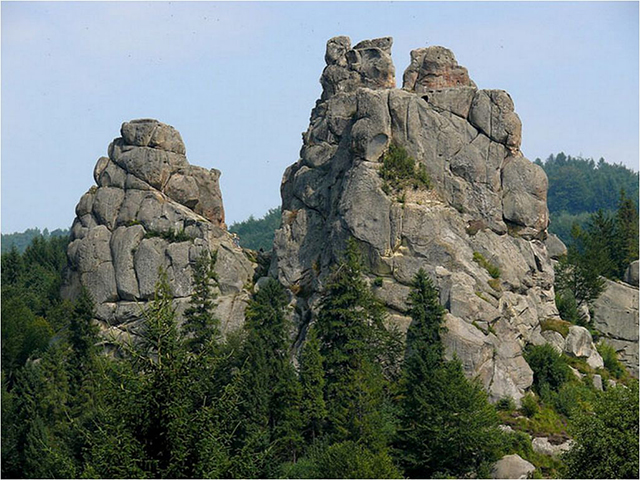 The amazing, terrifying rocks have long attracted people. Even a thousand years before the birth of Christ, a pagan temple of Thracians of the Hallstatt culture was equipped in them. From the people of the Bronze Age on the rocks, and especially on the Stone, petrographs depicting the sign Solarius, that is, the Sun, have been preserved. With the same period is associated the emergence of one of Tustani’s visages — a giant rock face of a formidable pagan deity. By the way, similar primitive «photos» carved in stone have been found in the places of Mayan settlement.
The benefits of the economic and geographical position of the mountain settlement were appreciated by the White Croats, one of the tribes that replaced the Thracians. It is clearly known that from the IX to XIII century this Slavic tribe controlled the Salt Route, which went from Galicia to Europe. There is a version that city-fortress Tustan was one of the strongholds of the Silk Road, for which it received a duty. Confirmation of the above are artifacts recovered from the Tustan soil: rings, gold Arabian dirhams, maces, as well as arrowheads-copies-crossbows found in bulk.
In order to defend their riches gained from trade operations and duties, the tribal nobility of the White Croats started building a fortress. The peculiarity of this structure is that it was not carved in stone, but was built over a rock made of wood, as evidenced by the numerous grooves and remains of fastenings. Staying in Skhidnytsya, you will be able to see the remains and reconstruction of the only architectural construction of this kind in the world, as original as the Chinese Wall or the Hanging Gardens of Semiramis.
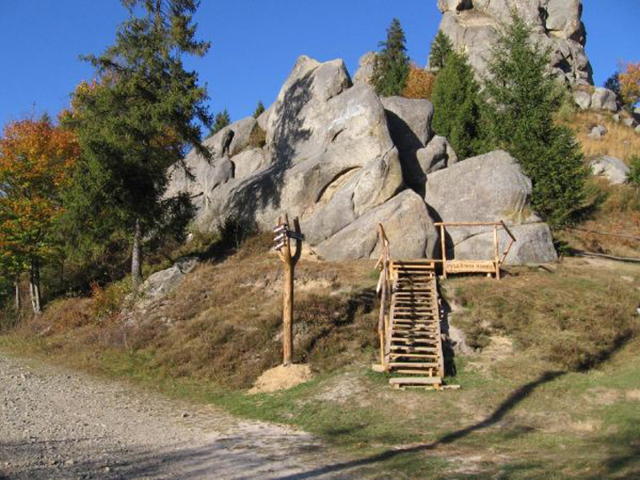 Unfortunately, the appearance of this ancient Slavic fortification was spoiled by the Mongol-Tatars and the army of Casimir the Great, although the latter repented of it and ordered to rebuild the fort. Under the Poles, Tustan played the role of a border fortress, but inexorably lost its position as a transit trade point. And in the XVI century, its fortification parameters were much inferior to all Polish fortresses. In 1539 its remains and the surrounding land were taken over by the magnate Blitzinski.
The sample of Slavic architecture of the pre-Mongolian period attracted here many outstanding personalities: Ivan Frank and Daniel Halytsky, Lesya Ukrainka and the whole author’s team of the movie «Zakhar Berkut». Today the Tustan Reserve has been created here, the reins of which are shared between the Lviv Historical Museum and National Park «Skolivskie Beskidy».
The Old Slavic fortress has taken a worthy place in the list of attractions of Ukraine. To see it, many who are on vacation in the Carpathians, spare no time to stop by the Skolivskie Beskidy and look for the village of Urych with its dragon-shaped relief. Naturally, those on vacation in Skhodnica, Morshin or Truskavets have the best chance of finding a coin or an encolpion cross.