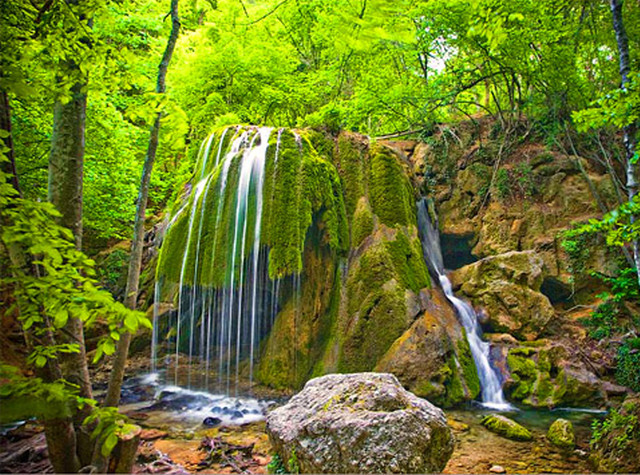
When writing about some remarkable places, the epithet «the most» is not sparing. The description of Crimean waterfalls is not without it. Uchan-Su we have the highest, Jur-Jur — the most full-flowing. Waterfall «Silver Streams» neither height nor fullness does not impress, and yet, it is also «the most». The most beautiful, the most unusual, the most lyrical, etc.
People who would not be delighted by the «Silver Streams», I have not met. In summer, whole crowds of excursionists flow to it and all return enthusiastic and in high spirits.
Even surrounded by bustling visitors, the waterfall does not lose its charm.
 .
.
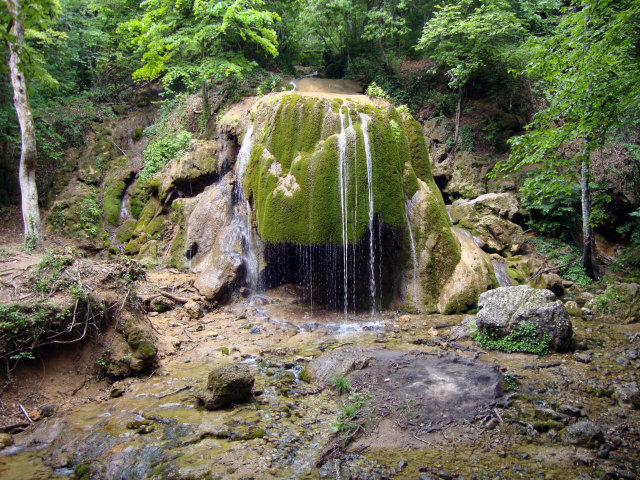
But during the cooler months, when the resort rush dies down, Silver Jets is doubly beautiful. All overgrown with green moss, it stands lonely among the forest, dropping thin, really silver, streams. The water flows smoothly down the rounded tufa tread, under which the cavity of a spacious grotto is black. If you look at the waterfall from the side, it looks like a massive beast, tilting its steep-headed head with a small trunk from which water drips. It reminds me of a crying mammoth.
It’s amazing what shapes nature can create. The sloping dome — the main decoration of the silver jets — is formed of limestone tuff deposited by the Sary-Uzen River over many thousands of years.
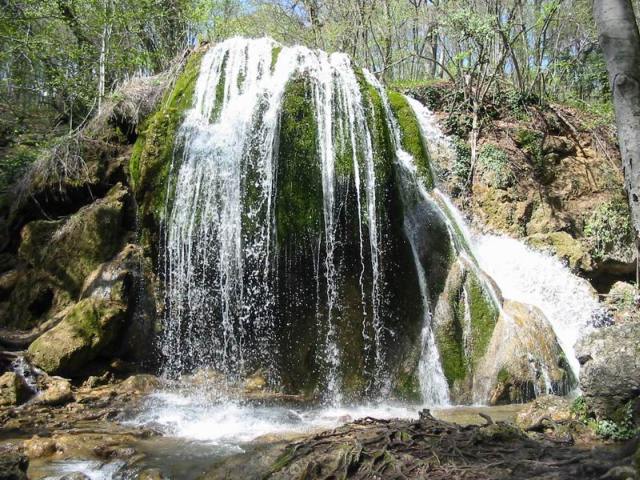
The spring-flowing waters of some mountain rivers contain a lot of dissolved calcium carbonate (calcite). Coming to the day’s surface the waters are exposed to different conditions and the calcite begins to precipitate out of solution. Curiously, tuff deposits are not formed on every mountain stream. The intensity of tuff formation depends not only on the content of dissolved calcium carbonate, but also on the temperature difference between the source and the river bed. The greater this difference, that is, the faster the water warms up, the more intense calcite precipitates. By the way, moss, abundantly growing on the «Silver Streams», also contributes to the deposition of tuff, as it absorbs carbon dioxide from the water. The less carbon dioxide in water, the lower its dissolving power. Deprived of carbon dioxide, water can no longer hold dissolved calcium carbonate, and deposits it in the form of limestone tuff.
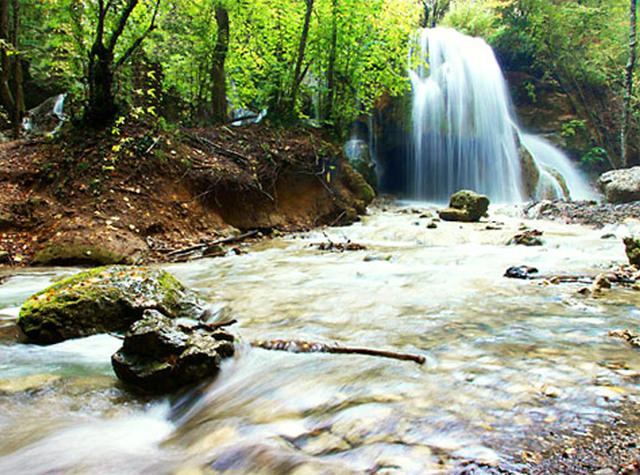
Tuff formation in the Sary-Uzeni riverbed is very fast. Among the stones, here, sometimes, you can find objects, a few years ago thrown by gore-tourists and had time to be completely covered with tuff crust. The name of the river is also directly connected with tuff. «Sary-Uzen» means «yellow river». The name reflects not the color of the water, but the color of the tuff, which covered the bed with yellowish-green layer.
At the beginning of the XX century, when Prince Yusupov liked to vacation in Kokkozakh, on his instructions an artificial lake was built on the Sary-Uzen River for trout breeding. This fish is capricious, it will not live anywhere else. It needs only clean and cold water. Here the conditions were almost ideal for the capricious fish — the dam was placed just a few meters away from a cold karst spring. The water had no time to get muddy or warm up on the way to the pond. Trout from here was delivered not only to the prince’s table, but also to Livadia for the royal family.
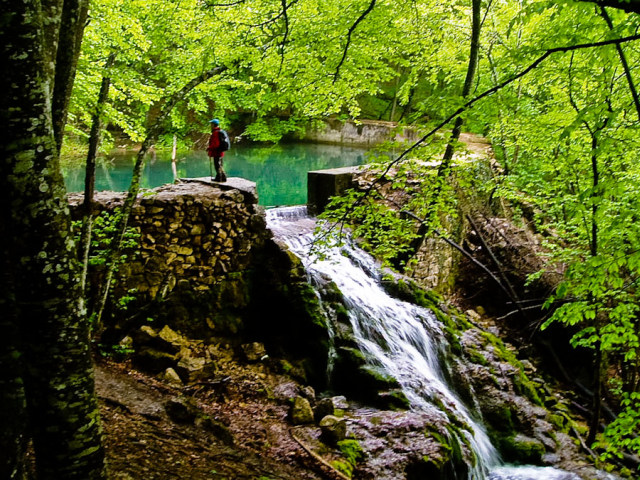
The karst spring that gives rise to the river can be viewed from the opposite side of the road that skirts Yusupovskoye Lake. It flows out of a narrow gap in the rock. This crevice is so small that it seems impossible to squeeze into it. Nevertheless, in the 60s, the local historian Sedov managed to get inside and discovered a spacious karst cavity. In its anteroom part there was an underground lake, behind it there was a waterfall, and even farther away there was a collapse gallery with deposits. This is how one more of the numerous Crimean caves — the Yellow Cave — was discovered.
Yusupovskoe Lake is located just above the waterfall «Silver Streams», in the bed of the same river Sary-Uzen, almost at its source. By the way, the Sary-Uzen valley is geomorphologically a continuation of the Grand Canyon gorge.
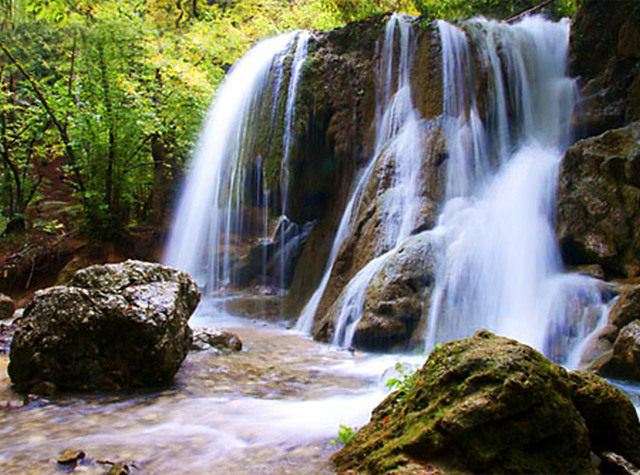
Interestingly enough, our waterfall has only recently become famous. Until the mid 90’s almost no one had heard about it, except for local historians and hikers. It had no name, you can say! In the book «Ai-Petri» by V. Dushevsky and Y. Shutov, published in 1986, this waterfall is mentioned as having no specific name and called by tourists as Magic, Crystal, or something else. But the 90’s came, the tourist business began to gain momentum and the picturesque waterfall, located not far from the highway (some 1.2 km), came into the field of vision of entrepreneurs. They equipped a convenient road to it, marked it, quickly came up with a sound name and the nameless forest waterfall became a local celebrity — the waterfall «Silver Streams».