 Built in a wonderful area, a fabulous medieval fortress with a castle, the turrets of which sharp peaks poke into the endless blue sky, amazes each of its beholders for more than six centuries. It was admired by contemporaries, Peter the Great dreamed to learn its secrets, only a hundred-thousand Turkish army was able to conquer it, taking the city, which was located within the walls of the fortress, by force. And today any guest of Kamyanets-Podolsky, the historical center of Podillya, an ancient city famous for its breathtaking, sometimes literally miracles, can see this fairy tale embodied in stone.
The history of the whole city began with the Kamyanets-Podolsky fortress, when in the middle of the XIV century Lithuanian princes decided to build an impregnable castle on the area surrounded by a deep moat and to establish a settlement where they would rule. According to legend, they were led to this place by a deer running away from them while hunting. But there is another version of the appearance of the «flower on the stone» — as Lesya Ukrainka named the fortress.
The image of the arched bridge on the famous Trojan Column in Rome, which looks very similar to the Castle Bridge of the fortress, which was discovered by supporters of the Roman origin of the city, allows us to say that the Kamenets-Podolsk fortress began to be built in the II century, but whether this theory is true for sure, no one knows. In any case, for the most part, the appearance of the fortress, which appears before tourists today, came down to our time from the XVI century, when all the wooden structures in the fortress were replaced by stone ones designed by architect Job Breitfus.
The fortress has the shape of an elongated polygon surrounded by high walls, which are crowned by towers at each corner. .
.
At different times local and Western European architects, among them M. Wlodek, M. Galician, Camillus, T. Schomberg, A.A. Glover de Gleiden, W. Rappe, Jan de Witte, S. Zavadsky, worked on the creation of its architectural appearance. The concept of the fortifications of the fortress is an organic combination of natural protection provided by the 40-60 meter deep canyon of the Smotrich River surrounding the rocky island, as well as artificial stone fortifications.
The only way to access the fortress is the Castle Bridge on the western side, which today connects the Old Town with the New Town. The fortifications on the territory of the fortress were built gradually, and six towers, Turkish and Armenian bastions, in addition to the main ones, Polish and Russian gates, a gunpowder storehouse and barracks have survived to this day. Fortifications, as well as many buildings in the fortress, have survived to our time almost in their original form, thanks to which a walk through it gives the opportunity to feel the atmosphere of a real medieval city. The logical culmination of the magnificent architectural complex is the medieval castle, which welcomes guests right at the entrance to the fortress after the Castle Bridge.
Even more interesting is the opportunity to visit the towers and part of the dungeons, where the expositions «The Last Acquisitions», «Castle Defense in 1672» and «Light Throwing Weapons» are located. Pictures from the past come to life here, the walls, untouched by modernity, take you back several centuries and leave you with vivid impressions.
Peter the Great was interested in the military secrets of this attraction, and modern 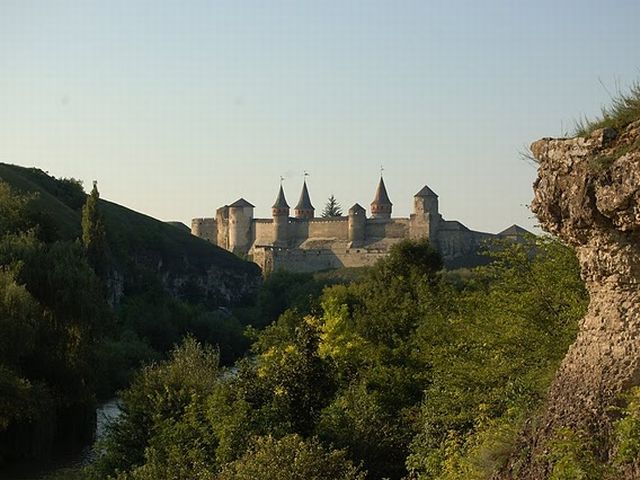 military experts, and ordinary people, getting to the territory of the fortress, get incredible impressions due to the feeling of touching history, beautifully preserved buildings. Each stone of ancient walls and sidewalks remembers the centuries, during which Kamyanets-Podolsk fortress rises above a deep cliff.
To say about this landmark of Kamyanets-Podolskiy that it is unique is not exaggerating — it is the only fortress city in the world, built on a peninsula washed by the river in the middle of the land.
The highest status of this landmark of Ukraine was confirmed in 1994, when it was included in the register of world cultural heritage, but no proof of its splendor is really required: it is obvious in photos, it is incredible in person.