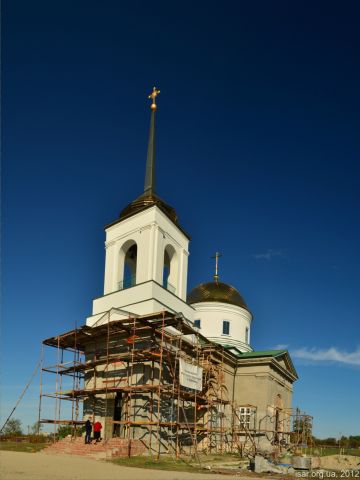
On the outskirts of the town of Primorsk stands a church — it is the oldest church in the Zaporizhzhya region. Its history is as follows.
In 1800, Count Orlov-Denisov, who later became famous during the Patriotic War of 1812, received as a gift from the tsarist government a large land plot of more than eleven thousand dessiatinas on the coast of the Sea of Azov. He transported several dozen serfs from his Ryazan estate and settled them on the left bank of the river, naming the new settlement after the name of the river — Obitochnoye. Soon Armenians, Germans, Poles, Jews settled in the village, which was located on the busy road from Crimea to Taganrog. There were also 24 families of the indigenous inhabitants — Nogais, whose administration in 1808 was located in Obitochnoye. In 1811, under the guidance of the count’s gardener Clerfon, the serfs laid a large orchard, which eventually became a kind of gardening school for the whole district.
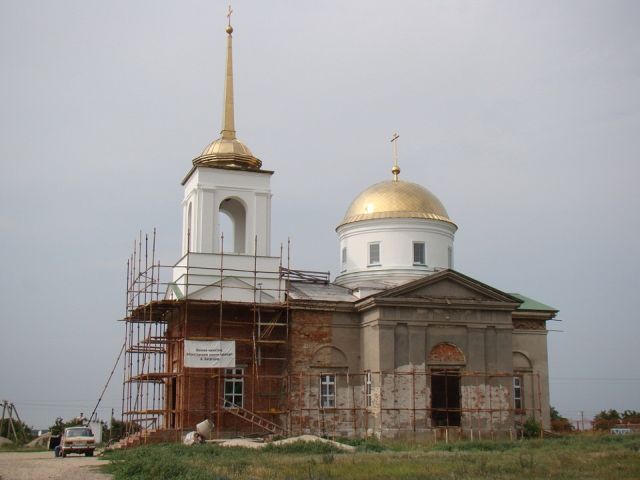
But from the first decades of Nogaysk’s existence only a small Trinity Church has survived until now. It was laid in 1813 on the territory of the village. Obitochnoye (now Primorsk) to commemorate the victory of the Russian Empire in the Patriotic War of 1812.
Initially the church was built of wood (years of construction 1813 — 1814), but after some time it was decided to build a church of stone, realizing the plan in 1836.
The built temple was consecrated in honor of the Holy Trinity. Then the church was painted by masters specially invited from all parts of the Russian Empire. The interior painting consisted of 12 frescoes, — 8 of which have been restored in our time. In this form the church existed until the 30s of the last century, when the bell tower was destroyed, and the temple was turned into a warehouse, whitewashed and painted in it the faces of the saints.
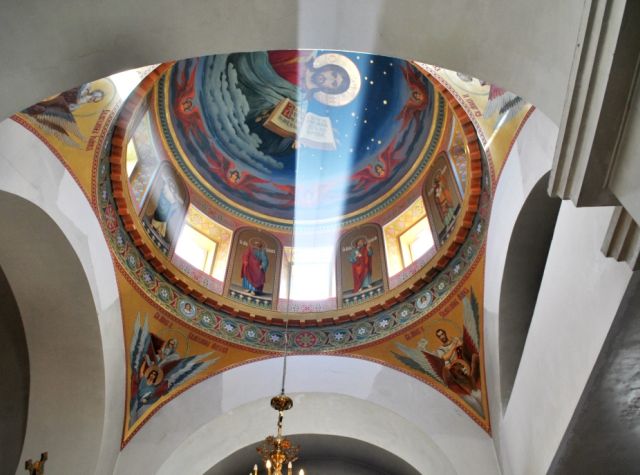
The structure in plan has a cruciform shape. Three of its end walls are treated in the form of four-pillared porticoes with pediments, and the fourth was adjoined by a bell tower, dismantled in 1933. The central volume of the building passes into a light drum, which has 8 window openings, and ends with a hemispherical dome. The mosaic of the XIX century is preserved on the floor.
By its architecture the monument belongs to the period of late classicism in Ukraine and is a monument of architecture. The rector of the temple for more than ten years is Father Dmitry.
Since 1991 the church belongs to the Orthodox Church again and opened its doors to the parishioners, actively operates and is gradually restored. There are also plans to establish a monastery next to the church.
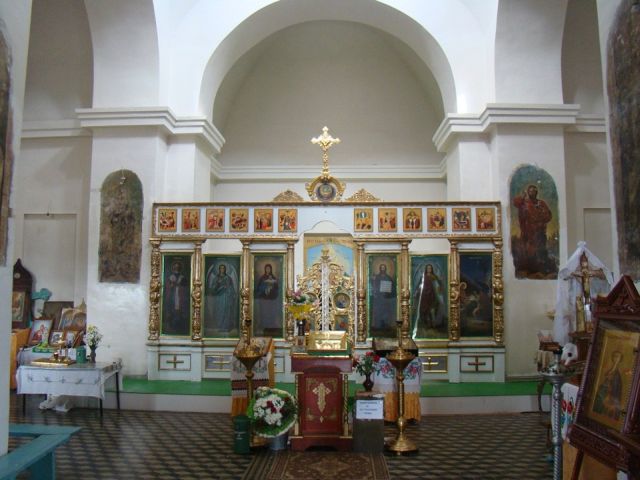
The temple itself is not without miracles! The icons of Christ and the Virgin Mary are myrotochivayut. And over the face of the Mother of God of Kazan sometimes appears a cross. Fr. Dmitry believes that the reason for this is the holiness of these lands. «The place was not chosen by chance. Here in the district there are four Holy Trinity churches — in addition to ours, there are also in neighboring Raynovka, Razdolovka and Petrovka. Here, take a look,» and shows a map of the district with the marked locations of all the churches. They form a Christian cross with a regular shape.