The town of Primorsk is so small that it’s hard to assume it has several «strong» landmarks and amazing history. So, this star Nova is located not in the constellation of Lyra, Perseus or Swan, but on the bank of the river Obitichnaya, carrying its waters into the Sea of Azov. At a distance of 3.5 km from Primorsk is the village of Kamyshevatka, which pleases every transit traveler with its name.
People inhabited the picturesque shore of Obitichnaya back in the Paleolithic. In the official chronicles this settlement appeared in 1770, when Russian troops stopped in the settlement of the Nogai people. In 1821 the city was named Nogai. But already in 1861 here, on the bank of the Obitichnaya River, began to settle Bulgarians who fled from Bessarabia. They were looking for a quiet place to live and agricultural labor. It is curious that every young Bulgarian, if he could not find a bride from his ethnic group, went to Bessarabia for a future wife. In this way Bulgarians tried to preserve the national monolithic character of their community.
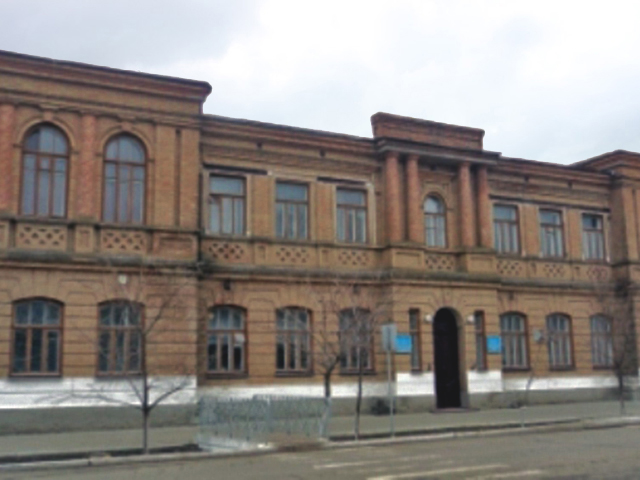
One of the ways to maintain the culture and language of this ethnic group was the local Bulgarian Pedagogical Technical School. It was opened in 1921. In this form, it existed until 1937, until the Ukrainian SSR began to stifle any manifestations of nationalism and ethnic identity. The task of the pedagogical technical school was the most banal — its graduates were to teach literacy to little Bulgarians, and those who were older — other sciences in their native language.
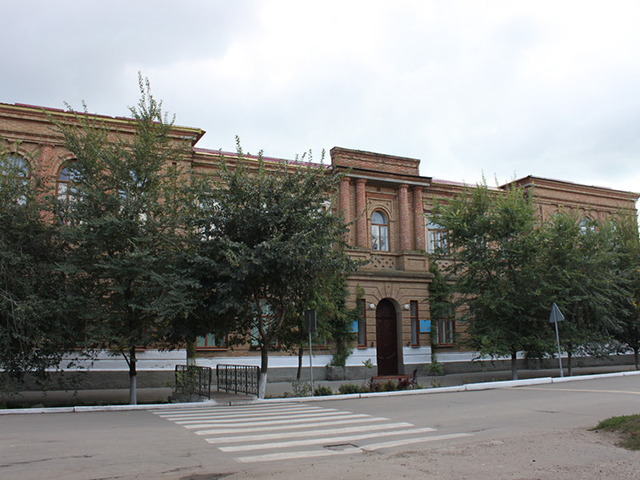
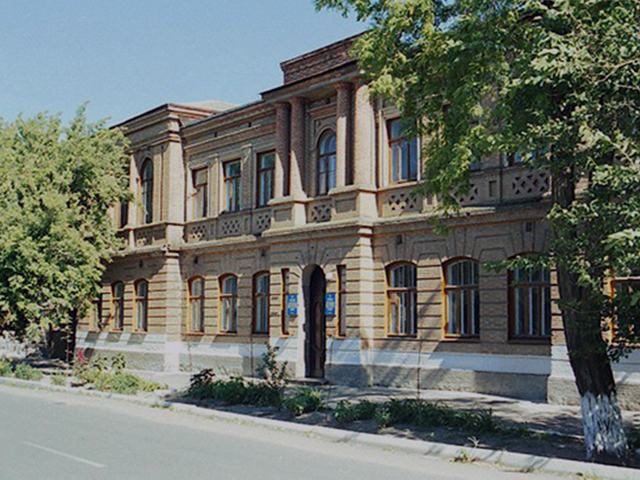
The Bulgarian Pedagogical Technical School was located in the best building in the city. It is a two-storey building in neoclassical style. The builders put it on a massive plinth. The facade is decorated with 3 porticoes and pseudo-columns. Each window on the first floor is highlighted with fluted molded sunbursts. Each window on the second floor is decorated with a pseudo-balcony. The building is clothed in a shaped sand-colored «coat» and covered with a plaque roof. The house is so old-fashioned that it seems to have stepped off the pages of Chekhov, Gilyarovsky or Isaac Babel’s novels.
 .
.
When Ukraine gained independence, the idea of reviving an educational institution for Bulgarians appeared. With the help of the national cultural and educational society and the assistance of the authorities of the Zaporizhzhya region, the Ukrainian-Bulgarian Lyceum appeared in Primorsk in 1996. In the south-east of Ukraine it became the same cultural oasis as the Bulgarian gymnasium in Odessa, the capital of the former Bessarabia, from where Primorsk dzhigits brought their wives.
Today the lyceum accepts pupils, and not only ethnic Bulgarians, to study from 8th to 11th grade. Bulgarian language is taught by volunteer teachers from Bulgaria. One of the problems of the institution is that the language of the national minority is introduced in the educational process only at the level of the variation component program. Work is underway to provide graduates of the lyceum with the opportunity to study in Bulgaria.
Naturally, that on the Ukrainian-Bulgarian Lyceum the sights of Primorsk do not end. The city has preserved the Holy Trinity Church, several pre-revolutionary buildings and 8 real stone babas. «Ladies» are collected on the territory of the local Museum of Local Lore and are living witnesses of the history of the Azov region.