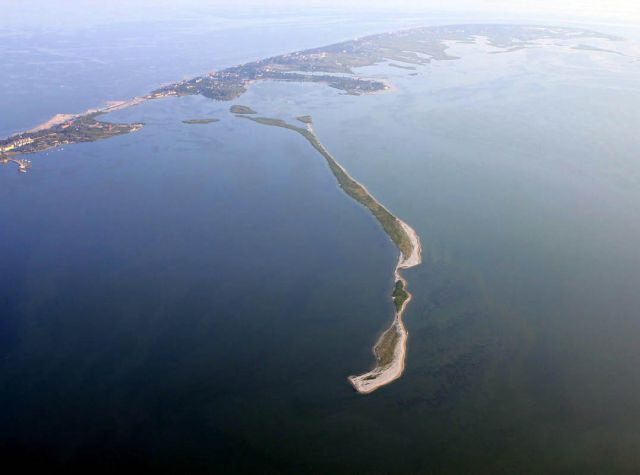
Berdyanskaya Spit is located in the north of the Sea of Azov, separating Berdyansk Bay from the sea. The spit owes its origin to the Berda River, which flows into the sea to the east of the base of the spit. The length of the spit is 23 kilometers, and the width varies from 40 meters to 2 kilometers. The area is about 7 square kilometers. Currently, Berdyansk Spit is located in the city limits of Berdyansk.
The earliest information about this area dates back to the V century BC. The territory of the modern North Azov is depicted on maps made by Strabo, Pliny the Elder and Herodotus. At that time Berdyansk spit was called Agarsky cape (from Agria — «excessive», «abundant»). The right bank of Berda became Russian in 1783, after the Crimean Khanate joined Russia. In 1827, the town of Berdyansk was founded near Berdyansk Spit, which later expanded to the territory of the spit.
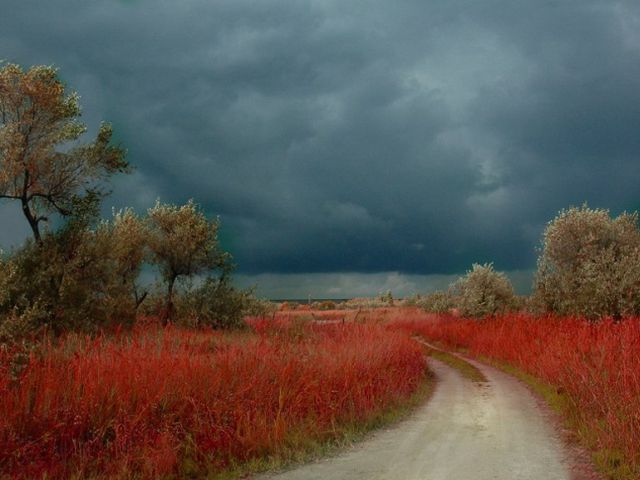
The Spit is a nature reserve of state importance.
The plant world is very diverse. There are more than 300 species of higher plants, some of them are included in the Red Book (e.g., Kolkhid sedge, Seaside bluebush). The vegetation cover is represented by plants with strong roots. To the west of the dune sand zone, the character of the vegetation cover changes, where predominantly representatives of steppes are found.
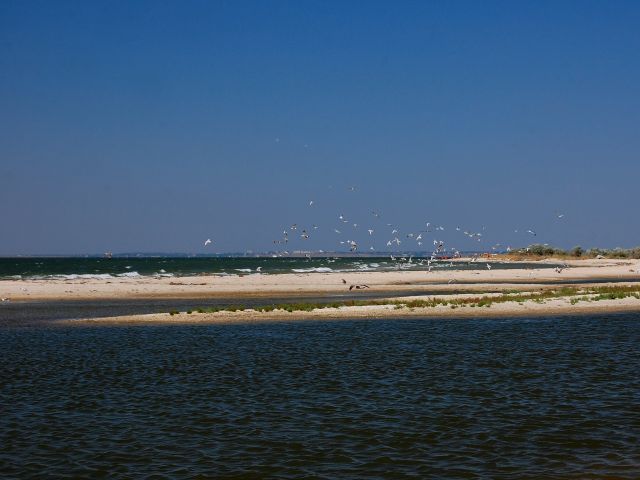
The local fauna is also diverse: insects, reptiles, birds and mammals. Although the kosa is a rather crowded place, hares, hedgehogs, martens, foxes, weasels and steppe cats live on its territory. A large number of birds live on the territory of the Spit: sandpipers, swans, herons, ducks, magpies, gulls, cormorants, reed warblers, and even more of them during migrations.
 .
.
The islands Big and Small Dzendzik, small islands of the Astapiha archipelago serve as a habitat for birds.
The ichthyofauna is also diverse: there are more than 70 species of fish in the sea, including beluga, sturgeon, Sevruga, flounder, pelengas, mullet, tulka, hamsa, taran, shemaya, pusanok, herring, needle, various species of gobies. The Sea of Azov is also called the sea of mollusks. It is an important source of food for fish. The most important representatives of mollusks are cockles, sendesmia, mussels. Dolphins appear in coastal waters.
There is a conventional division of the spit into Near, Middle and Far.
The sea coast from the mouth of the Berda River to the beginning of the spit is called «Verkhovaya».
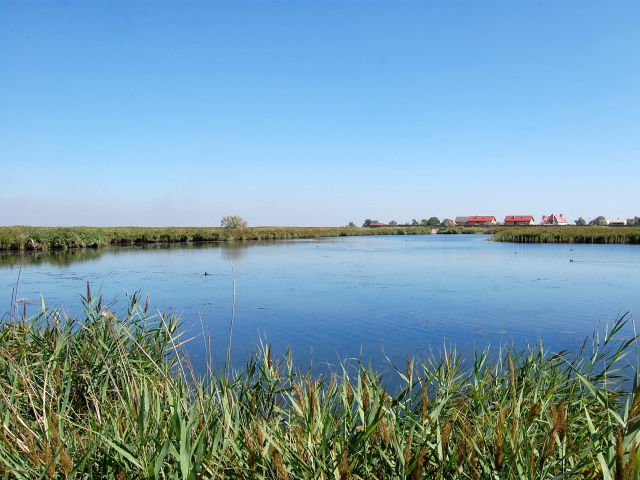
Almost near the very mouth of Berda in the XVIII century was located Petrovskaya fortress. Along the sea lie small salty lakes (Berdyansky or Sredny Liman, lakes Krugloe, Mazankovoe, Krasnoperoe, Long, Bolshoe, Krasnoe) and many absolutely small ones. Water salinity varies from 4-6 g/l in the Sweet Liman to 130 g/l in the Long Lake (almost like in the Dead Sea). The limans are a source of therapeutic mud. The whole Verkhovaya is a sandy beach. In the city limits there is a small landscaped area (beach «Lazurny»). At the very base of the spit (but still within Verkhovaya) is located mud and climatic resort «Berdyansk». Verkhovaya passes into the Near Spit quite imperceptibly, only the buildings and the beach of the sanatorium «Berdyansk» can serve as a note. From the side of Berdyansk Bay (very shallow in this place), the Near Spit forms a bend.
The width of the Near Spit reaches 1-2 km. On the open sea side there is a children’s sanatorium,
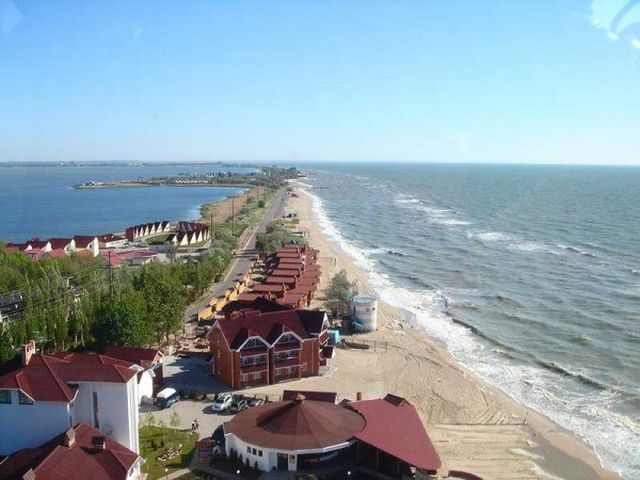
and on the bay side — children’s health camp «Gvozdika» and the largest on the whole territory of the former USSR Aquapark. From the children’s sanatorium along the sea (between the sea and the highway) stretches a chain of mud estuaries. Between the estuaries and the sea there is an unfurnished nudist beach. At the end of the chain of limans, the Near Spit passes into the Middle Spit.
The middle part of the Berdyansk Spit starts from Lake Krasnoye and goes to the island of Bolshoy Dzendzik. The Middle Spit is rather narrow, with well-maintained beaches and recreation centers. There is practically no private sector.
The far spit starts at Bolshoy Dzendzik Island. The predominant buildings are recreation centers and low-rise private sector. Here is one of the oldest lighthouses of the Sea of Azov — the Lower Berdyansk lighthouse, which has been pointing the way to the port of Berdyansk for more than 160 years.
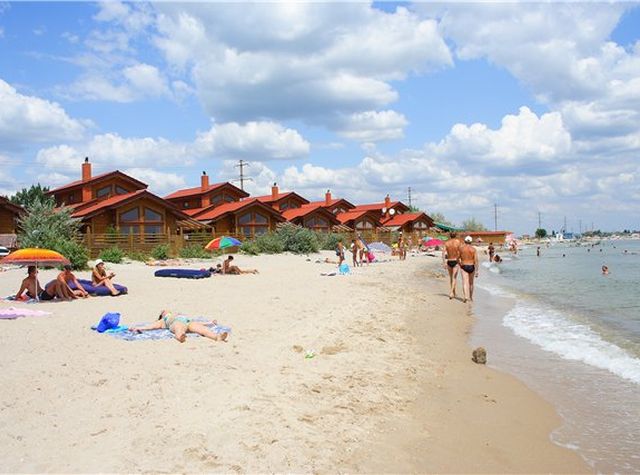
The coastline of the spit from the open sea side is flat, and from the side of the Berdyansk bay it is also flat at first, but starting from the end of the Middle Spit it is cut by small warm bays.
There is a hard-surfaced automobile road to the Spit. But cars are forbidden to park on the sand — only in special parking lots, equipped almost all along the Spit. Since July 2010 the entrance to the Spit is free of charge. Shuttle buses (flights every 5 minutes) connect the Spit with the center and different districts of Berdyansk. The bus schedule changes every year. Route #15, goes from the bus station to the spit through the market, railway station to the spit. On the Middle Spit from the side of Berdyansk bay there is a pier built. In summer between it and Berdyansk seaport there is a passenger ship «General Kungurtsev».